

A chant, a victory, and a message to his wife: Pat Fitzgerald’s long road back
Fitzgerald waited 1,469 days to win another college football game and the family that carried him through that absence was never far from his mind
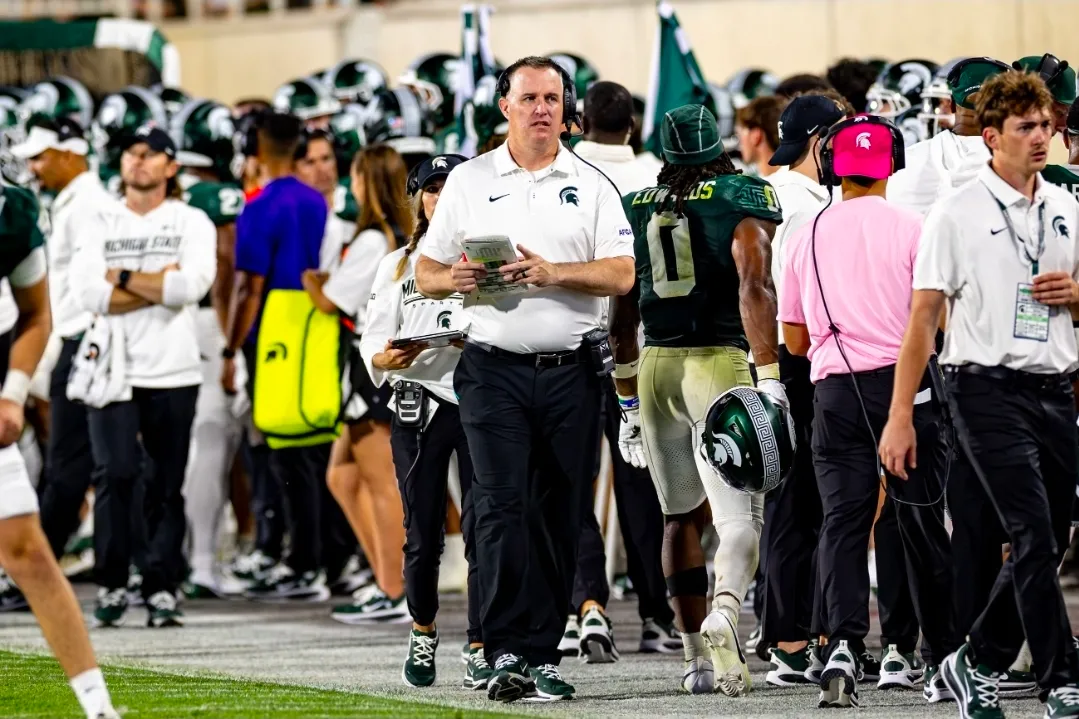
With approximately 50 minutes remaining on the countdown clock Friday night, Pat Fitzgerald emerged from the tunnel at Spartan Stadium.
Michigan State could not host recruits for the season opener because they were serving one of the remaining NCAA penalties stemming from violations committed during the Mel Tucker era.
Instead, the program invited donors and community partners whose work touches Michigan State football to join them on the sideline.
Fitzgerald made his way through them, stopping to shake every hand with intention.
At that point, he was nearing the student section.
Nearly 10,000 students had arrived well before kickoff despite the threat of inclement weather. When they saw Fitzgerald approaching, they began chanting his name.
It was an emotional moment for Fitzgerald. Those who had been with him through the preceding three years understood what that moment truly meant. They knew how far he had fallen from the heights of his profession, how fiercely he had fought to restore his name, and how uncertain his return to college football had once seemed.
Put bluntly, they believed he had been to hell and back. They also believed he deserved to hear 10,000 Michigan State students chanting his name in that moment.
Before Fitzgerald had coached a single snap at Spartan Stadium, the place had embraced him.
The students could not have known the magnitude of the meaning of the chant and how he felt it deep in his soul. They could not have known how it felt for Fitzgerald to walk through that tunnel as a college head coach again or what it meant to reach the other side and find thousands of them waiting.
They simply gave him the moment.
At 11:48 p.m., Fitzgerald finally put words to some of what had followed him through the tunnel.
He had earned his first victory as Michigan State’s head coach, his 111th as a college head coach, and his first in 1,469 days.
During most of the postgame radio interview, he did what coaches do. He credited his players, thanked the fans, assessed mistakes, praised his quarterback, and began looking toward the work awaiting Michigan State in the coming week.
Then, at the end of the interview, Jehuu Caulcrick asked a worthwhile question.
How would Fitzgerald celebrate?
Fitzgerald mentioned the game film he planned to watch before he could fall asleep. He joked about dealing with the media. Then the names began coming.
“My mother-in-law and father-in-law are here, Wayne and Peggy, my sister Jackie and her husband Ken, and my son Jack are here,” Fitzgerald said. “And just really grateful for my family.”
His voice did not break. Fitzgerald did not offer a long reflection or attempt to make the night about himself.
He needed only five words.
“We’ve been through a lot.”
Behind those words were more than four years without a victory and more than three years away from college coaching. They held the abrupt loss of the place that had defined Fitzgerald for most of his adult life, the uncertainty about whether another opportunity would ever come, and the burden carried by a wife and three sons who had lived through all of it with him.
The distance between Fitzgerald’s previous win and this one cannot adequately be measured in days.
His last victory came Aug. 27, 2022, when Northwestern defeated Nebraska, 31-28, in Dublin, Ireland. The Wildcats lost their remaining 11 games that season. Fitzgerald then lost something far greater than football games.
Northwestern was not merely his employer. It was woven into his identity.
Fitzgerald had become an All-American linebacker there, helping transform one of college football’s most downtrodden programs into a Big Ten champion. He returned as an assistant coach and, after the sudden death of Randy Walker, was elevated to head coach at 31 years old.
Over 17 seasons, Fitzgerald became the winningest coach in Northwestern history and the face of its football program.
Then, in July 2023, it was gone.
Northwestern fired Fitzgerald amid allegations of hazing within the football program. The university’s investigation did not find credible evidence that Fitzgerald knew about the conduct, but Northwestern held that he bore responsibility for the culture as the head coach.
Fitzgerald maintained that he did not know about or condone the behavior and sued the university for wrongful termination. The sides reached a settlement in August 2025.
Northwestern subsequently said evidence uncovered through discovery did not establish that any player had reported hazing to Fitzgerald or that he had condoned or directed it.
The legal case ended. The damage of the preceding two years could not be undone.
A man who had spent almost his entire adult life inside a college football program had suddenly found himself outside the game. There was no team to prepare, no practice to lead, and no Saturday opponent waiting.
So Fitzgerald returned to football in its simplest form.
He became a parent volunteer at Loyola Academy, where his sons played. The longtime Big Ten head coach who had led teams to conference championship games and bowl victories helped wherever a high school program needed him.
There was humility in that return, but there was also refuge. Football remained part of the Fitzgerald family, even when the college game no longer seemed to have a place for him.
His family remained there, too.
They were there through the public accusations and the legal fight. They were there when Fitzgerald’s name became inseparable from a scandal he insisted he did not know about.
They were there when his career was in limbo and when the possibility of another head coaching opportunity remained only that – a possibility.
And they were there when Michigan State offered him a way back.
When the Spartans hired Fitzgerald in December, he spoke about earning the trust of the players, alumni, and fans. This was more than another coaching stop. Michigan State was asking Fitzgerald to rebuild its football program while giving him the opportunity to rebuild a career and public legacy that had been shattered.
Michigan State also gave him something vital: a place with the resources, commitment, and desire to rebuild alongside him.
For more than nine months, Fitzgerald poured himself into that opportunity.
“Two hundred seventy-plus days ago, this football family came together,” he said Friday night.
In that time, Michigan State had already begun to take on the personality of its coach. The toughness and effort Fitzgerald promised were becoming visible. The Spartans remained far from a finished product, but the foundation of the culture he wanted was taking shape.
The first game offered an immediate test of it.
Michigan State built a 13-point lead against Toledo, surrendered it, and found itself trailing, 20-19. The first game of Fitzgerald’s second act had tightened into the kind of moment that could not be controlled by an offseason plan or motivational message.
All Fitzgerald could do was trust the football family he had built in East Lansing.
The Spartans drove 70 yards for the go-ahead touchdown, added a two-point conversion, and finished the game with 11 unanswered points.
“Test one accomplished,” Fitzgerald said. “Our guys responded pretty boldly.”
That was enough discussion of the game.
Because when Caulcrick asked how he would celebrate, Fitzgerald’s thoughts stretched beyond the Michigan State locker room.
His wife, Stacy, was not at Spartan Stadium. She was driving to Iowa City with their son Brendan, who plays football for the Hawkeyes.
“Maybe she’s listening in,” Fitzgerald said. “And if she is, I love you, and just travel safe.”
Every husband and father listening recognized the tone in which he said it.
It was the voice of a man who knew his family had absorbed every blow alongside him, who understood what their loyalty had cost them, and who wished the person who had carried so much of that weight could have been beside him for this moment.
It was a quiet message delivered over the radio near midnight, but it carried the emotional weight of the entire journey.
Stacy had been beside him when Northwestern football was the center of their family’s life. She was beside him when that life changed almost overnight. She remained beside him through the fight to clear his name, the seasons away from college football, and the uncertainty surrounding what would come next.
On the night he finally won again, she was on a highway in another state, supporting one of their sons.
Fitzgerald called his acknowledgment of everything the family had endured “a selfish statement.”
It wasn’t.
The victory belonged to Michigan State’s players, staff, students, and fans. Fitzgerald made certain to say that. But part of it also belonged to the people who knew what it had taken for him to stand in that locker room.
The victory belonged in part to Wayne and Peggy, Jackie and Ken, and Fitzgerald’s three sons, Jack, Ryan, and Brendan.
And judging by the tenderness in his voice when he spoke directly to her, perhaps it belonged most of all to Stacy.
They knew what lived inside the words “we’ve been through a lot.”
There will be more significant football victories if Fitzgerald succeeds at Michigan State. There will be rivalry wins, bowl games, and seasons that restore the Spartans to national relevance. A season-opening victory over Toledo will not define his tenure.
It will always mean something different, though.
It was the night Fitzgerald returned fully to college football. It was the night a program searching for its way forward gave a coach searching for his way back his first victory.
The story began with Fitzgerald walking through a tunnel, shaking every hand in his path, and approaching a student section chanting his name.
It ended at 11:48 p.m., with Fitzgerald speaking directly to his wife as she drove through the night.
The record book will call it his 111th victory.
For Fitzgerald and the family that traveled the long road back with him, it must have felt something like the first.