ANALYSIS: Michigan State’s biggest concern is certainly not Alessio Milivojevic
In a wide-ranging conversation with Matt Sheehan, Chase Glasser examined MSU’s quarterback, its problems in the trenches, and its path through Big Ten play
Matt Sheehan opened our conversation on the Locked On Spartans podcast with a question Michigan State fans have been trying to answer through the first three games of the season.
What, exactly, should they make of Alessio Milivojevic?
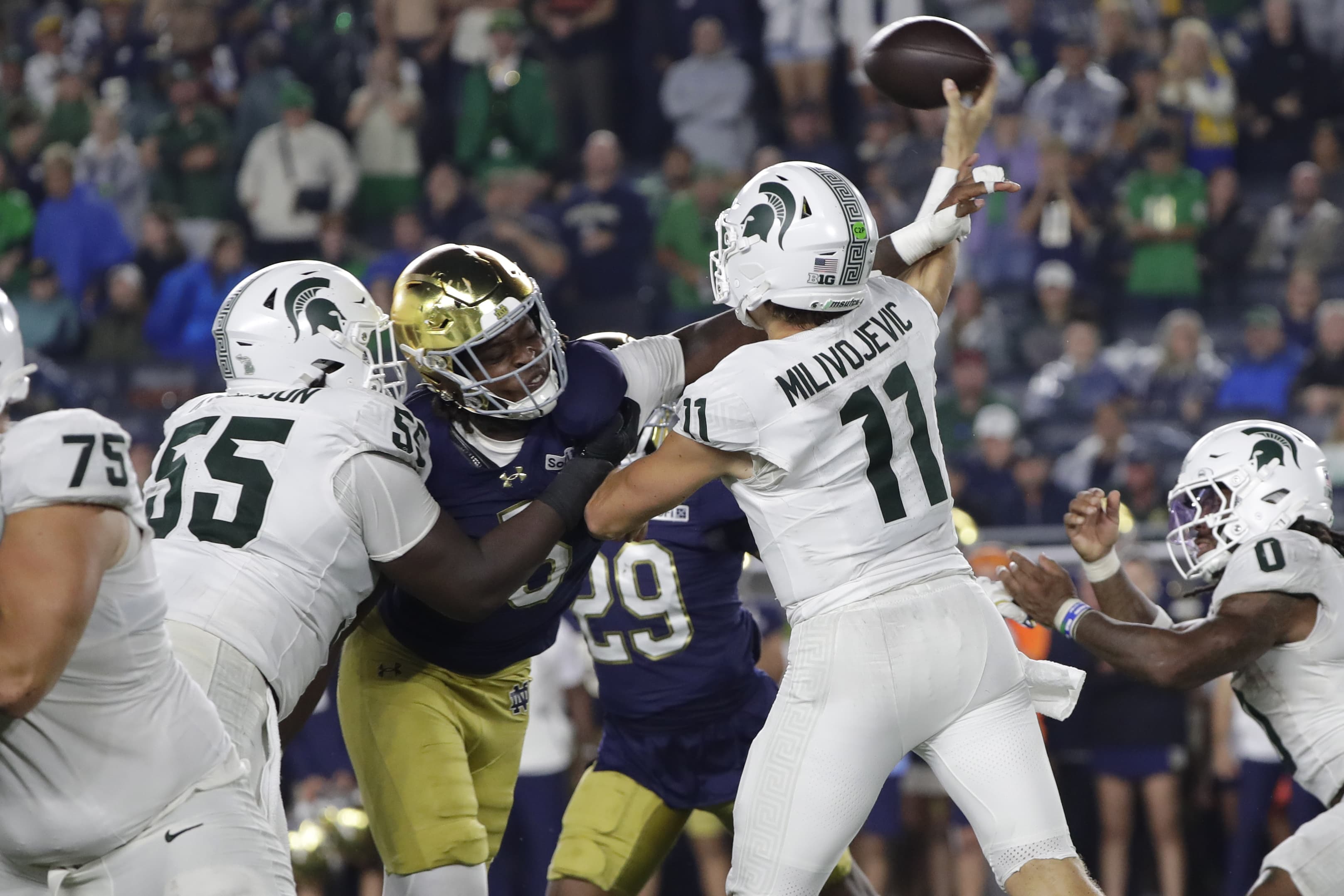
The evidence is conflicting. Milivojevic played well against Toledo and Eastern Michigan, producing no turnover-worthy plays in either game. Then he faced Notre Dame, threw two interceptions, produced four turnover-worthy throws, and received a 38.9 grade from Pro Football Focus.
Sheehan wants to believe Milivojevic is Michigan State’s answer at quarterback. After examining the Notre Dame game and the larger state of MSU’s roster, I think he has good reason to believe it.
Milivojevic did not play well in South Bend. His first interception was a young quarterback’s mistake. He telegraphed the route, failed to move the safety with his eyes, and floated the ball inside when it needed to be driven toward the sideline – if it should have been thrown at all.
The second interception came late, with Michigan State chasing the game and Milivojevic trying to manufacture something while under pressure. Taking the sack would have been preferable, but desperation tends to produce those decisions.
Those mistakes cannot be excused, and Milivojevic did not attempt to excuse them afterward. They also do not establish that Michigan State has a quarterback problem.
If anything, the Spartans’ 27-10 loss exposed more consequential concerns around him.
Michigan State’s offensive line deteriorated as Notre Dame changed its pressures and attacked protection weaknesses in the second half. Its receiving corps struggled to create consistent separation against an elite secondary. On the other side, injuries intensified questions about whether the defensive front has enough depth to survive a full Big Ten schedule.
Compared with those issues, quarterback remains relatively far down my list.
Milivojevic’s first three starts have come against two MAC opponents and one of the country’s best defenses. Toledo and Eastern Michigan tested whether he could operate the offense, make timely decisions, and avoid giving the ball away. Notre Dame tested whether he could do those things while facing superior athletes, tighter throwing windows, and rapidly deteriorating protection.
He passed the first two tests. He did not pass the third.
As Sheehan put it during our conversation, Milivojevic went from writing book reports on Green Eggs and Ham and Little Blue Truck to sitting for an examination on War and Peace. That leaves a considerable amount of middle ground still to evaluate.
Big Ten play should begin providing those answers.
Michigan State is not asking Milivojevic to carry a national championship roster. The program’s immediate objectives are more modest: qualify for a bowl game, compete credibly against the conference’s middle tier, and establish a functional foundation under Pat Fitzgerald.
Milivojevic appears capable of helping the Spartans accomplish those goals.
He completed approximately 66% of his passes through three games, threw three touchdowns against two interceptions, and did not produce a turnover-worthy play in either of his first two starts. Even some of his incompletions demonstrated encouraging judgment. An early-season end-zone attempt toward the sideline was placed where his receiver could catch it and the defender could not. It fell incomplete, but that is precisely the type of miss a quarterback can live with.
That discipline disappeared on his first interception against Notre Dame. One poor decision against an excellent defense, however, should not erase the evidence that preceded it.
Milivojevic also delivered Michigan State’s biggest offensive play in South Bend, connecting with Rodney Bullard for 53 yards on a well-placed deep ball. The play demonstrated that the Spartans can still create explosive gains through the air despite the limitations of their receiving corps.
The larger question Sheehan and I kept returning to was whether the offense around Milivojevic can give him enough help.
Offensive line presents the greater threat
When Sheehan asked whether Michigan State’s offensive line or its receiving corps could be more detrimental to the offense during Big Ten play, I chose the line.
Football is the ultimate team sport because of how specialized it is. Every position group must operate in concert, and almost everything an offense wants to accomplish begins with the offensive line.
Michigan State’s line held up reasonably well early against Notre Dame. The Spartans moved the ball on the ground more effectively in the first half than expected, and Cam Fancher’s touchdown run was an example of scheme and execution working together. Michigan State left the end defender unblocked, brought a tight end around the formation, and created a clean opportunity for Fancher.
Those moments provided evidence that Michigan State can manufacture advantages without overwhelming opponents physically.
They were eventually overshadowed by an offensive line that could not consistently handle Notre Dame’s movement and pressure. The consequences reached beyond the sacks Milivojevic took.
Michigan State’s running backs repeatedly found themselves serving as the final line of protection against linebackers and defensive backs arriving with momentum. They absorbed violent collisions simply to give Milivojevic another moment in the pocket. An offense cannot ask its backs to survive that punishment every week, particularly when the line already has questions in the running game.
Protection problems also magnify the limitations at wide receiver.
As Sheehan has emphasized throughout the offseason, Michigan State lacks size in that room. The Spartans do not need an entire group of 6-foot-4 targets, but they would benefit from having one established receiver capable of shielding defenders, winning contested balls, and expanding the offense in short-yardage and red-zone situations.
Size is not a requirement for an effective receiving corps. Jayden Reed and Jalen Nailor demonstrated that during the 2021 season. But having one bigger target would give Milivojevic an option this roster does not currently possess.
The offense was constructed with the expectation that Nick Marsh would be an experienced centerpiece in his third season. His departure left Michigan State with a smaller, less established group that must rely upon speed, route combinations, and separation rather than physical mismatches.
That is one of the costs of a coaching transition. It does not doom the offense, but it places more pressure on the staff to scheme receivers open and on the tight ends to provide dependable targets between the numbers.
The offensive line is the greater concern because its performance affects everything. It determines whether the Spartans can establish the run, how many receivers they can release into routes, how often their backs must remain in protection, and how much time Milivojevic has to work through his progression.
Even that, however, may not be Michigan State’s most serious vulnerability.
Defensive depth could define the season
When Sheehan asked me to identify my biggest concern with the entire team, my answer was...
Subscribe to Spartans Illustrated to continue reading.
