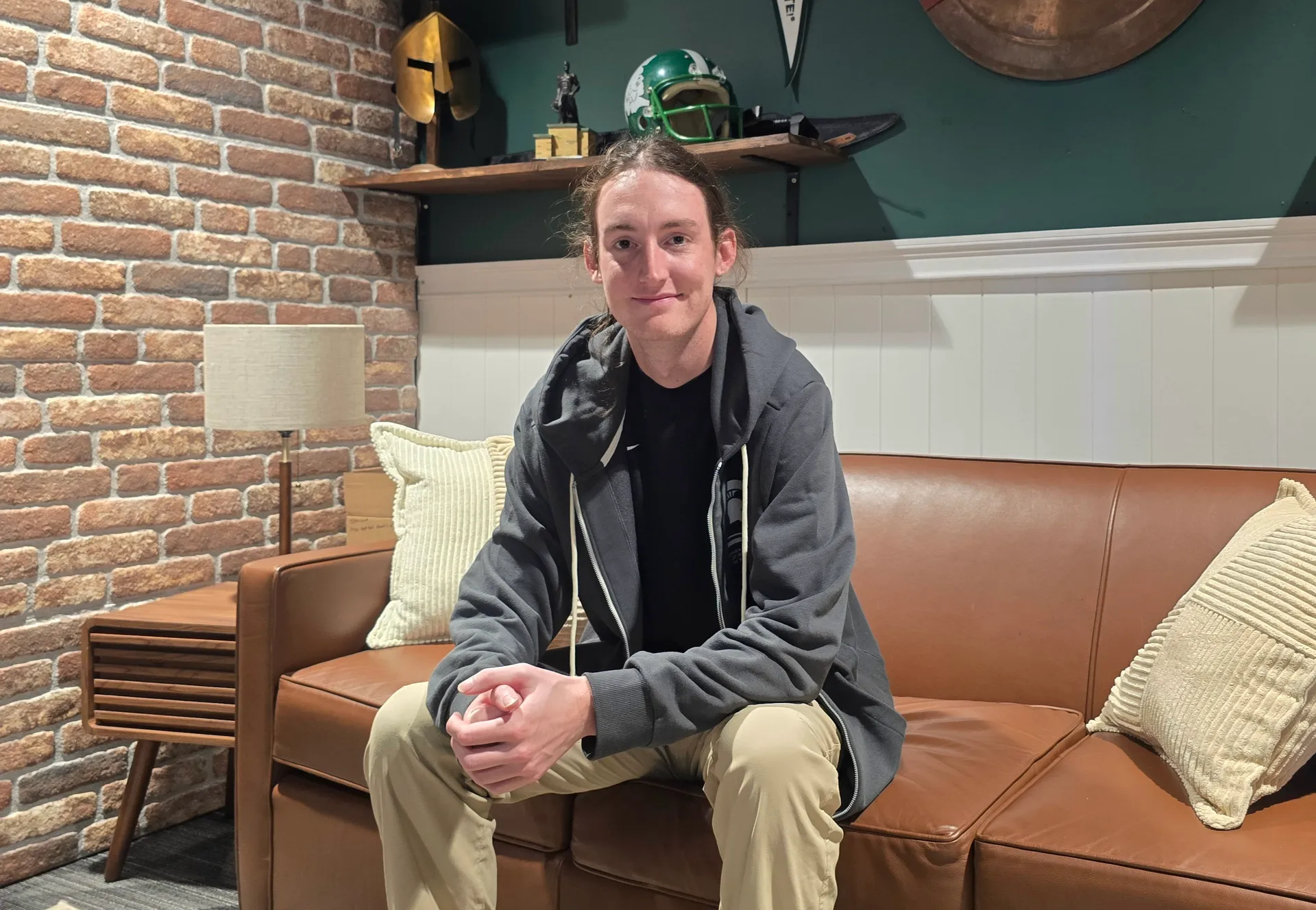
Allen Bernard was standing behind a camera in Michigan’s visiting locker room when Nick Sheridan gave him something he knew he might want later.
“Violence will be rewarded.”
The words came during the pregame speeches, before Michigan State had beaten Michigan, before the Paul Bunyan Trophy had changed hands, and before Bernard had a weekend’s worth of editing ahead of him. He was moving through the room, following the coaches as they addressed their players, collecting the sounds and expressions that could eventually help explain the night.
Sheridan spoke shortly before Pat Fitzgerald’s final remarks. Bernard had positioned himself to capture the offensive coordinator in the smaller locker room, and he noticed quarterback Alessio Milivojevic listening, locked into what Sheridan was saying.
He had the sound byte. Now he needed to see the game.
“If this speech matches the play on the field, which it absolutely did,” Bernard told Spartans Illustrated on Tuesday, “this is going to be the coolest video I’ve ever made in my life.”
Michigan State won 15-6. Bernard and the football creative staff turned the night into a film that ran nine minutes and 10 seconds, moved from the force of the game to the tenderness of Etta James singing “At Last,” and gave Spartan fans another way to experience a victory they had spent a long time yearning for.
By Monday afternoon, the video was out. Bernard still had another assignment to film before he could go home and sleep. When he eventually woke up from a three- or four-hour nap, he began reading the messages and comments waiting on his phone.
Fans were telling him the video had made their day. They recognized something they loved in the players, in the coach, and in the way the story had been assembled. Some fans had become emotional while watching the video. Bernard became emotional reading them.
“It really overwhelmed me a lot,” he said. “For me, this is the biggest video that I’ve ever made for a fan base and for a team.There’s a lot of emotions that went into it.”
Much of what made it possible had happened before Saturday. Bernard and his colleagues were already in the football building, already in the meetings, already carrying cameras through the less satisfying weeks. They had been close enough to see the work that continued when the results gave fans little reason to celebrate.
The win in Ann Arbor gave them a chance to show it.
Bernard’s habit of collecting material began long before anyone gave him access to a college football locker room. As a child, his parents covered a table in their home with a large sheet of paper and let him draw. Crayons, markers, and room to fill the page were available whenever he wanted them.
His mother, Jill, kept drawing supplies in her purse. The backs of church bulletins became another place to work. His father, Eric, a landscape architect, would take him out with a sketchbook to draw what they saw. Buildings interested him. So did the other subjects he could study and try to reproduce by hand.
There was no need to decide then what any of it would become. His parents gave him the materials and the freedom to explore, an approach he still sees as central to the career he eventually chose.
“They’ve been supporting me 110%,” Bernard said. “They pushed me to really dive into that and just enjoy being creative.”
He grew up moving among college communities, the child of a professor whose work took the family around Big 12 country. Manhattan, Kansas holds one of his earliest memories of someone recognizing his artwork. At about 4 or 5 years old, he took classes at Kansas State’s Beach Museum of Art. He drew snowmen for a Christmas card contest, and his drawing was selected for the museum’s card. He remembers being excited then. Looking back, he appreciates the experience differently, as an early opportunity to make something that other people would see.
It was years of drawing and painting before he began seriously pursuing cameras. He painted livestock, drew buildings, and even painted shoes. By college, he was becoming increasingly interested in photography and video, particularly the possibility of capturing a moment as it happened.
He arrived at Oregon State during COVID, when much of the usual college experience was unavailable. His mother suggested looking for a recreation course that would let him do something in person. Adventure Leadership provided that opportunity, including a trip to Smith Rock in Oregon that involved planning for backpacking and rock climbing.
Bernard brought a GoPro he had saved money to buy while in high school. He mounted it on his helmet, then began using it to document more of the trip and the people taking part. Another student, who worked for the athletic department, noticed.
They started talking about cameras. The conversation became a friendship, and the friend suggested Bernard come work with him. After the trip, Bernard received a call from the student’s boss on a Tuesday. Soon he was operating a broadcast camera at a volleyball match.
Due to the pandemic, there were no fans. Being allowed inside at all made an impression.
“I’m one of the only people getting to do this right now,” he remembered thinking.
The equipment interested him, as did the people working around it. He liked being in a position to document something others would watch, and he wanted to learn how to do it well. A recreation course chosen partly to get him away from online classes had led him into college athletics.
His first months were an introduction to the work and a chance to demonstrate that he could handle it. Then a supervisor left for Washington, creating a transition in the operation. Bernard returned early for football camp and became part of a smaller group helping keep things moving while the staff was rebuilt.
He worked camera positions, learned replay, and eventually became an in-house director, helping manage what fans saw on the venue’s video boards. He also developed a close connection with Oregon State women’s basketball and coach Scott Rueck, gaining experience documenting a program over time.
The two sides of the job taught him different skills. Working a live production meant processing images quickly and choosing among multiple available angles. Following a team meant learning which people and moments could carry a story beyond the game itself.
Those experiences still influence how he leads. Bernard knows he cannot personally record every important moment. He needs other people to recognize what matters, position themselves, and bring back footage the staff can use.
“If you’ve done it, you can coach other people on how to do it,” he said.
That requires giving up the idea that the best way to get every shot is to take it yourself. His own experience can help a student understand an assignment, but eventually the student has to carry it out. The director has to trust the person holding the camera.
Bernard moved into a job at Texas Tech while finishing his Oregon State coursework online. In Lubbock, he worked with football, baseball, and women’s soccer. The pace meant helping across sports and working closely with students who were near his own age.
He wanted them to understand how to prepare for the next opportunity because he had only recently been in their position. He had gone from a student with a camera to someone helping students use theirs, while still learning how to handle a career that was moving quickly.
Then Michigan State offered another step.
Nicklos Bristol, whom Bernard knew from Oregon State and who now oversees football digital and brand strategy at MSU, told him about an opening. Bernard already knew Jonathan Smith’s staff from his senior year working with Oregon State football. Michigan State offered familiar professional connections and the chance to work in the Big Ten.
The decision also required another move. Bernard and his fiancee, Galena Wortman, had just gotten settled in Lubbock. They had met at Oregon State, then spent a year apart while she finished school and he worked in Texas. He flew back on bye weeks when he could, or they met in Denver.
Wortman had been in Lubbock less than a month when the Michigan State opportunity arrived. Some of her belongings had not been unpacked. Bernard, who had moved repeatedly growing up, was asking her to make another move almost immediately after the previous one.
“With her blessing,” he said, they headed to Michigan.
He moved in the day before the first practice of fall camp in 2025 and started work the next day as an assistant director of football creative video. He was promoted to director in 2026. The transition between coaching staffs brought some uncertainty. His response was to trust the work.
“The work’s going to speak for itself,” he said.
He had come to show what he could do at a Big Ten school, and Michigan State’s following appealed to him. The investment he saw from fans reminded him of Kansas State, where he had spent part of his childhood. People cared about the university and wanted to be part of it.
That attachment has now become personal. Bernard and Wortman have MSU basketball tickets. They love the campus, and he talks about persuading his family to move north. Wortman works for Michigan Audubon, where her interests in birds and communication have come together in a job she loves. They plan to marry in June 2027.
Bernard's relationship with the football program is built through daily proximity. The creative staff works inside the football building, with an office near the meeting spaces. Bernard and his colleagues attend meetings, follow practices, travel with the team, and document what happens between the events that fans have access to.
Bernard still carries a camera himself. Last season, he worked as a "creative game shooter." This season, his game-day assignment is the bench, giving him a view of players and coaches responding to what is happening on the field. He also records team meetings and other moments during the week.
The student staff extends that coverage; seven students work with the creative operation, with three or four concentrating on video. They help provide the range of footage that allows a finished piece to move among the sideline, the field, the locker room, and the stands.
A viewer can watch all of those perspectives in a few seconds. Getting them requires people to be in different places before anything happens, sometimes following an assignment, sometimes recognizing an opportunity on their own. The staff has to communicate, anticipate, and keep recording without knowing which pieces will eventually fit together.
Fitzgerald helped establish the conditions for that work when he arrived.
“Capture everything,” Bernard said of the direction he received.
He is grateful for the access and for a coaching staff willing to let people see how the program operates. Fitzgerald’s voice is particularly useful to a storyteller because players respond to him, and because his messages give Bernard ideas he can follow through the week.
The access also means the creative staff is present during difficult stretches. Bernard sees the relationships being built, the coaches continuing to teach, and the players returning to work. He has footage from moments that never become a widely shared celebration.
He values those recordings, too. Last season produced relationships with staff members, players, and recruits who are now part of the team. It also produced a record of the program at that point in time, even when the season did not reach the goals people had set for it.
Before there was an exhausting edit to be made following MSU's win over UM, there were decisions to make in Ann Arbor. Bernard listens during the week with the game in mind. When a coach describes how the team should act, he starts thinking about what that might look like through a camera.
A comment about walking together becomes a reason to look for the team moving as one. A comment about silencing the stadium becomes a potential sound cue. A demand for physical play becomes something he can return to if the players deliver it.
He remembers those possibilities while he works. Some survive the game. Others never find the moment that would make them useful. Sheridan’s pregame declaration was a particularly strong possibility, but Bernard still needed Michigan State’s play to support it.
The same process continued at halftime. In a loud locker room, with multiple coaches talking, he could not be certain in the moment exactly what his camera had captured. Later, reviewing the footage, he could hear a message about physicality and connect it with plays from the game.
A forceful run, a catch followed by the offensive line pushing the pile, or a collision that finished a play could give those words a visual answer. The speeches supplied expectations. The game supplied the evidence Bernard needed to bring them back.
He was also thinking ahead to the trophy.
During the game, Bernard went looking for student videographer Maya Kolton and gave her an assignment for a moment that had not arrived yet.
“When we get Paul (Bunyan),” he told her, he wanted her behind the fans, positioned to capture the players coming toward them with the rivalry trophy.
No one knew precisely where the trophy would emerge. He was concentrating on Fitzgerald’s response to the finish, the handshake, and the coach’s on-field interview. He needed someone else to give the film another perspective on the celebration.
The creative staff knew that the plan was to take the trophy around to the Michigan State fans. Bernard told Kolton to watch where those fans gathered and get herself into position. Beyond that, there was no way to guarantee the celebration would come toward her.
She went to the corner - and the moment came her way.
Kenny Soares ran with Paul Bunyan toward the end-zone crowd, cameras following across the field. Kolton’s position allowed her to capture the trophy approaching the people who had stayed to celebrate. Bernard had followed the coach; she had the view from the fans.
“She executed it to absolute perfection,” he said.
His appreciation extended beyond what the shot could do for this edit. He texted Kolton after the game to tell her that fans would remember that footage for years. He expected it to appear repeatedly because it captured an important part of an important win.
Her assignment also allowed Bernard to stay with his own. He was behind Fitzgerald when the coach used a late timeout to tell players to shake hands after the game, still documenting the messages being delivered as the victory became secure. Then he followed the coach into the immediate aftermath. The eventual edit could include what he saw there and what Kolton saw elsewhere because both kept working their part of the field.
Another piece arrived through a friendship inside the building. Malik Gill, Michigan State’s director of recruiting communications, texted Bernard about a song he had been listening to before the game.
“At Last.”
Gill had helped introduce Bernard to Michigan State when he visited before accepting the job. He took him around campus and explained the school, the program, and the people. Bernard describes it as receiving his own version of the recruiting pitch prospective players get.
They became friends. The song suggestion grew out of that relationship, rather than a formal request to supply music for a video. Gill told him what he had been listening to. Bernard heard a possible ending.
The staff had considered other music, including instrumentals and classical selections. Etta James offered something that seemed to fit the way fans would receive the victory. Bernard could imagine the song carrying images of people finally getting to celebrate together.
“This song is absolutely perfect for everything that the fans have felt,” he said.
James was only 22 when she recorded “At Last” in 1960. Decades later, the recording gave Bernard a way to change the feeling of the film without leaving the story he had been telling. The players had spent the game fighting for the trophy. The final stretch could let them, and the audience, enjoy having it.
Bernard knew where he wanted the edit to go. He still had to build the route there.
He left Ann Arbor on the first bus with the team. The creative work continued during the ride, including footage of Fitzgerald beside the buckled-in trophy and the players making the trip home.
Back in East Lansing, Bernard began labeling footage and making sure the material was accounted for. He estimated he left work around 4:30 or 5 a.m. Sunday, slept briefly, and returned around 8:30 or 9.
His goal was to finish most of the substance of the video that day. He wanted an initial version ready for other people on the creative side to review that night, leaving Monday for captions, refinements, and any final discoveries.
The footage was only part of what he needed to review. He listened to the television broadcast, searching for calls that would help explain what Michigan State had done. He particularly liked a comment from Yogi Roth about people not believing in the Spartans.
Bernard had also been standing behind Fitzgerald during the coach’s on-field interview. He heard the reference to the man in the arena, a message Fitzgerald uses often, and recognized another piece that could help carry the film.
He sees that message as useful beyond one recap. Prospective players watching the program’s videos can hear how Fitzgerald talks, see how the players respond, and begin to understand the experience the staff wants to offer them. The footage serves fans, but recruits and their families can watch it, too.
Bernard knew that every voice needed to contribute something, whether it belonged to Fitzgerald, Sheridan, another coach, or an announcer.
“There shouldn’t be a moment where you’re like, ‘Oh, I want to turn this off or I want to skip it,’” he said.
That is a demanding goal for something viewers can leave with a movement of a thumb. Bernard was trying to make people stay for more than nine minutes in an environment where the next video is always available.
His answer for that involved changing the pace. He describes the video in segments that build toward a high point, settle, and build again. A scene from Fitzgerald’s introduction to the program could lead into a team meeting. The energy could rise toward the coin toss, accelerate into the game, then pause around a coach’s words or a meaningful sound.
The quieter moments made room for another push. The audience could hear the connection between something said earlier and something happening now. Bernard used audio cues to help those transitions feel like parts of the same experience.
“The audio really drives it,” he said.
One way he evaluates the work is to listen with his eyes closed. He wants to know whether the sound can tell the story on its own. Then he considers the pictures without audio and asks what they communicate.
Both need to work. A strong shot can lose something if the sound fights it. A useful speech can become more effective when the viewer sees exactly what the coach was asking players to do. Bernard is looking for those relationships as he puts the pieces together.
By the end, “At Last” could provide a different pace and feeling. He had already made the audience move through the tension and physicality of the game. Now the images could linger on the reward.
Choosing that ending also gave him a practical editing problem: He needed to earn the change in tone. Bernard described working backward from the final song, considering how each earlier segment could carry viewers toward it. The quieter finish would have room to breathe because the preceding sections had already shown the demands of the night. He wanted viewers to stay with the players through the celebration, still interested after the competitive question had been settled.
He sent an initial version for review around 10:30 or 11:00 Sunday night and estimated he left the building around 1:00 a.m. Even then, sleep did not come immediately. His mind was still working through the project. He thought it was 2:00 or 3:00 before he finally fell asleep.
He woke around 8:00 and returned to finish.
Monday brought captioning, small adjustments, and a look at additional angles he had not realized the staff possessed. There was also a firm publishing target. Fitzgerald wanted the Michigan content finished around the conclusion of his Monday press conference so he could turn the program's attention to the next game.
One o’clock became the deadline and the video went out on time. His workday continued with a jersey-reveal shoot. Then, finally, he went home and slept.
The reaction waiting after he woke up was larger than anything he had experienced with a video for a team or fan base. Earlier Michigan State pieces had drawn attention, including longer videos of Fitzgerald discussing the program’s culture during fall camp. This response felt different.
Bernard read through comments and replied to people. They were describing their love for the Spartans and what it meant to see the team this way. The messages connected the work he had just finished with people whose weeks, moods, and memories were wrapped up in Michigan State football.
He had been part of the program for a little more than a year. He understood the investment because he shared it with the people he followed every day, and because he had worked through difficult stretches. He had seen what happened after losses, and he wanted fans to have a better view of the effort that continued.
“We see the back end of it,” he said. “And I want to show that to you guys.”
Praise came from people who understood the craft, too, including friends working as cinematographers and directors of photography. A former student from Texas Tech offered a particularly satisfying review. He was a Michigan fan, which made the subject difficult for him to watch. He still thought the video was outstanding.
On Tuesday morning, Bernard ran into Fitzgerald. The coach told him the film was awesome.
That exchange fit the way Bernard describes his ordinary interactions with Fitzgerald: a greeting by name, a fist bump, a question about how he is doing. He appreciates working for people who recognize that the creative staff contributes to the program and who take an interest in the people doing the work.
He sees the same care extending from Fitzgerald to others in the building, including the custodial and food-service staffs. In Bernard’s view, the way Fitzgerald treats people is consistent with the relationships his cameras record between coaches and players.
Bernard can assemble speeches and highlights, choose a song, and adjust the pace. The daily relationships are what give him something to document when he arrives with the camera.
“This is their story,” he said.
The Michigan film gave fans a piece of an experience the staff gets to witness throughout the season. Bernard hopes they could see how much the coaches invest in the players and how much the players care in return. The victory opened a wider audience for material his staff had been collecting all along.
Asked whether this was the mountaintop of his career so far, Bernard preferred to describe it as another base camp. He is still climbing. He hopes future seasons bring bigger games, championships, and reasons to return to images being recorded now.
For the moment, he has a film he considers his biggest, a student whose shot helped complete it, and a song a friend happened to send at the right time. He has messages from fans explaining why they needed to see it. And he has the next assignment waiting inside the football building.
The cameras will be there again, collecting the words, the faces, and the work - before anyone knows how the next game will end.
This article was presented outside of the paywall by our sole sponsor - Nudge Printing - your #1 source for officially licensed, high quality MSU t-shirts, hats, sweatshirts, hoodies, and more. If you appreciate story telling like this, please consider supporting Spartans Illustrated by subscribing today. New annual subscribers receive their choice of apparel from Nudge Printing ($50 value) - email SpartansIllustrated@gmail.com with your choice after subscribing.
Here is the video, in case you haven't watched it yet - or in case you want to watch it again: