

BEHIND THE SCENES: How a Ground Zero New York firefighter ended up at midfield at Spartan Stadium last weekend
Saturday's MSU game-day remembrance grew far beyond what anyone expected - and it all started with a routine grocery run
Capt. Dan Renner and three other East Lansing firefighters were trying to get their grocery shopping done before a 9:30 a.m. training session Friday morning.
The crews cook their meals together at the firehouse, so somebody has to make the run. Sometimes it is Meijer. That morning, it was the Kroger on Lake Lansing Road.
As the four firefighters waited near the checkout, five men they had never met approached them and thanked them for their service.
Then they started talking.
The five were from New York and had come to East Lansing for an annual get-together. They were scattered around the country now, but reunited every year on the first weekend after Labor Day.
Four were firefighters. The fifth had worked in financial services and had been at Ground Zero.
One of the firefighters was a retired FDNY lieutenant named Tom. As the conversation continued, Renner learned that Tom had worked at Ground Zero, too, on Sept. 11, 2001.
Then there was the date.
It was Sept. 11, 2026 – 25 years, almost to the minute, since the first plane struck the World Trade Center.
Four East Lansing firefighters had walked into Kroger to buy groceries for their station. Five men from New York had walked in during a weekend together. Somehow, on that morning, their paths had crossed.
Eventually, the firefighters finished their shopping and headed back to the station.
At that point, it had been nothing more than an extraordinary chance encounter in a Kroger checkout line.
Then Renner started thinking about Saturday.
An invitation grows
Two days earlier, members of Michigan State football’s creative staff had visited East Lansing Fire to shoot content connected to the Spartans’ first-responder recognition.
Firefighters and fire trucks became part of the shoot, but the conversation expanded beyond cameras and a jersey and helmet reveal.
Michigan State wanted local first responders involved on game day.
There would be an opportunity to join the Spartan Walk, leading Pat Fitzgerald and the football team toward Spartan Stadium. Some would later help hold the enormous American flag during the national anthem.
Renner said the tone of the invitation stood out to him.
“They stressed that it wasn’t anything to build themselves up,” Renner said. “It wasn’t anything to garner attention. It was that they just wanted to honor us in whatever capacity they could and just wanted us to enjoy the day and have a good time.”
For East Lansing Fire, accepting required some juggling.
Football Saturdays are among the department’s busiest days. Renner said about 15 firefighters staff the stations while another 18 work inside Spartan Stadium.
Some are assigned to medical posts. Others have to remain available for emergencies throughout the city.
Still, the department had begun figuring out who could participate.
Then, in the middle of that planning, Renner met five men from New York at Kroger on Sept. 11.
He started wondering whether the invitation could stretch a little further.
Renner contacted Michigan State and explained what had happened.
Could they come, too?
The response was immediate.
Tickets were arranged. Field access followed. The visitors could participate in as much of Saturday’s tribute as they felt comfortable doing.
“They just happened to be in town for the weekend and weren’t even really planning on going to the game on Saturday,” Renner said.
Their plans had changed.
Back in a firehouse
When Lt. Mike Schaefer arrived at Station 2 on Saturday, on Shaw Lane directly across from Munn Ice Arena, he saw several unfamiliar men sitting around the station.
He did not know who they were.
That was not particularly unusual. On football Saturdays, firefighters from other departments sometimes stop by to see the station.
Then Schaefer learned these were the men Renner’s crew had met at Kroger the day before.
Firefighter-paramedic Brett Van Horn spent time with them there, too.
What struck Van Horn was how quickly they seemed at home.
“You can never take the firefighter out of a guy,” Van Horn said.
They wanted to see the rigs. They asked about life at the East Lansing department. They swapped stories. For a while, they watched one of the noon college football games.
The conversation did not dwell on Sept. 11. Much of it sounded like what Schaefer might hear during any shift with firefighters who had known one another for years.
At one point, Schaefer sat down and propped his feet on a chair.
One of the visitors sat beside him, put his own feet on top of Schaefer’s, and gave him a look.
“How long do you got on, young man?”
Schaefer told him 14 years.
The man promptly moved his feet.
It was the sort of joke, Schaefer said, an experienced firefighter might play on a rookie before discovering the other guy had been around awhile himself.
“You could tell they just liked being in the station again,” Schaefer said. “Just having the banter back and forth and stuff like that.”
There were heavier moments, too.
The firefighters talked about peer support, including firefighters from around the country who came to East Lansing after the 2023 shooting on Michigan State’s campus to spend time with crews who had responded.
But nobody pressed the visitors to relive Sept. 11.
One of the New York men did tell Schaefer about a ritual he shares with his son each year.
Every Sept. 11, he sends the same message.
Never forget.
His son always sends one back.
Never, ever.
For Schaefer, the ease with which the men settled into Station 2 made sense.
Firefighters talk about their profession as a brotherhood, a term they use for the community as a whole, regardless of gender. Twenty-four-hour shifts mean crews cook together, eat together, sleep under the same roof, and answer calls together when the tones sound.
Schaefer compared it to siblings.
“Sometimes you really like your siblings, and sometimes you can’t stand your siblings,” he said. “But you always love your siblings, and you’ll always do what you can to help them. And that’s kind of how it is for us.”
For about an hour, before the crowds, cameras, and ceremonies, five men who had been strangers to East Lansing Fire the morning before simply settled into the rhythms of Station 2.
Then it came time to get across campus.
Back on a firetruck
The original plan was to get the five visitors over to the Spartan statue in an ambulance. But on a football Saturday, plans at a fire station tend to remain provisional.
Both ambulances were dispatched on calls before the group was ready to leave.
That left another option.
East Lansing firefighters brought out a frontline fire truck and a backup truck, and the visitors climbed aboard.
For men who had spent much of their careers around firehouses and apparatus, the change in transportation turned out to be a welcome one.
“They all had a smile on their face,” Schaefer said. “They were all excited to get back on one.”
Station 2 sits only a short distance from Spartan Stadium, but driving two large fire trucks across campus on a football Saturday is not something the department does casually. Traffic was building, the Spartan Walk was approaching, and Schaefer knew they needed to get the group there without lingering.
What he remembers most about the ride was not anything anyone said. It was how much the men seemed to enjoy simply being back inside a fire truck.
“It was great for those guys,” Schaefer said. “You could tell it was real cool for them just to be on a fire truck again.”
The two trucks made their way toward the Spartan statue and pulled in as the crowd was gathering for the walk. Schaefer brought his rig to a stop, the doors opened, and the visitors climbed down.
There was little time for anything more.
The trucks still had work to do, and the Spartan Walk was about to begin. Schaefer watched the men join the gathering near the statue, then pulled away and headed back.
What he did not see was the effect their arrival had on the firefighters waiting there.
Two fire trucks pull up
Firefighter-paramedic Kevin Zimmerman noticed the trucks before he knew why they were coming. That alone was enough to get his attention.
“I was like, ‘Oh man, I wonder what they’re doing,’” Zimmerman said.
Then the trucks stopped, the doors opened, and the five visitors began climbing out.
Zimmerman had already heard the story about the chance meeting at Kroger, but he had not known the men were going to join them for the Spartan Walk.
“I was like, ‘Wow,’” Zimmerman said. “That’s kind of a big deal.”
The sight gave him chills.
“Absolutely. Oh, absolutely.”
By then, Zimmerman knew enough about some of the men’s connection to Sept. 11 to understand the significance of who had just stepped off those trucks. He would later describe the feeling in simpler terms.
“I felt like I was kind of standing next to some giants that day,” he said.
The Michigan State football team was only about 10 minutes away, leaving little time before the walk began. Zimmerman could have used those minutes to ask about New York, Ground Zero, or what the anniversary meant to them.
He chose not to.
“As interesting as it would have been to talk to them about that, I don’t think that was the time or the place,” Zimmerman said.
So they talked about ordinary things instead.
One of the visitors complimented Zimmerman’s mustache. The East Lansing firefighters had given the group union shirts to take home, and several of the men wore them that afternoon. There was small talk, a little joking, and the kind of easy interaction that had already developed back at Station 2.
A little more than a day earlier, the two groups had not known one another.
Now they were standing together beside the Spartan statue, waiting for Pat Fitzgerald and the Michigan State football team to arrive.
‘Join me for a walk’
Deputy Fire Chief Derek Johnson had been with East Lansing Fire for 25 years, long enough that Michigan State football Saturdays had become familiar territory. He joined the department in March 2001, just six months before Sept. 11.
Johnson had finished a shift that morning and gone home. He was watching SportsCenter when he got a call telling him to change the channel. He did, then spent much of the next 12 hours watching the day unfold.
25 years after the attacks he had watched unfold on television, Johnson stood beside the Spartan statue waiting to take part in something he had never experienced. His normal game-day assignment is inside Stadium Command, so despite all his years working Michigan State football games, he had never seen the Spartan Walk in person.
He had heard about Renner’s encounter with Tom at Kroger, but like Zimmerman, he had not known the visitors would arrive aboard East Lansing fire trucks.
“It was actually a pretty cool surprise for me,” Johnson said. “Even though it was our own trucks, I didn’t know it was going to happen.”
Their presence carried particular weight because Johnson and other firefighters had been talking around the station about what Sept. 11 anniversaries can mean within the fire service.
Public ceremonies have their place, Johnson said, but many firefighters prefer something quieter, especially on a day tied so closely to loss.
“They want to be with their brothers just around the station,” Johnson said. “They want to just be with their brothers and remember it.”
That helped explain why the visitors seemed to fit so naturally once they arrived. The departments were different, the cities were different, and the careers had taken place hundreds of miles apart, but Johnson saw the same culture underneath all of it.
“This is a brotherhood,” Johnson said. “No matter how big your department is or how small it is, everybody does a similar job, and you get the sense of family everywhere you go.”
Not long after the visitors arrived, the Michigan State football team came into view.
Fitzgerald reached the Spartan statue and moved through the group of first responders, greeting them individually. Van Horn remembered him shaking hands, patting shoulders, and thanking them personally. Zimmerman remembered Fitzgerald placing a coin at the statue before turning toward the group.
“Join me for a walk to the stadium.”
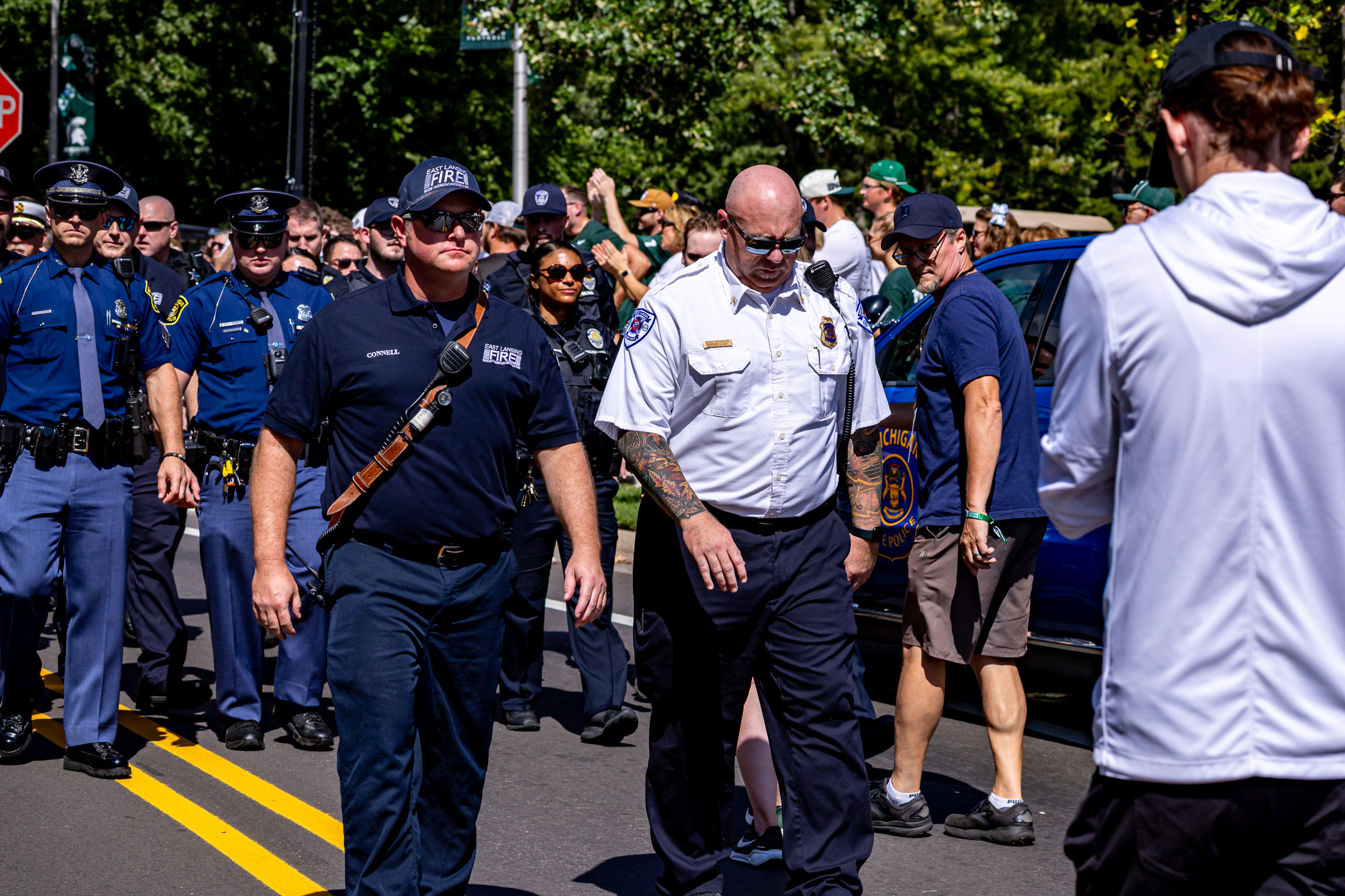
Photo credit: Marvin Hall/Spartans Illustrated
Johnson, dressed in his white uniform shirt, wound up near the very front of the procession.
That created a slightly awkward situation: The first responders had been told they would lead the team, but nobody had provided much choreography beyond that.
“We’re kind of leading,” Johnson said, “but we don’t know exactly where to go.”
After 25 years with East Lansing Fire, Johnson at least knew where Spartan Stadium was - so headed in that direction, moving out front with other first responders, and the Michigan State football team followed them.
In the crowd, two familiar faces
Zimmerman had deliberately positioned himself on the right side of the route because his wife, Amanda, had told him where she planned to stand with their 2-year-old son, Kellan.
Kellan is Zimmerman’s only child, the “apple of my eye,” as he puts it, and Amanda had made the trip specifically so their son could see his father take part in the Spartan Walk. As the procession moved beyond the Spartan statue, Zimmerman began scanning the crowd until he spotted them along the route, Amanda holding Kellan as the two watched him approach.
Zimmerman waved, and his son waved back.
The exchange lasted only a few seconds before the procession carried Zimmerman forward, and he had no idea that a Michigan State video camera behind him had captured the moment.
Van Horn was taking in the scene from a different perspective. In six years with East Lansing Fire, his game-day responsibilities had always kept him either at the station or already inside Spartan Stadium when the Spartan Walk took place. He had never even watched it in person before Saturday. Now he was walking in it.
“I did a lot of looking around and staring,” Van Horn said, “just kind of taking in the experience.”
The route was lined with people applauding, calling out, and offering words of thanks. Much of the attention was naturally directed toward the football players following behind, but the first responders at the front of the procession could tell that some of it was meant for them.
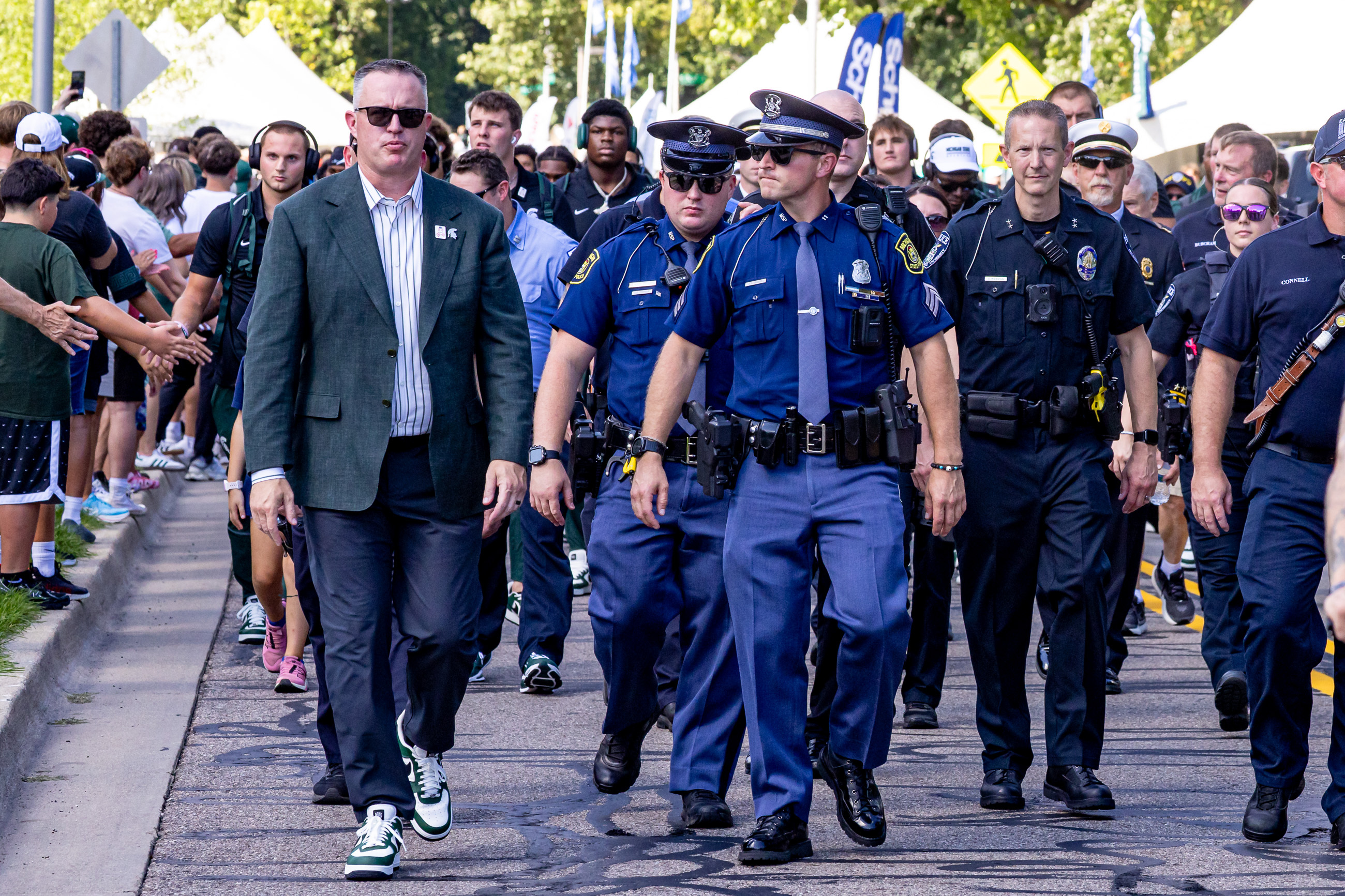
Photo credit: Marvin Hall/Spartans Illustrated
For Zimmerman, that kind of recognition has always been a little difficult to accept. Firefighters hear “thank you for your service,” but he considers himself fortunate simply to have a job he loves and the opportunity to help people who need him.
“I would do what I do for anyone every day,” Zimmerman said.
Renner sees it much the same way. East Lansing firefighters are fixtures at Michigan State events, working football and basketball games, volleyball, gymnastics, and countless other gatherings across campus. Most of the time, their goal is to be ready if something goes wrong while otherwise remaining largely unnoticed.
“We’re always just happy being in the background,” Renner said. “We’re not trying to get in the paper, and we’re not trying to get on the Jumbotron. It’s just our service to the community.”
On Saturday, remaining in the background was not really an option. For once, the firefighters who normally watched over Michigan State game days from the edges were out front, leading the football team toward Spartan Stadium.
15 or 20 handshakes
The procession carried the first responders through the entrance of Spartan Stadium and into the passageway leading toward Michigan State’s locker room, where the experience took on a more personal dimension for Johnson.
Rather than immediately dispersing to their game-day assignments, the firefighters were directed to line both sides of the corridor the Spartans would use on their way to the locker room. For a few minutes, the men and women who had just led the football team across campus became a receiving line of sorts as the players began filing past them.
Johnson remembers one player after another reaching out as they passed. Some offered a handshake, others a fist bump or a simple nod of acknowledgment, but enough stopped that Johnson estimates he shook hands with 15 or 20 players before the team had made its way through.
Van Horn remembers much the same scene. Most of the players remained understandably locked into their pregame routine, but many still made a point of acknowledging the first responders standing along the corridor. Fitzgerald came through again as well, greeting members of the group before heading toward the locker room.
Johnson did not recognize every player who reached out to him. His responsibilities on football Saturdays have kept him from following the roster as closely as he once did, and players can look considerably different without helmets and uniforms anyway. None of that mattered much in the moment.
What stayed with him was the simple fact that they stopped.
“They’re recognizing us,” Johnson said, “but we’re also fans of them.”
Zimmerman appreciated the balance the players struck. There were handshakes, high-fives, fist bumps, and brief words of thanks, but nobody expected players minutes away from kickoff to linger. In his mind, there was actually something familiar about watching them acknowledge the people around them without allowing themselves to lose focus on the job ahead.
Firefighters understand that feeling.
When a crew arrives at an emergency, Zimmerman said, people may be talking to them, thanking them, asking questions, or trying to get their attention, but there is only so much of their focus they can surrender while they are there to do a job.
“There’s only so much focus we can break while we’re doing our job,” Zimmerman said. “Just like they were going in to do their job.”
Eventually, the two groups went their separate ways. Michigan State disappeared into its locker room to prepare for the game, and the firefighters returned to the responsibilities that ordinarily bring them to Spartan Stadium in the first place.
Johnson made his way toward Stadium Command on the sixth floor of the west tower. Zimmerman and Van Horn reported to their medical post near the north end zone, where they got their equipment situated and watched as the stands gradually filled.
For a little while, after everything that had already happened that afternoon, game day settled back into something familiar.
‘That one hit me pretty hard’
Zimmerman and Van Horn knew they would eventually be back on the field, but until then they remained at their post as fans streamed into Spartan Stadium.
Zimmerman used some of the downtime to sit in the sun and drink water. It was a warm afternoon, and after seeing numerous heat-related medical emergencies during Michigan State’s previous home game, he expected the conditions could make for another busy shift.
Eventually, word came down that they needed to be on the field by 3:05.
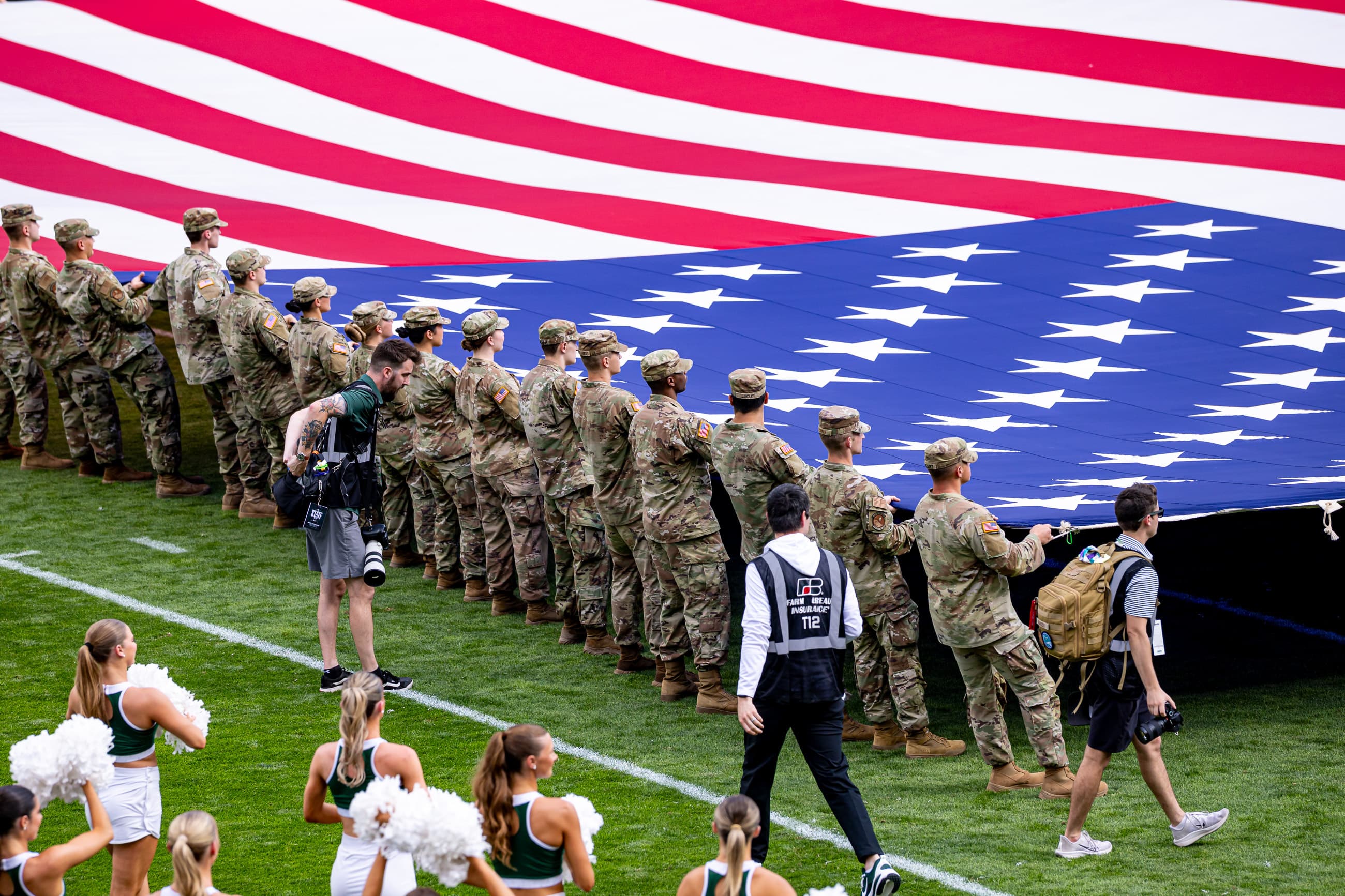
They made their way downstairs and onto the sideline as the pregame ceremony began to take shape around them. The National Guard brought out the enormous American flag, unfolded it across the field, and positioned it for the anthem. Once everything was in place, first responders and other participants moved forward to take hold of its edges.
Zimmerman and Van Horn stood near one another along the west side of the flag, facing east across the field.
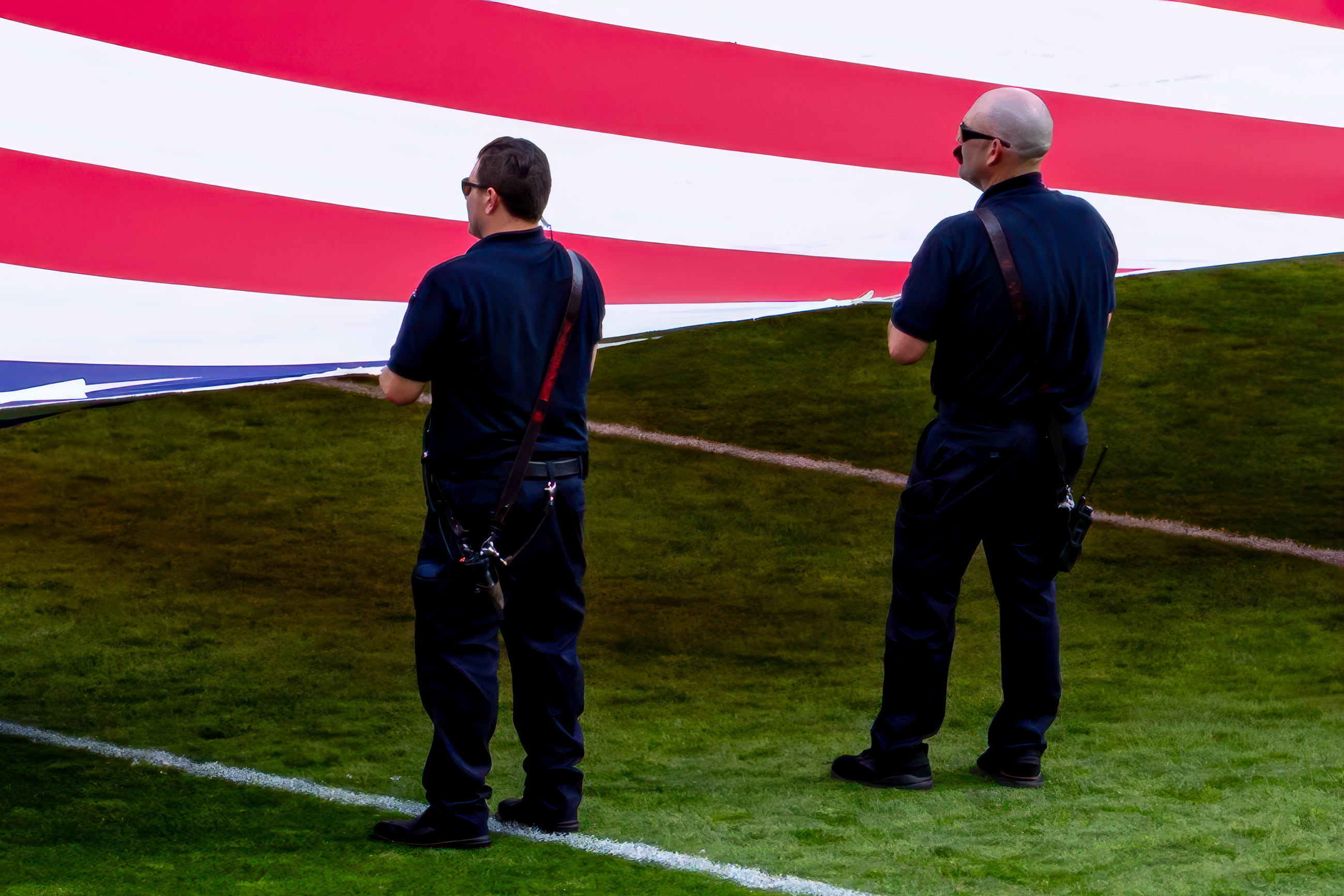
Photo credit: Marvin Hall/Spartans Illustrated
For Van Horn, the setting itself was not entirely new. He had previously been on the field for a Michigan State pregame ceremony, including in 2024 when he was among a group of first responders selected as honorary captains for the coin toss.
This felt different.
Before the national anthem began, a remembrance played over Spartan Stadium’s public-address system. Van Horn listened as the words turned the stadium’s attention back 25 years, remembering those who died aboard the airplanes, those who were working inside the towers, and the first responders who moved toward danger as thousands of others were trying to escape it.
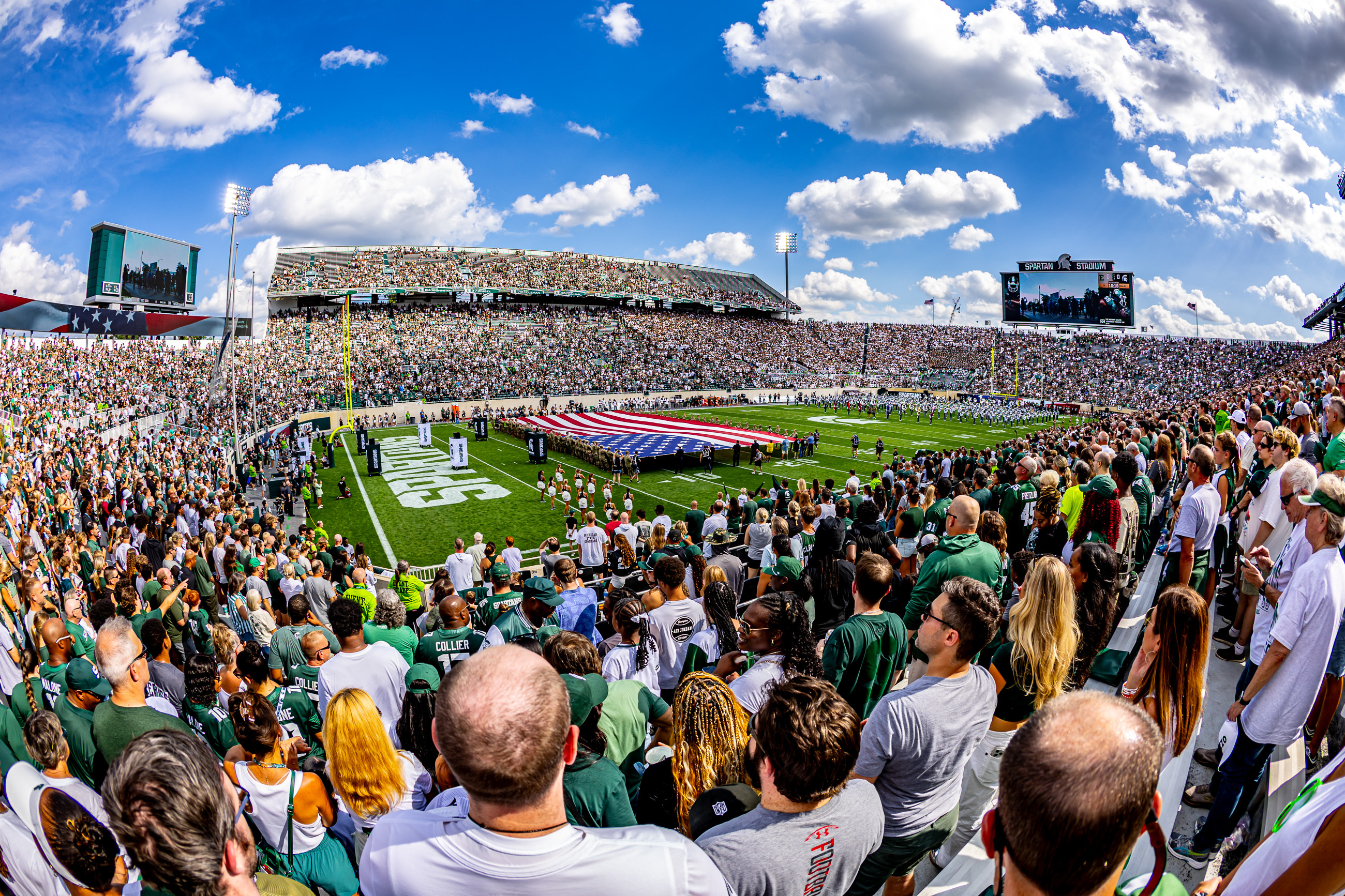
Photo credit: Marvin Hall/Spartans Illustrated
Van Horn had been young on Sept. 11, 2001. His understanding of what happened that day developed over time, through the news footage, documentaries, interviews, and stories that followed him as he grew older. Those accounts became part of what shaped his understanding of the fire service and, eventually, the profession he chose for himself.
Now he was standing on the field at Spartan Stadium with an American flag stretched out in front of him, listening to those sacrifices described over the loudspeakers while men who had experienced that day firsthand stood nearby.
The parallel was difficult to miss.
“Everybody’s running out, but we’re all running in,” Van Horn said. “They were all running in to the unknown.”
For Van Horn, that idea reaches beyond Sept. 11. Every firefighter who reports for a shift knows generally what the job asks of them, but none knows what the next alarm will bring, where the next call will take them, or what might be waiting when they arrive. The uncertainty is part of the profession, and so is the expectation that when everyone else needs help, they will move toward the problem.
As the remembrance ended, the Spartan Marching Band began the national anthem. The stadium stood around them, the enormous flag stretched across the field, and A-10s eventually thundered overhead.
Van Horn felt the moment physically.
“It gave me goosebumps,” he said.
A few feet away, Zimmerman was experiencing something altogether different and deeply personal.
Earlier that afternoon, during the Spartan Walk, Zimmerman had spotted his wife, Amanda, and their 2-year-old son, Kellan, along the right side of the route. He had waved toward them as the procession passed, and Kellan had waved back. Zimmerman knew it had happened, of course. What he did not know was that a Michigan State camera had been positioned behind him and captured the exchange.
Now Zimmerman was standing on the field helping hold the American flag when he glanced toward the stadium video board.
Footage from the Spartan Walk was playing above him.
Then Zimmerman saw himself.
There on the screen was the moment from earlier in the afternoon – Zimmerman walking toward Spartan Stadium, turning toward the crowd, and waving to his wife and young son.
What had been a fleeting exchange among thousands of people along the route was suddenly being replayed over Spartan Stadium while Zimmerman stood below it, surrounded by first responders, holding the flag during a ceremony commemorating the 25th anniversary of Sept. 11.
“That one hit me pretty hard,” Zimmerman said.
The moment connected several pieces of an afternoon Zimmerman had not even known he would experience until shortly before it happened: his profession, his family, the firefighters from New York standing nearby, and a Michigan State game day he had spent years working mostly from the background.
This time, for a few minutes, he was standing in the middle of it.
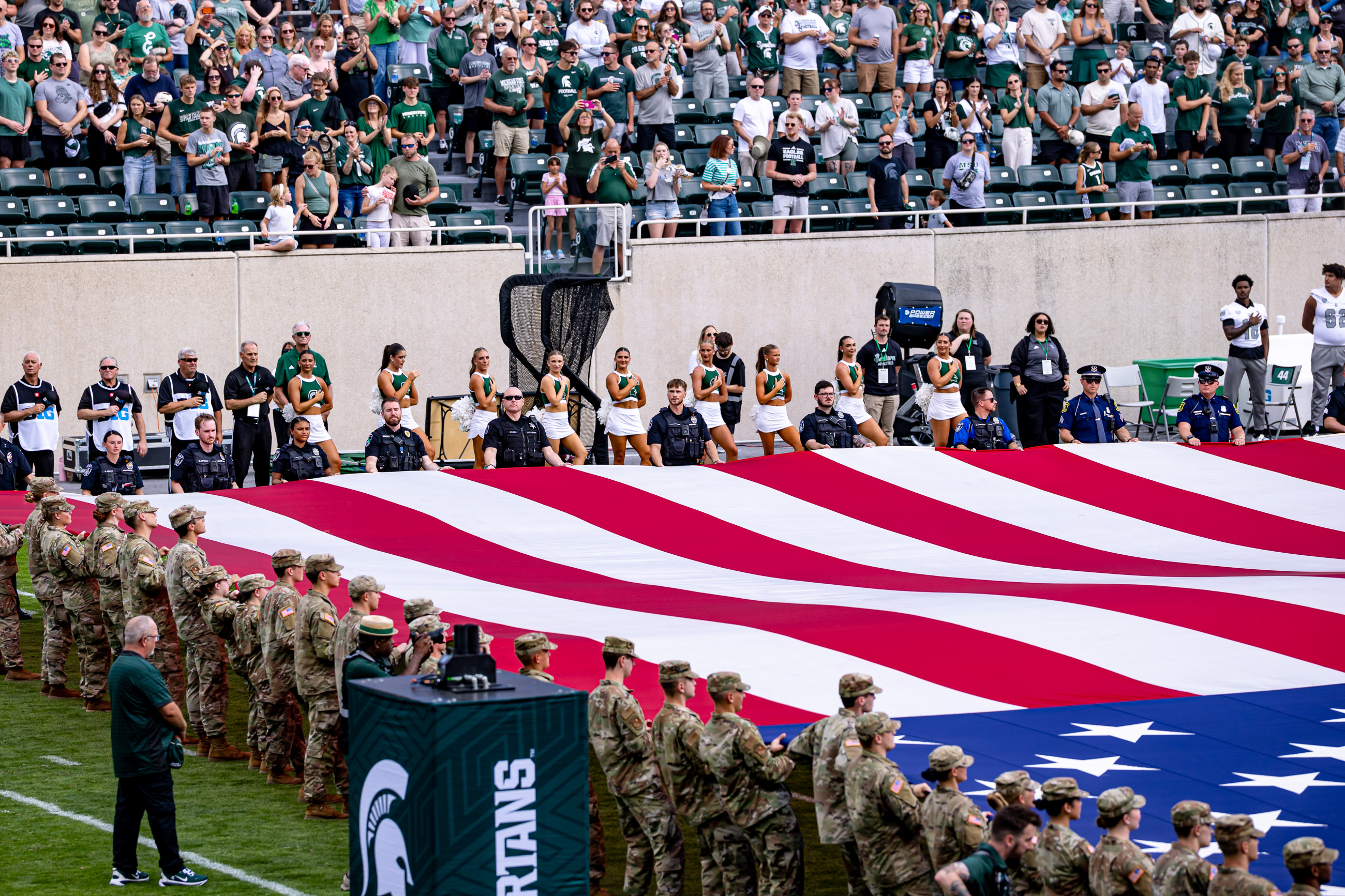
Photo credit: Marvin Hall/Spartans Illustrated
From Kroger to midfield
Renner spent much of the pregame ceremony alongside Tom while the rest of the group helped hold the large American flag on the field. The retired FDNY lieutenant had been invited to take part in the coin toss, so the two remained near midfield as the rest of the ceremony unfolded around them.
While they waited, Michigan State’s captains came over to thank them. Members of the coaching staff did the same, and even the game officials stopped to offer their appreciation. Renner could tell Tom was a little nervous as the moment approached, which was understandable considering how unexpectedly he had arrived there.
The previous morning, Tom and his friends had been picking up a few things at Kroger during a weekend together in East Lansing. Now he was standing on the field inside Spartan Stadium, surrounded by tens of thousands of people and preparing to walk to midfield before a Big Ten football game.
Renner watched as Tom headed out for the coin toss. When it was over and he turned back toward the sideline, whatever nervousness had been there beforehand was gone.
“He was grinning ear to ear,” Renner said.
That became Renner’s favorite moment of the entire experience, and not because being on the field at Spartan Stadium was particularly novel for him. Renner has officiated football, worked around Michigan State athletics, and spent plenty of time in places inside the stadium most fans never experience. What moved him was watching someone else absorb the moment.
Zimmerman noticed much the same thing during the national anthem. As he looked around at the visitors from New York standing on the field, what stayed with him was how happy they seemed.
“They were all smiles,” Zimmerman said.
That led him to wonder how many Sept. 11 anniversaries had given them a chance to experience something that felt joyful rather than heavy. Whatever memories they carried into East Lansing that weekend, Zimmerman hoped Saturday had provided something different to carry away.
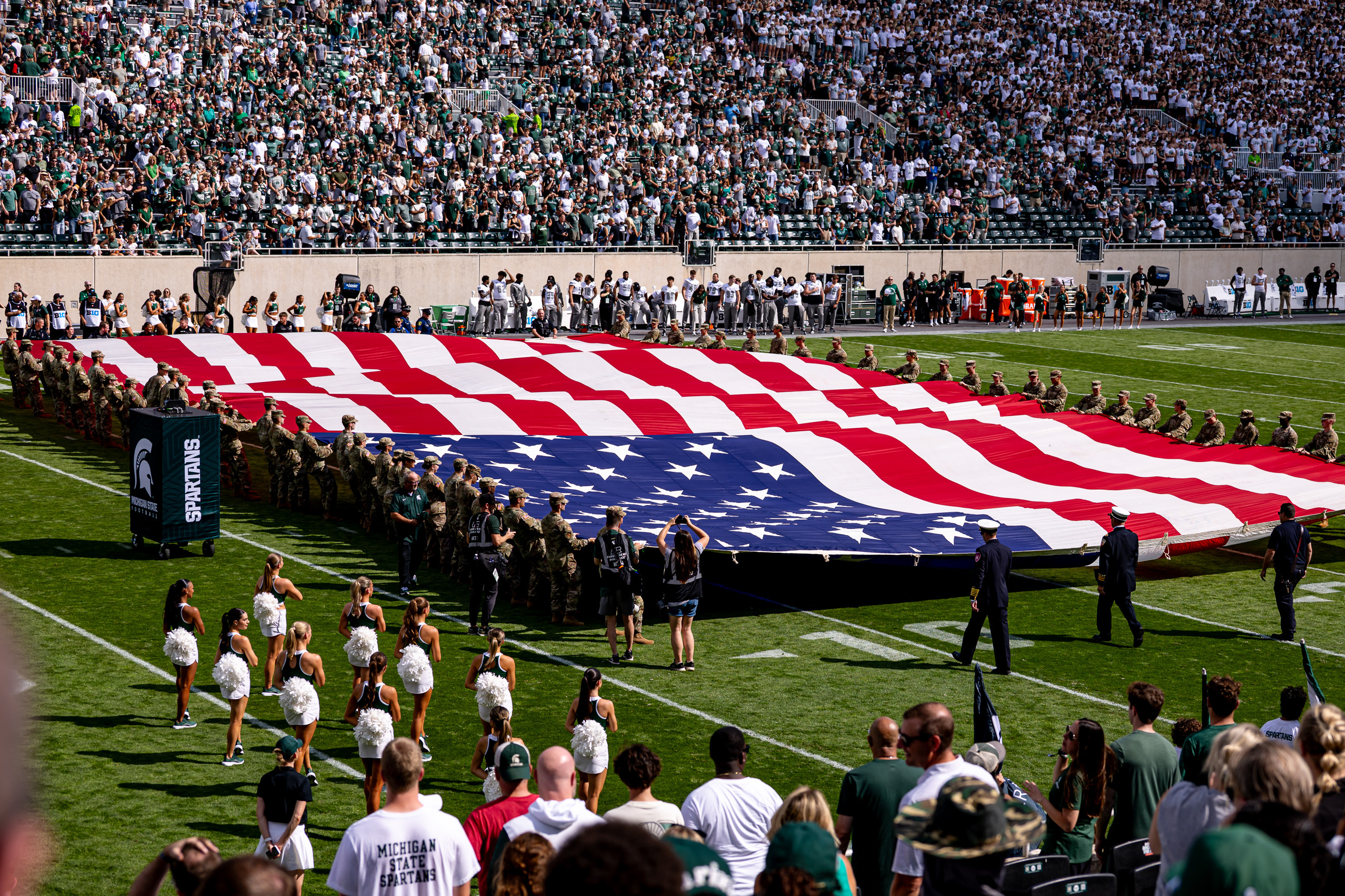
Photo credit: Marvin Hall/Spartans Illustrated
Van Horn kept returning to the sheer improbability of how any of it had happened. There had been no carefully arranged connection between the New York visitors and Michigan State, no longstanding relationship, and no plan to make them part of the game-day ceremony. There had simply been a chance encounter between two groups of people at a grocery store, followed by one gesture after another.
“The world, it’s such a small world,” Van Horn said. “Here in our nice little town of East Lansing, just by happenstance running into that group of guys at the grocery store, and one thing led to another.”
For Van Horn, the hope was that an anniversary so closely associated with loss had unexpectedly produced something positive for the men who had experienced it so personally.
“A positive memory,” he said.
For lack of a better word, Van Horn called the way the entire weekend came together “magical.”
‘One of the best shifts I’ve had’
Mike Schaefer experienced Saturday differently from the colleagues who took part in the Spartan Walk and pregame ceremonies.
After spending time with the New York visitors at Station 2 and helping drive them across campus to the Spartan statue, Schaefer returned to work. He did not walk in front of the football team, help hold the flag, or stand anywhere near midfield for the coin toss. His role in the public portion of the afternoon effectively ended when the visitors climbed out of the fire truck.
Yet as the shift continued, Schaefer found himself thinking about how much the day had meant to him anyway.
“I wasn’t part of the walk or anything like that,” Schaefer said. “And as I was working that day, I was like, this is one of the best shifts I’ve had in a really, really long time.”
Part of that feeling came from simply having the visitors at the station. Schaefer had enjoyed watching them settle back into the familiar rhythms of a firehouse, trading jokes, talking shop, and climbing aboard a fire truck again. But it also came from watching what Michigan State had done for his colleagues and for five men who had arrived in East Lansing with no expectation of becoming part of anything.
Schaefer had seen first responders recognized at sporting events before. Usually, that means an announcement, a brief ceremony, or a round of applause before everyone’s attention returns to the game.
This had become something far more involved and far more personal. Michigan State had welcomed the firefighters into the Spartan Walk, brought them onto the field, opened the experience to the visitors from New York, and allowed the day to grow organically rather than treating the recognition as another item on a pregame schedule.
“They went out of their way,” Schaefer said. “That greatly, greatly improved our morale. And it really spoke volumes to us about who he is.”
Schaefer was talking about Fitzgerald - Michigan State's first-year football coach - whose involvement throughout the week had convinced the firefighters that the gestures were not simply ceremonial, but reflected something more genuine.
‘We got the right guy here now’
Renner saw the same sincerity in a smaller gesture that began almost as an afterthought.
Earlier in the week, he had given East Lansing Fire shirts to members of Michigan State’s creative staff as a thank-you for including the department in the first-responder recognition. Somewhere in the conversation, Renner floated the possibility that Fitzgerald might wear one.
He did not know whether anything would come of it.
Then, after Michigan State’s victory Saturday, Fitzgerald walked into his postgame press conference wearing an East Lansing Fire Department shirt.
Word traveled quickly through the department. Renner’s phone began filling with messages from firefighters who had seen the press conference or caught photos afterward. To them, the shirt was more than another piece of game-day apparel. It reinforced the feeling that had been building throughout the week – that Fitzgerald’s interest in recognizing first responders was genuine.
“You know that he supports us,” Renner said.
For Renner, so much of the weekend had unfolded through small gestures rather than grand announcements. The invitation to join the Spartan Walk had felt sincere. Fitzgerald had stopped to greet the firefighters personally. Players had shaken their hands on the way to the locker room. And now the head coach was standing in front of reporters after the game wearing their department’s shirt.
“We got the right guy here (at MSU) now,” Renner said.
Van Horn noticed the significance, too. He has spent six years with East Lansing Fire and graduated from East Lansing High School, giving him a long familiarity with both the department and the university community. He could not remember another Michigan State coach making that kind of public gesture toward East Lansing firefighters.
Michigan State gifted the department with something more permanent as well.
(Courtesy photo)
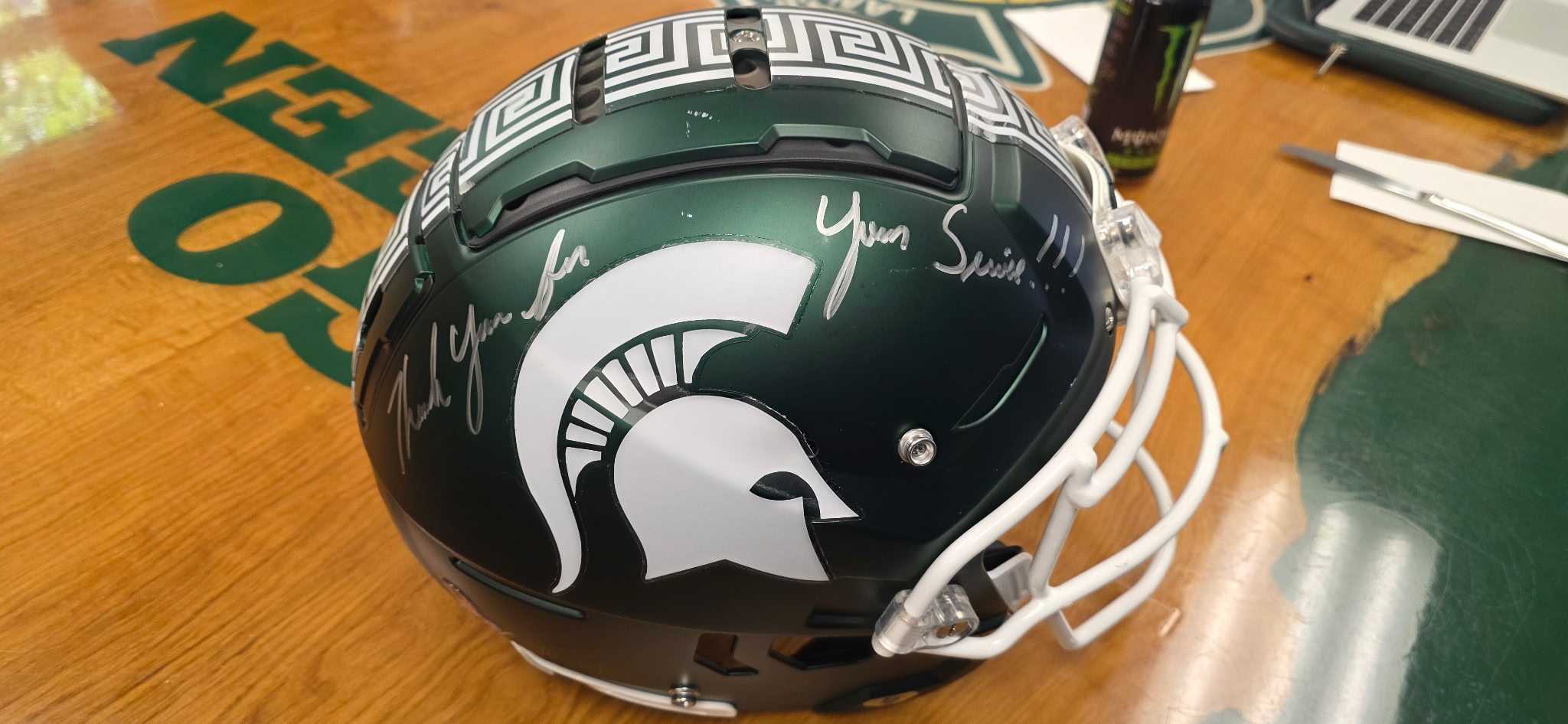
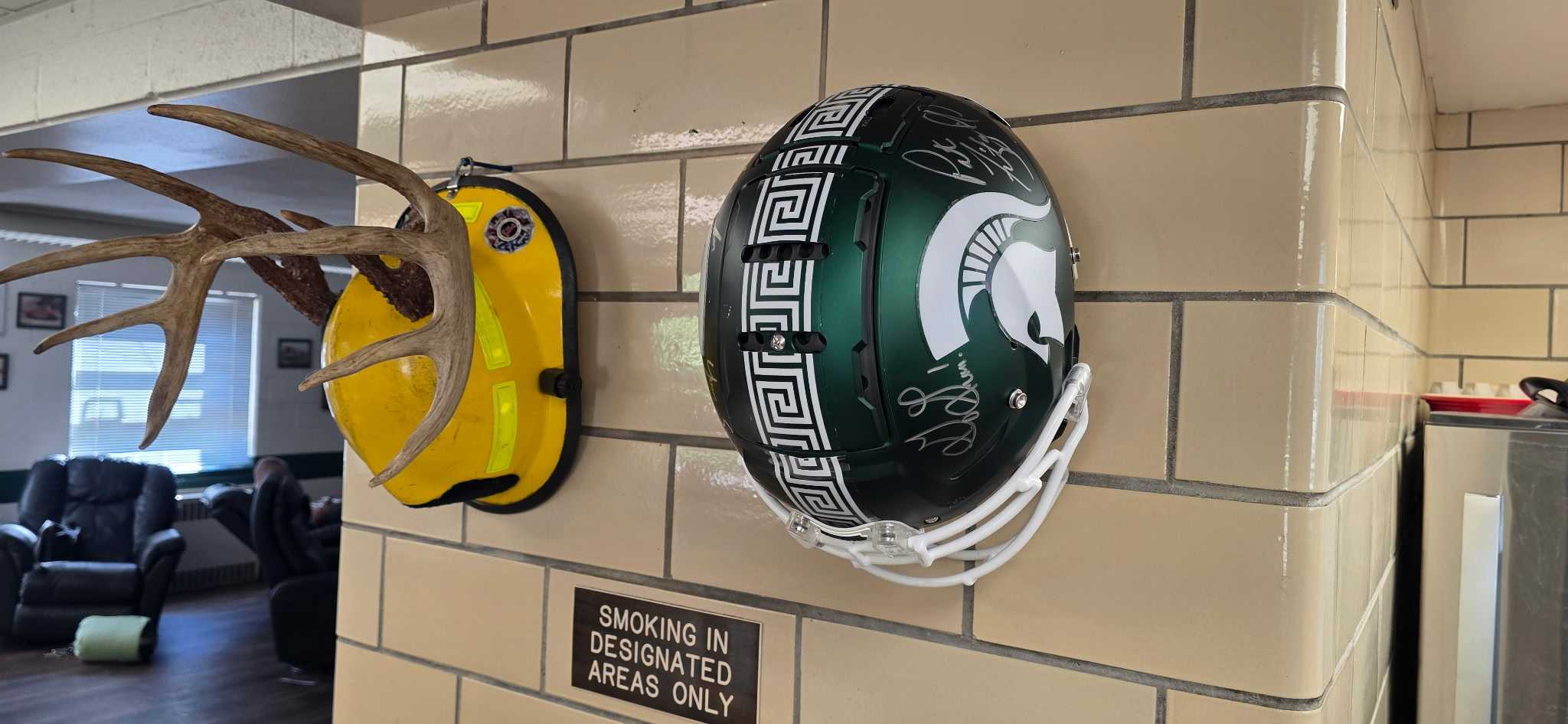
The program gave East Lansing Fire a Spartan football helmet signed by Fitzgerald with a message thanking the department for its service.
It did not sit around long before finding a place inside Station 2.
(Courtesy photo)
The helmet now hangs on the wall between the kitchen and dining area, only a short distance from where the visitors from New York had spent part of Saturday watching football, trading jokes, talking shop, and settling back into the familiar atmosphere of a firehouse.
Giving the honor away
For Schaefer, that quieter part of the day remained every bit as meaningful as the ceremonies that followed.
Before anyone walked alongside Michigan State’s football team, before the American flag was stretched across the field, and before Tom stood at midfield for the coin toss, five men from New York had simply spent an hour inside Station 2 with people they had met only the day before.
They watched football together. They swapped stories. They joked with one another in the way firefighters do, including the moment one visitor tried to pull rank on Schaefer until learning he had 14 years on the job. When it came time to leave, the men lit up at the prospect of climbing into a fire truck again.
“They just really enjoyed being around us,” Schaefer said. “And we really enjoyed being around them.”
That simple connection helps explain the way the rest of the weekend unfolded.
Michigan State had set out to honor East Lansing’s first responders, but the firefighters themselves seemed almost instinctively inclined to pass that recognition along. Renner talks about the people around him rather than his own role in making the weekend happen. Zimmerman, when asked what the Spartan Walk and flag ceremony meant to him, keeps returning to the visitors from New York standing nearby. Johnson, Schaefer, and Van Horn describe the brotherhood of the fire service and the people who shared the experience with them far more readily than they talk about themselves.
And when the attention finally reached the men from New York, they redirected it, too.
They declined to be interviewed for the story. They did not want the weekend to become about them and preferred that the focus remain on the friends, colleagues, and 343 FDNY members who went to work on Sept. 11, 2001, and never came home.
The recognition kept moving from one group to another because nobody seemed especially interested in holding onto it.
Michigan State wanted to honor East Lansing’s first responders. The firefighters wanted to share that honor with the men from New York. And the visitors, in turn, wanted the focus to rest with those who were lost.
By the end, everyone involved seemed more interested in giving the honor away than receiving it.
