

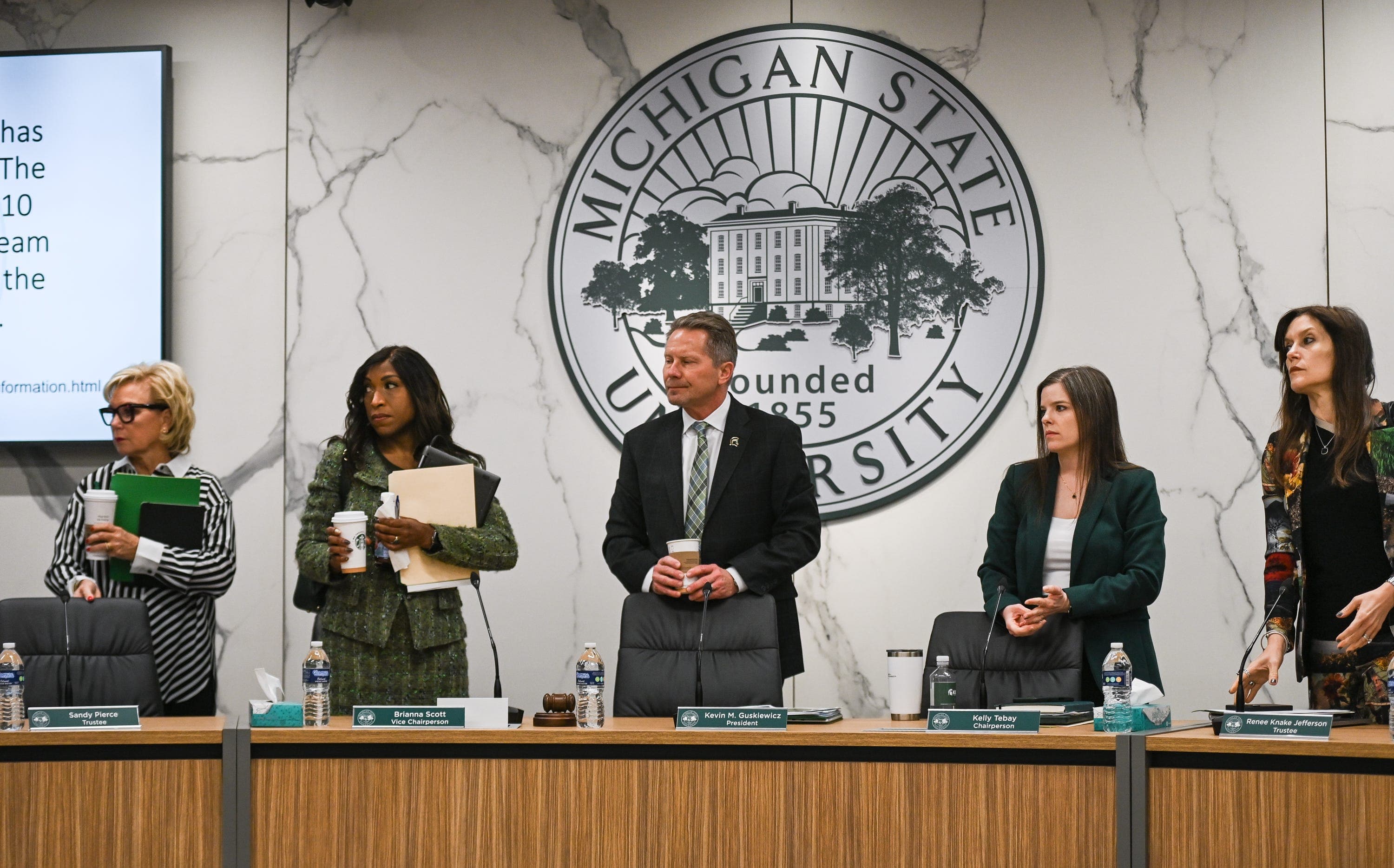
Beyond Elections: What accountability might look like when MSU stakeholders believe their university has been harmed
A look at a rarely used option available to concerned Spartan stakeholders
For months, the conversation surrounding Michigan State has focused on personalities, politics, and boardroom drama. Trustees have traded public criticisms. Ethics disputes have dominated headlines. Questions have been raised about governance, communication, and board conduct. It's not been fun, by any stretch.
And now, Michigan State has lost its president.
Michigan State has lost its athletic director.
The university faces the cost, disruption, and uncertainty of replacing two of its most important leaders in the span of a few weeks.
At some point, MSU stakeholders must ask the question:
What remedies exist when fiduciaries (trustees, in this case) are alleged to have harmed the institution they are entrusted to govern?
Most people are familiar with elections as a mechanism of accountability. Trustees stand for election. Voters decide whether they remain in office. But that only happens every eight years.
What many people do not realize - and I just recently learned - is that elections are not the only form of accountability available to organizations.
In the corporate world, shareholders have a legal mechanism known as a derivative lawsuit. Sounds fancy, but the concept is straightforward. When directors or officers allegedly breach their fiduciary duties and cause harm to the corporation, the corporation itself is the victim. If those responsible for governing the corporation refuse to act, shareholders may seek to pursue claims on behalf of the corporation.
Universities are not publicly traded corporations, and Michigan State does not have shareholders. But the underlying fiduciary principles are remarkably similar, or so I'm told by lawyers who know this stuff.
Trustees owe duties to the institution they govern. Those duties generally include the duty of loyalty and the duty of care.
The duty of loyalty requires fiduciaries (trustees) to place the interests of the institution above personal interests, political agendas, personal disputes, or individual ambitions.
The duty of care requires fiduciaries (trustees) to exercise appropriate judgment, remain informed, and make decisions in a manner reasonably believed to be in the institution's best interests.
Interestingly enough, these are not goals - they are actual legal obligations.
Before we get into it, it is worth noting that fiduciary-duty litigation against university trustees is relatively uncommon.
Most large-scale lawsuits involving universities are brought by students rather than stakeholders challenging governance. In recent years, higher education has seen a wave of class-action litigation involving antitrust claims, financial aid practices, tuition disputes, admissions policies, and other student-focused issues.
Those cases have focused on the relationship between universities and students.
Lawyers tell me that a fiduciary-duty claim is fundamentally different, though, as it focuses on the relationship between trustees and the institution itself. And that distinction helps explain why governance litigation is relatively rare.
Trustees are often viewed through a political lens. Yet trustees are more than elected officials. They are fiduciaries with legal obligations to act in the best interests of the institution they govern.
Lawyers also tell me that the relative rarity of fiduciary litigation does not make those obligations any less real. If anything, it may simply reflect the fact that stakeholders don't usually view university governance through that framework.
However, when stakeholders begin asking why a university has lost key executives, why confidence in leadership has eroded, why governance controversies dominate public discussion, and why the institution appears consumed by internal conflict, they are ultimately asking whether the institution itself has been harmed.
That is where the conversation becomes significantly more serious.
My first reaction to this idea was that no lawsuit could succeed because there doesn't appear to be obvious damages - but that assumption showed my ignorance to the nature of fiduciary litigation.
The potential harms to a university actually extend far and wide.
Consider the costs associated with replacing a university president. National presidential searches routinely cost hundreds of thousands of dollars once search firms, travel expenses, candidate evaluations, staff time, and transition costs are considered.
Now add the cost of replacing an athletic director.
Add the disruption to fundraising efforts.
Add the uncertainty experienced by donors.
Add the impact on strategic initiatives that were championed by departing executives.
Add the costs of investigations, outside counsel, public relations responses, and crisis management.
Add reputational harm that may affect donor confidence, student recruitment, faculty recruitment, and institutional standing.
None of these damages exist in isolation; collectively, though, they represent real costs borne by the university.
Whether those costs can be traced to particular conduct is a question for evidence. The more immediate question is whether anyone seriously believes a university suffers no harm when it loses both its president and athletic director within the same month.
In many fiduciary cases, however, damages are not even the primary objective.
Discovery is.
Most members of the public never see how institutional decisions are made. They see public meetings. They see press releases. They see carefully crafted statements prepared by attorneys and communications professionals.
They do not see internal communications.
A lawsuit changes that.
Discovery can compel the production of emails, text messages, meeting materials, notes, memos, and testimony under oath.
Communications between trustees.
Communications with administrators.
Communications with donors.
Communications regarding executive retention.
Communications concerning governance disputes.
The legal process provides a mechanism to examine actual evidence.
Perhaps that evidence would support the actions of university leaders. Perhaps it would not. But the determination would be made through documents and testimony rather than speculation.
Another commonly overlooked issue involves indemnification. Indemnification in this case basically means that the university will pay the legal bills for trustees.
Trustees usually assume that the institution will defend them and pay legal expenses if they are sued for actions taken in their official capacity. In many circumstances, that assumption is correct. However, indemnification is not always automatic, unlimited, or unconditional.
Lawyers tell me that whether a fiduciary is entitled to indemnification often depends upon whether they acted in good faith and in a manner reasonably believed to be in the institution's best interests. The governing documents, applicable statutes, insurance policies, and facts of a particular case all matter. The details vary considerably from case to case.
The broader point is that fiduciary litigation can create questions about personal exposure that trustees never expect to confront. It also helps explain why many governance cases never reach a final verdict.
The public often imagines lawsuits ending with dramatic courtroom victories and massive financial judgments. In reality, though, I'm told many governance disputes are resolved through settlement - and those settlements frequently focus on institutional reform rather than on money.
And now we're getting somewhere.
The remedies in a settlement like this can include governance changes, enhanced transparency requirements, independent oversight mechanisms, revised ethics policies, new reporting requirements, committee restructuring, restrictions on certain conduct, or - this one is important - voluntary resignations.
The objective is often not punishment; the objective is protecting the institution.
A stakeholder concerned about governance failures is not really seeking financial compensation; the goal is to ensure that the institution is governed effectively going forward.
In this scenario, the question of standing would also become important.
Who has the right to bring such a claim?
The answer depends upon state law, the structure of the institution, and the nature of the claims asserted. Different jurisdictions recognize different pathways for stakeholder involvement in nonprofit governance disputes. In some situations, attorneys general play a significant role. In others, donors, members, or other stakeholders may have avenues to seek relief.
Any serious effort would require careful legal analysis specific to the state of Michigan and Michigan State University's governance structure.
To be clear, none of this is to suggest that any trustee has violated a fiduciary duty. Nor is it to suggest that litigation is necessarily warranted. Those are conclusions that require evidence, investigation, and legal analysis.
But stakeholders should understand that accountability does not begin and end with elections. Michigan State Trustees are not merely political figures. They are fiduciaries entrusted with governing one of the nation's leading public universities.
When stakeholders believe governance failures have imposed substantial costs on an institution, elections are one remedy. Public criticism is another. Organized donor action is another. Governance reform efforts are another. And, in certain circumstances, fiduciary litigation might also become part of the conversation.
For years, discussions about Michigan State's Board of Trustees have centered on politics. Perhaps it is time to discuss governance instead.
After all, the university has now lost both its president and its athletic director within the same month. Whether those departures are connected to board conduct is a question that deserves careful examination.
If stakeholders ultimately conclude that the institution has been harmed, they should understand that the law provides mechanisms designed specifically for those situations. The question is not whether accountability tools exist. The question is whether those who care about Michigan State are willing to use them.
