

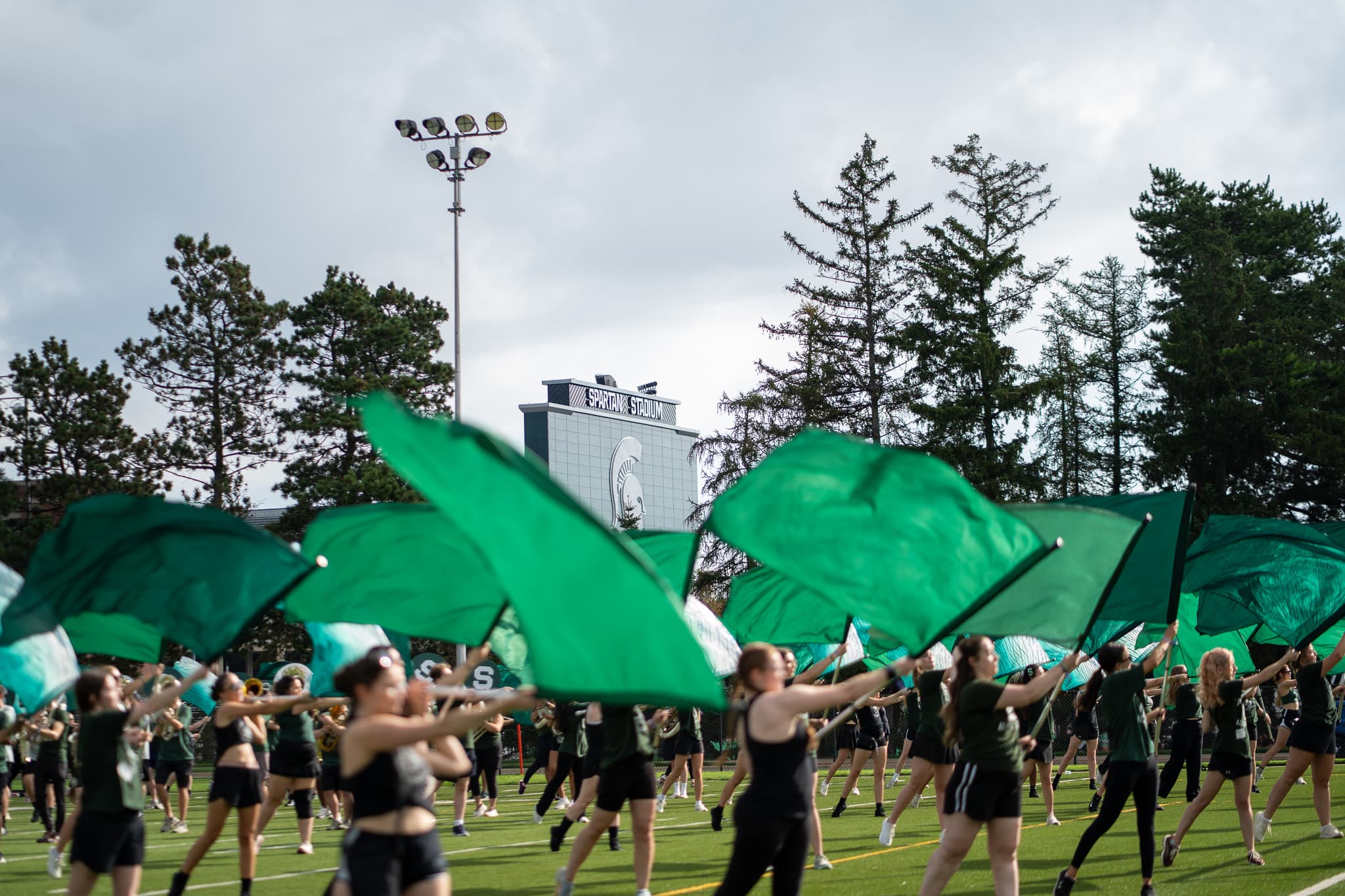
Celebrating 50 years of Color Guard in the Spartan Marching Band
For half a century the Spartan Marching Band Color Guard has been spinning with pride.
The first note of the Spartan Marching Band fanfare hits, and Libby Draeger knows what comes next.
She comes through the tunnel at Spartan Stadium, flag in hand, into the noise of tens of thousands of Michigan State fans. After the early mornings, late nights, endless rehearsals, and hours spent perfecting a routine, this is the moment that makes all of it worthwhile.
“Once you step on that field, it’s so addicting,” Draeger said. “You walk out of that tunnel and there’s 75,000 people yelling and screaming because the band just hit that first note of the fanfare right at the beginning of pregame. You walk out of that tunnel and it’s insane.”
For five decades, generations of Michigan State Color Guard members have experienced their own version of that moment.
This fall, the Spartan Marching Band Color Guard is celebrating its 50th anniversary – half a century of flags and silks, precision and performance, early-morning practices, football Saturdays, and friendships that have endured long after the final show.
Pride, family, and tradition are values that members of the Spartan Marching Band old and new use to describe the atmosphere that fills Munn Field, Spartan Stadium, and Demonstration Hall. Getting to be a part of a longstanding, prestigious group at a Big Ten university is an honor, and the Spartan Marching Band Color Guard (SMBCG) is no exception.
To understand how the Color Guard became an integral part of the Spartan Marching Band, Spartans Illustrated went back to its beginnings with former marching band director Dave Catron, who helped create and develop the group, and Draeger, a recent Michigan State graduate whose family’s connection to the band spans generations.
Where it all began
Catron arrived at Michigan State in 1970 as assistant director of bands.
During his first four years at the university he was tasked with writing all the marching band shows, which he continued up until his departure in 1974. At that time, Catron headed out, taking a leading role as sole director of bands at Wichita State.
But in 1979 Catron was told by former director of bands, Kenneth Bloomquist - who was the dean of the School of Music - that he was to come back to Michigan State and assume the role of associate director of bands.
Catron was to be in sole control of the marching band.
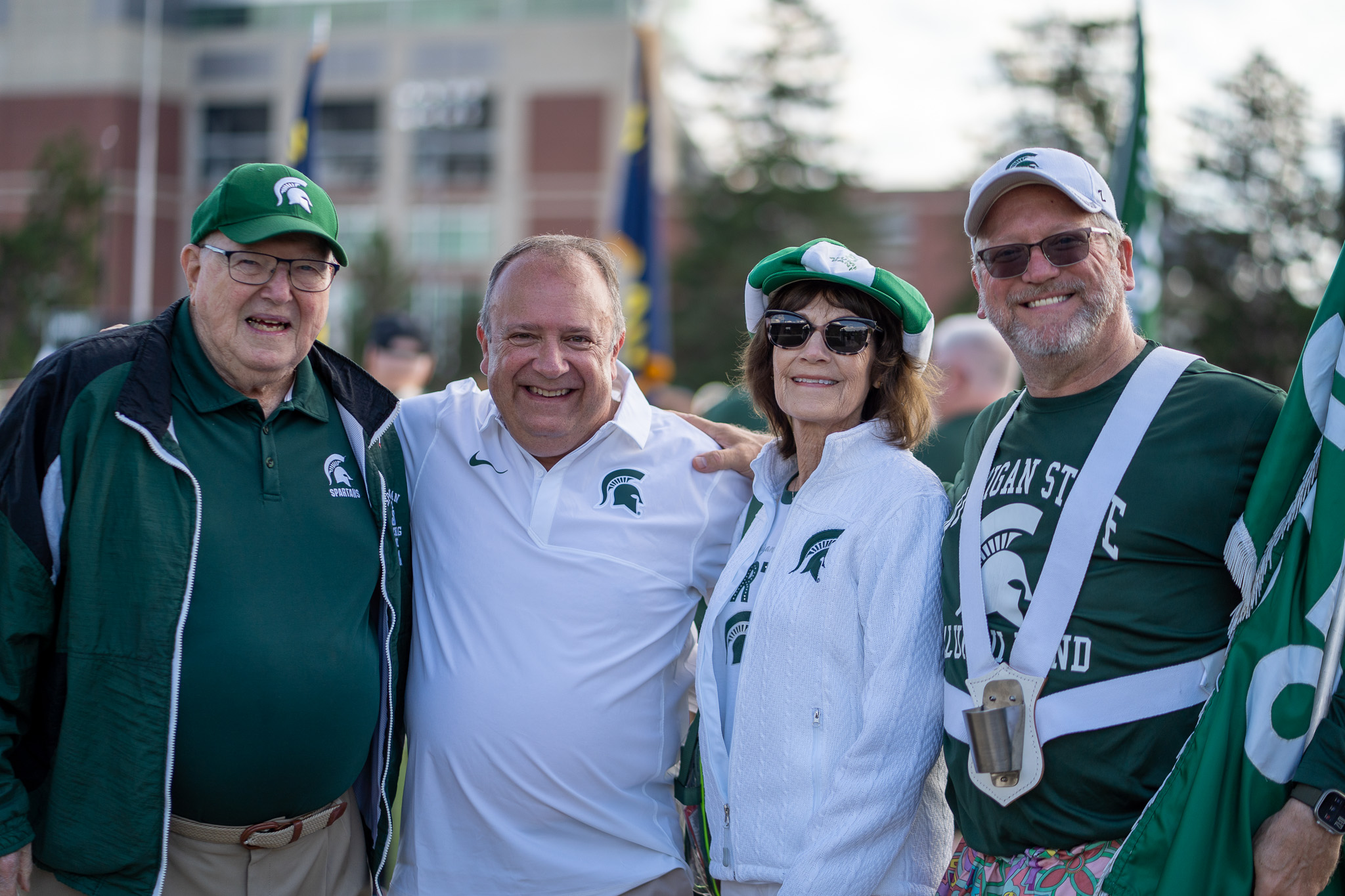
Credit: Sydney Padgett / Spartans Illustrated
Description: Dave Catron, Kevin Sedatole, Gail Catron, and Time Draeger (left to right) pose for a photo at pregame rehearsal
Catron said his history can be summed up as one band after another band.
"It's a lot of work, you've got 300 students out there and you gotta write a show," he said. "You got 100 yards long and 53 yards wide, and you've got to make it all fit."
When Catron came back to MSU in 1979, his motivation to add the color guard to the band came from the popular drum and bugle corps trend that was sweeping through the United States at the time.
"All of the drum corps had great color guard groups and I said 'we can do that here,'" Catron said.
In developing the football show, Catron said his job was to place the guard into their positions, but he had "big time help" creating the "silk routines" to fit with each show.
Catron knew he wanted the group to dance, but also not be limited only to dancing. He brought in help to ensure the group incorporated as many technical skills as possible.
The group grew each year, beginning with 16 to 20 members and ending with around 40 members at the time of his departure from the role of associate director of bands in 1988. The group now stands with exactly 40 members each season.
"I always wanted to make it part of the entertainment," shared Catron. "So, we bought a lot of different silks so that the colors on the field would be different from game to game."
Catron invested time and energy to blend the color guard into the Spartan Marching Band and focused on keeping the group flexible and the routines filled with dance steps.
During Spartans Illustrated's conversation with Catron, it was evident just how much the process of writing shows has evolved since the '70s.
"We mimeographed a whole packet of instructions for every person in the band," started Catron with a chuckle. "There were charts that showed their position on the field, and there weren't any phones to look at. The band was really a mathematical component."
Catron summarized each halftime show as a "creation." He stressed how the blending of all 300 band members together is truly a work of art. That art is enhanced by the color guard, who bring extra flair into each performance; although their routines may look free-flowing, they are painstakingly planned to mesh perfectly with the music.
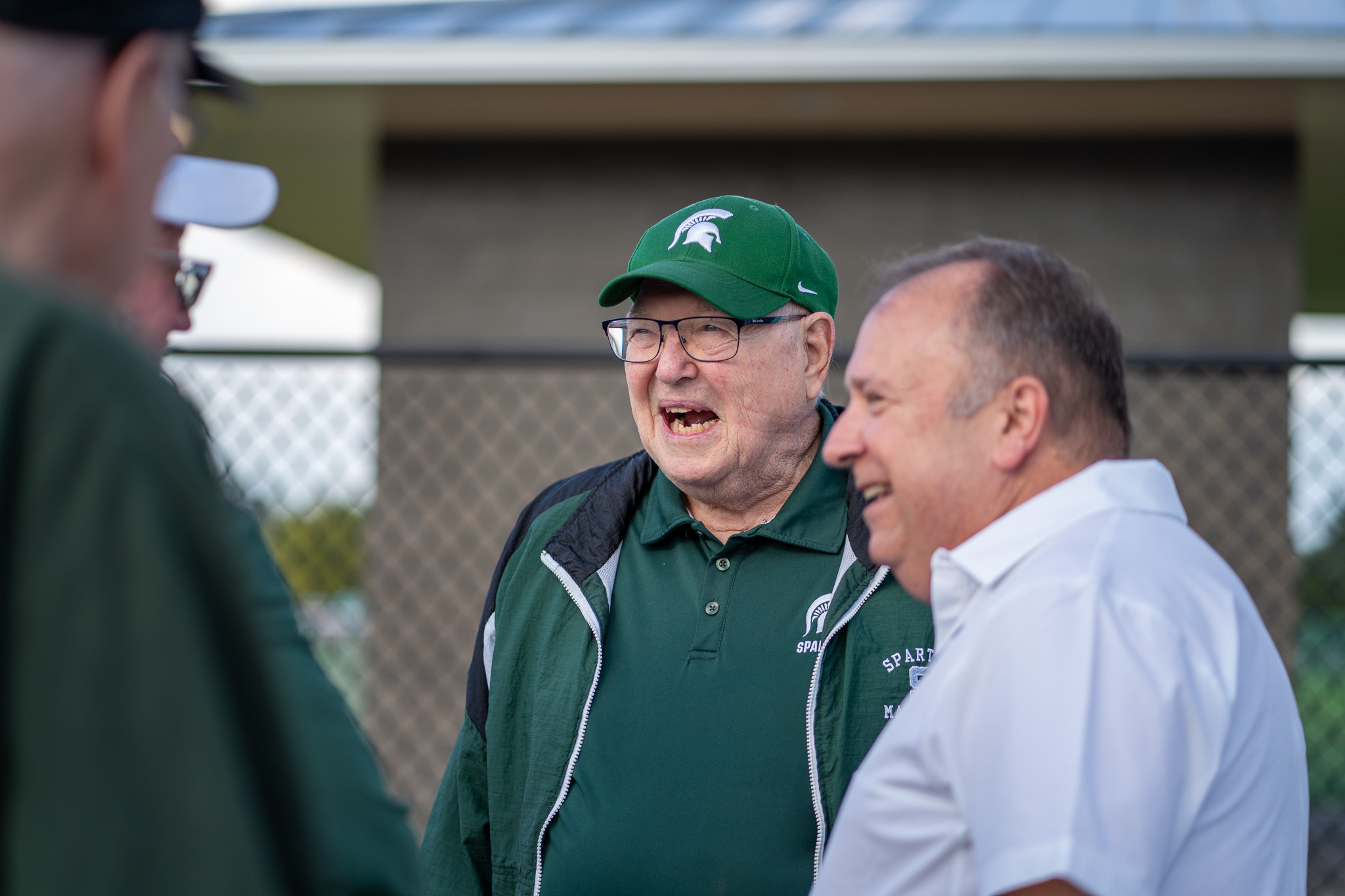
Credit: Sydney Padgett / Spartans Illustrated
Description: Dave Catron laughs during morning pregame rehearsal with current Director of Bands, Kevin Sedatole
Where the Guard is today
Libby Draeger, a recent graduate of Michigan State University, and current Alumni Band Member supplied an inside glimpse into what the SMBCG is like today.
Draeger's connection to the SMB runs deep. Her mother was in the color guard in the '80s, and her father is the current alumni band president. Her parents even met in the SMB.
