

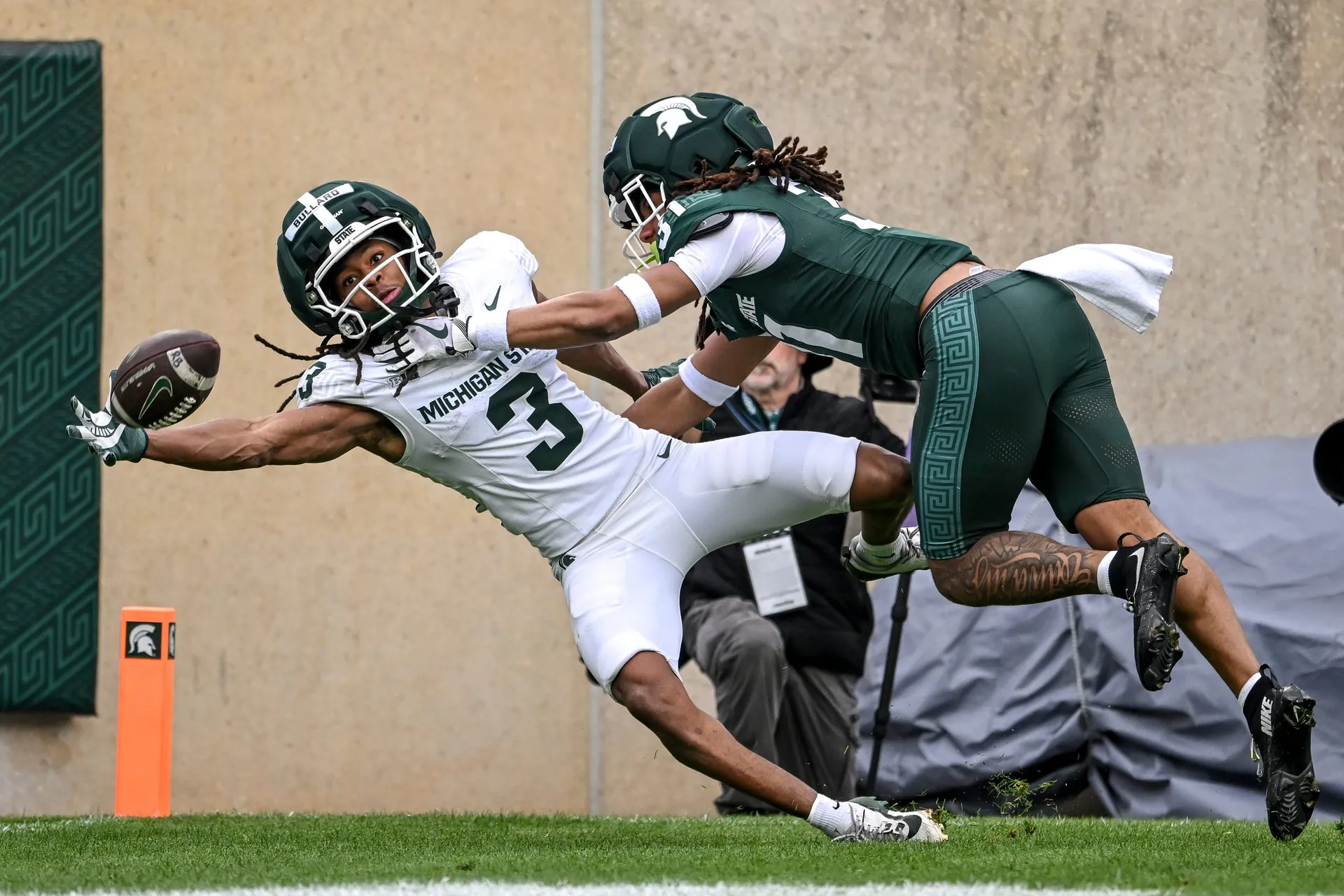
EXPLAINER: The NCAA’s case against MSU's Rodney Bullard gets harder to explain the closer you look
Bullard has played only three seasons, but a disputed 2021 enrollment designation could keep him off the field for MSU this fall
Rodney Bullard Jr.'s fight with the NCAA might initially look like another entry in the growing collection of college athletes going to court in search of additional eligibility, but the details make his case considerably different.
Bullard is not asking the NCAA to erase a season in which he played, nor is he seeking a fifth or sixth season of college football through an unusual interpretation of the rules. He has played exactly three seasons – at Valdosta State in 2023 and 2024, then at Michigan State in 2025 – and wants to play his fourth in 2026.
His argument is that the NCAA started his five-year eligibility clock one year too early because it determined he was a full-time student at Valdosta State in the fall of 2021.
Bullard says he wasn't.
If he can prove that, the case becomes far less complicated than many of the eligibility lawsuits currently moving through courts around the country.
Bullard was a part-time student at Valdosta State in 2021 and was not yet a member of the football program. He joined the team in 2022 and redshirted, played his first season in 2023, played again in 2024, then transferred to Michigan State and played his third season in 2025.
Michigan State pursued another year of eligibility through the NCAA during the spring, but the NCAA denied the school's appeal. Bullard has now taken the matter to Ingham County Circuit Court, where a preliminary injunction hearing is scheduled for Aug. 27 before Judge Wanda Stokes.
That hearing could effectively determine whether Bullard plays football for Michigan State this fall.
Why everything goes back to 2021
Connor Earegood from The Detroit News reported today that the dispute traces back to Bullard's first semester at Valdosta State, before he had any involvement with the school's football program.
Bullard graduated from Westover High School in Albany, Georgia, in 2021 after accumulating substantial college credit through early-college coursework. According to The News, he entered Valdosta State with an associate's degree and intentionally planned to attend college part time.
An administrative complication followed.
The Detroit News reported that Valdosta State registered Bullard for an additional course, Anatomy & Physiology I, because transcripts from Albany State University and Albany Technical College had not yet been received. Bullard had already completed the course elsewhere, and - according to The News - he was told that once his previous coursework was recognized, his 2021 record would reflect that he had actually been a part-time student.
That seemingly minor academic detail became extraordinarily important five years later because the NCAA determined that Bullard had been enrolled full time in the fall of 2021, causing his five-year eligibility clock to begin.
Under the eligibility framework governing Bullard's college career, athletes generally had four seasons of competition available within a five-year period. The dispute is therefore not about whether Bullard has already played four seasons – everyone agrees he hasn't – but about when that five-year window began.
If 2021 counted as the first year, Bullard's five-year period ran through the 2025 season.
If it did not begin until 2022, the 2026 season still falls within his eligibility window and Bullard has a fourth season of competition remaining.
One enrollment designation could therefore determine his entire case.
The NCAA's own explanation
The Detroit News also obtained a statement from the NCAA months before Bullard filed his lawsuit that gets directly to the heart of the dispute.
When The News asked the NCAA in April when an athlete's five-year eligibility period begins, NCAA assistant director of external communications Jericho Barr-Redmond said:
“A student-athlete’s five-year period of eligibility begins when the student enrolls full-time at a collegiate institution.”
Barr-Redmond added that if a student was not on a squad list and did not compete during a season, that student most likely had not used one of the four seasons of competition.
That statement does not decide Bullard's lawsuit, and the NCAA can certainly argue that its formal bylaws and Bullard's official academic records carry more weight than a spokesperson's explanation to a newspaper. Still, it illustrates why the factual dispute over 2021 is so important.
Bullard is not necessarily asking Stokes to reject the NCAA's underlying rule. He is arguing that the NCAA applied that rule to an incorrect fact.
The NCAA says the clock begins with full-time enrollment. Bullard says he was not enrolled full time.
If Valdosta State's records support him, that distinction could be decisive.
He wasn't even a college football player yet
The chronology also makes Bullard's case unusual because, according to The Detroit News, he had not joined Valdosta State's football program during the disputed 2021 semester.
It was not until the spring of 2022 that he met members of the team, began working out with them, and eventually joined the program as a walk-on. His part-time enrollment status actually made him ineligible to compete at that point.
Bullard redshirted the 2022 season before becoming a productive Division II receiver in 2023 and 2024. He transferred to Michigan State before the 2025 season. His college football career consists of three seasons of actual competition.
That fact alone does not necessarily make him eligible because NCAA rules have historically limited athletes through both a season-of-competition limit and a broader eligibility clock, but it makes clear what Bullard is seeking.
He isn't asking for a bonus season. He is asking to play season number four.
The NCAA changed its eligibility rules – but that doesn't automatically solve Bullard's problem
Bullard's lawsuit also comes as the NCAA is changing the eligibility system itself.
Division I recently adopted a new age-based eligibility model that moves away from the traditional combination of redshirts and seasons of competition. Under the new system, an athlete's continuous five-year eligibility period begins based on initial full-time collegiate enrollment or an age-based trigger.
The transition from the old system to the new one is more complicated for current athletes. Players with eligibility remaining may receive whichever treatment is more favorable under the old or new structure, but that does not necessarily mean every athlete whose eligibility expired under the previous system automatically receives another year.
For Bullard, the NCAA could argue that, under its calculation, he had no eligibility remaining after the 2025 season because his five-year clock began in 2021.
Bullard's cleaner argument is therefore not that the new system should rescue him from the old one, but that the NCAA calculated his eligibility incorrectly under the rules that already applied to him.
If he establishes that the fall of 2021 was legitimately part-time enrollment and therefore should not have triggered his five-year clock, he can argue that his eligibility never expired in the first place.
What Bullard must prove Aug. 27
The Aug. 27 proceeding is a preliminary injunction hearing rather than a full trial on the merits, which means Bullard is asking for temporary protection while the underlying lawsuit continues.
In practical terms, he wants the court to prevent the NCAA from enforcing the eligibility determination that currently keeps him from playing.
Michigan courts generally consider several factors when deciding whether to issue a preliminary injunction, including the plaintiff's likelihood of succeeding, whether the plaintiff faces irreparable harm without immediate relief, the relative harm to the parties, and the public interest.
For Bullard, the first two loom particularly large.
The strongest version of his case would be supported by documentary evidence from Valdosta State showing that the extra Anatomy & Physiology course was temporary or erroneous, that he had already earned the equivalent credit elsewhere, and that his actual enrollment status for the semester should show as part time.
That would be materially different from Bullard merely saying he intended to take fewer classes. If Valdosta's registrar records, transcript history, correspondence, or other documents establish that he was properly a part-time student, Bullard can argue that the NCAA's entire eligibility calculation began with a factual mistake.
The NCAA's likely counterargument is straightforward: whatever Bullard intended, the governing question is how he was officially enrolled at the time. If his records showed enough credit hours to constitute full-time enrollment, the NCAA could argue that later recognition of transfer credit does not retroactively change his status.
That may become the central factual question before the court: Was Bullard actually a part-time student under the rules governing his eligibility, or did Valdosta State's registration records legally make him full time despite the circumstances surrounding the additional course?
The clock is now working against Bullard
Bullard also has an obvious time problem because football seasons cannot be returned later.
If a court ultimately determines in December that the NCAA should have allowed Bullard to play, there is no practical remedy that can recreate games missed in September, October or November. Money cannot replicate a final college season or the opportunities that might come with it.
That is why the preliminary injunction matters so much. Bullard does not simply need to win eventually; he needs enough temporary relief to preserve the possibility of playing while the legal dispute is resolved.
Every week that passes without an injunction makes the lawsuit less valuable even if he ultimately proves he was right.
The NCAA can respond that eligibility rules become difficult to administer if courts routinely allow athletes to compete while disputes remain unresolved, particularly because games cannot be undone either. If Bullard plays and later loses the lawsuit, the NCAA cannot retroactively remove him from those games.
That creates competing forms of irreversibility, although the personal harm to Bullard is obvious: without immediate relief, he could lose a season he can never get back.
What does “show cause” mean?
The Ingham County docket describes the Aug. 27 proceeding as a show-cause hearing, language that can sound more dramatic than what it means in this context.
The NCAA is not appearing because the court has already determined that it violated an order or committed some wrongdoing. In connection with Bullard's request for injunctive relief, the organization has been ordered to appear and explain why that relief should not be granted.
Bullard still carries the burden of convincing Stokes that a preliminary injunction is legally appropriate.
That means Aug. 27 is not a hearing at which the NCAA must prove Bullard is ineligible. Bullard must persuade the court that he has a sufficiently strong case and faces enough immediate harm to justify temporarily preventing the NCAA from enforcing its determination.
What could happen?
Stokes could grant the preliminary injunction, which could potentially allow Bullard to play for Michigan State while the lawsuit continues, depending upon the precise wording of the order. The NCAA could appeal and request that the injunction be stayed while an appellate court reviews the decision.
Stokes could deny the injunction, leaving Bullard ineligible unless he receives relief through an appeal or some separate NCAA action. His lawsuit could continue, but losing the preliminary-injunction fight would be a major practical setback because the season would continue without him.
The judge could also hear arguments Aug. 27 and issue a written ruling shortly afterward rather than deciding from the bench, although the approaching football season gives both sides a strong reason to seek a rapid answer.
There remains the possibility that the NCAA reconsiders the situation or the parties resolve the dispute without litigating it to completion, particularly if additional documentation settles the factual issue surrounding Bullard's 2021 enrollment.
In the end, it may come down to one class
For all the larger questions surrounding NCAA power, eligibility litigation, and the rapidly changing structure of college athletics, Bullard's case could ultimately turn on something remarkably mundane: an Anatomy & Physiology class on a five-year-old student record.
That detail, first explained in depth by The Detroit News, could be the heart of the entire case.
If Bullard was legitimately a full-time student in fall 2021, the NCAA has a much stronger argument that his eligibility clock started then.
If he was legitimately part time – and Valdosta State's records establish that – the NCAA faces a much more difficult question about why a semester in which Bullard was not even a college football player should prevent him from playing his fourth season five years later.
Michigan State already pursued the matter through NCAA channels and lost its appeal. Bullard has now taken the dispute somewhere the NCAA does not have the final word.
On Aug. 27, that word belongs to an Ingham County judge.
Bullard has played three seasons of college football. The NCAA says his five-year window has expired. Bullard says the clock started a year too soon.
For all the complexity surrounding modern college athletics, his case may ultimately be that simple.
Now, permit me some editorializing.
There are NCAA eligibility cases that should be difficult.
This should not be one of them.
Assuming the facts contained in Bullard's filing and reported by The Detroit News are accurate, Rodney Bullard has played three seasons of college football and wants to play a fourth. The reason the NCAA says he cannot apparently traces back to an Anatomy & Physiology course placed on his schedule in 2021, during a semester in which Bullard says he was a part-time student and before he had ever joined a college football team.
That is what has brought us here.
This isn't a player trying to squeeze out a sixth year of college football, somebody attempting to erase a season in which he actually competed, or an elaborate eligibility scheme involving multiple transfers, hardship waivers, and creative accounting.
Bullard has played three seasons.
He wants to play a fourth.
Yet rather than resolve what appears, based on the publicly available facts, to be an enrollment-record dispute, the NCAA denied Michigan State's appeal and forced the player to go to court.
It is an astonishing display of institutional stupidity.
The NCAA has spent years watching its authority erode in courtrooms, legislatures, and the court of public opinion, often because it has demonstrated an almost supernatural ability to take circumstances that could be resolved through ordinary judgment and turn them into existential fights over its regulatory power.
This case has all the makings of another one.
The NCAA told The Detroit News itself that an athlete's five-year eligibility period begins when the athlete enrolls full time at a collegiate institution.
Bullard says he wasn't full time.
If Valdosta State's records substantiate that – particularly if they establish that the Anatomy & Physiology course was added only because transfer records had not yet arrived and should not have counted toward his actual enrollment status – there should be nothing complicated about what happens next.
Correct the record, recalculate the eligibility window, and let him play football.
Instead, the NCAA has chosen lawyers, an appeal denial, and a courtroom, where it will apparently defend a result in which a player who has competed in exactly three college football seasons is told that his career is over because of the bureaucratic handling of a class he had already taken before he was even a college football player.
For what?
What exactly is being protected here?
Would college football somehow be compromised if Rodney Bullard plays a fourth season? Would Michigan State gain some outrageous competitive advantage because a receiver who has played three seasons is allowed the fourth season college athletes are ordinarily permitted? Does the integrity of NCAA athletics truly depend upon enforcing the technical consequences of an Anatomy & Physiology registration from five years ago?
Try explaining this dispute to somebody who doesn't spend his life reading NCAA bylaws.
Bullard has played four seasons?
No. Three.
He's trying to play a fifth?
No. His fourth.
Did he play football in 2021?
No. He wasn't even on the team.
Then why does 2021 count against him?
Well, there was an Anatomy & Physiology class on his schedule that he says shouldn't have counted because he had already completed it elsewhere, and that apparently caused the NCAA to treat him as a full-time student.
At some point, an organization should be embarrassed by the absurdity of the explanation it is forcing everyone else to give.
The NCAA is not a helpless computer executing code. Human beings administer these rules, review waiver requests, and hear appeals - and human beings are capable of looking at a set of circumstances and recognizing when blindly adhering to a bureaucratic result produces something plainly ridiculous.
That is what discretion is for.
The NCAA loves to defend decisions like these by invoking consistency because consistency sounds principled. Rules have to mean something, eligibility cannot be limitless, and schools cannot simply decide for themselves who gets to play. Those are legitimate institutional concerns.
But consistency without judgment is not fairness. Sometimes it is simply stupidity applied uniformly.
There is no meaningful principle preserved by telling a player who has competed three times that he cannot compete a fourth because an academic record from before his football career began allegedly contained the wrong enrollment classification.
If Bullard's version of events is supported by the documents, calling this “rule enforcement” gives the NCAA far too much credit. It would instead amount to the organization refusing to correct an error because accepting the obvious result would require acknowledging that its first determination was wrong.
That is bureaucracy at its absolute worst.
The timing makes the whole spectacle even more ridiculous because the NCAA has just rewritten its eligibility system while college athletics itself has been transformed almost beyond recognition. Athletes openly earn money, schools directly share revenue with them, players transfer freely, conferences now stretch from New Jersey to Southern California, and entire concepts the NCAA once insisted were essential to the integrity of college sports have been discarded, rewritten, or destroyed through litigation.
Against that backdrop, this is apparently where the NCAA has decided to rediscover its regulatory backbone.
Rodney Bullard's fourth season.
Of all the places to plant the flag, it chose an Anatomy & Physiology class from 2021.
That is almost parody.
The organization has spent much of the last decade losing enormous legal and political battles while repeatedly behaving as though every challenge to one of its decisions threatens the foundation of college athletics. Too often, that instinct has caused it to defend positions long after common sense should have told it to find another solution.
You would think there might be some institutional learning by now.
Someone inside NCAA headquarters should have looked at this file and asked a very basic question: Do we really want Rodney Bullard to become another plaintiff standing before another judge explaining why our internal process produced an outcome that makes no sense to almost anyone outside this building?
Apparently the answer was yes.
And that decision carries consequences beyond Bullard.
Every time the NCAA forces an athlete into court over something that ordinary people can immediately recognize as absurd, it teaches athletes, schools, attorneys and judges the same lesson: Do not expect the NCAA's internal process to fix the problem. Sue them.
For a regulatory organization that routinely complains about courts intruding upon its ability to govern college athletics, that is an extraordinarily self-destructive lesson to keep teaching.
If the NCAA wants judges to stop inserting themselves into eligibility disputes, perhaps it should stop handing judges cases that practically beg for intervention.
There may still be facts we do not know. There may be a document the NCAA believes changes everything, and Judge Stokes could hear something Aug. 27 that makes its position far more understandable than it appears today. Bullard still has to prove his case.
But based on everything publicly known right now, the NCAA isn't protecting college athletics from Rodney Bullard.
It is protecting an eligibility determination from common sense.
Rodney Bullard has played three seasons of college football. If his 2021 enrollment was legitimately part time, he should be allowed to play his fourth.
It should never have required a lawsuit to reach that conclusion.
And if this really is the hill the NCAA has chosen to die on, it deserves every bit of ridicule that comes with it.