EXPLAINER: Why Michigan State wants its pass defenders to be able to do it all
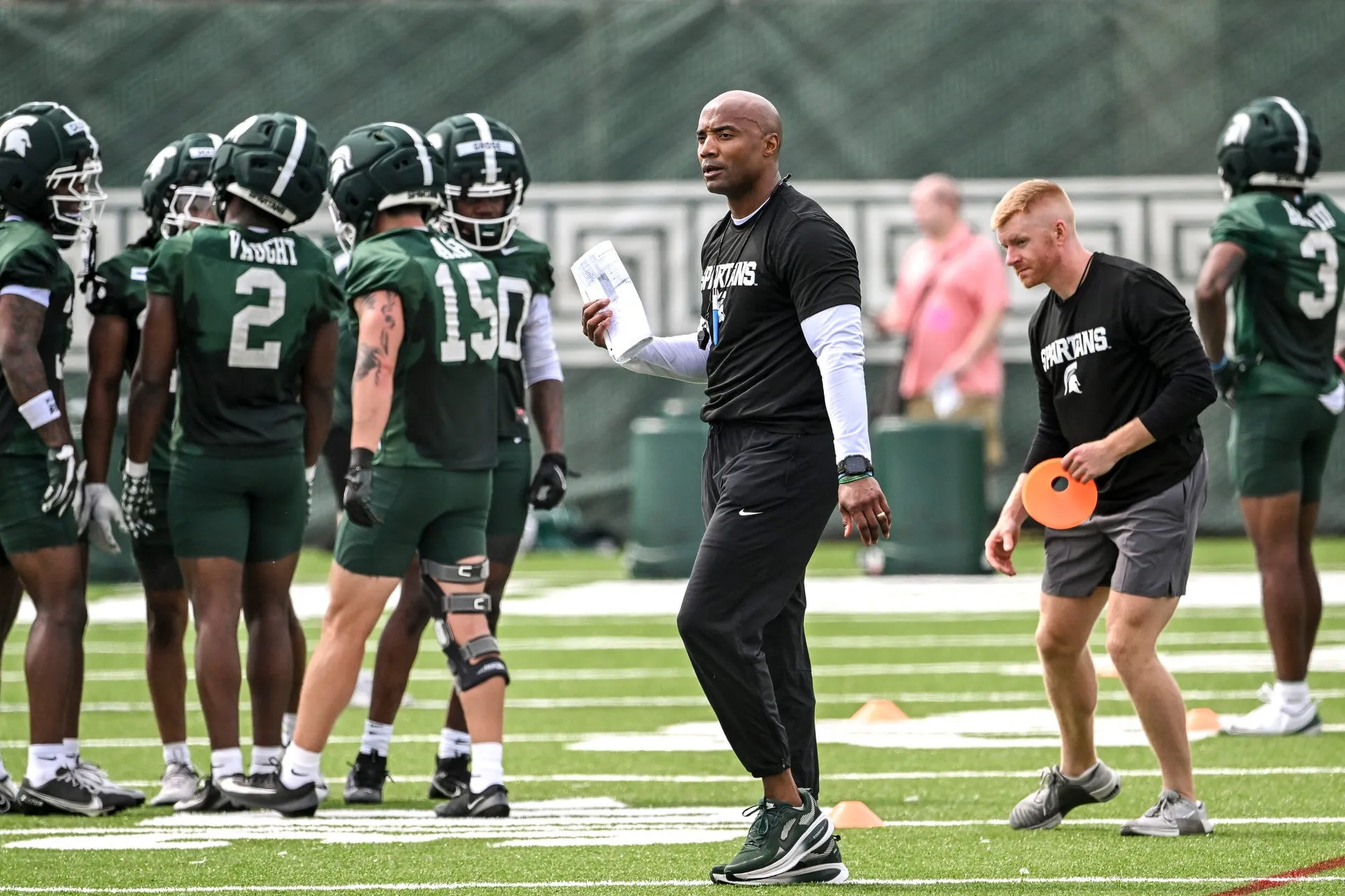
James Adams explained what Michigan State is looking for – and why the roles may not be as simple as they seem
Michigan State’s “dollar” may be one of the most demanding positions in Joe Rossi’s defense.
The player has to cover receivers like a cornerback, help stop the run like a safety, rush the quarterback, drop into deeper coverage, and understand enough of the defense to adjust when an offense changes its look before the snap.
Michigan State safeties coach James Adams has a simpler description.
A “Swiss Army knife.”
“You want a guy that in the back end can blitz, he can play deep coverage, he can play man coverage,” Adams said.
And Adams would prefer to have more than one.
Understanding what Michigan State is trying to build in its secondary first requires understanding some of the terminology.
A cornerback usually lines up across from one of the offense’s wide receivers, often near the sideline. His primary job is to keep that receiver from getting open and catching the football.
A free safety generally lines up farther away from the line of scrimmage, often toward the middle of the field. He serves as one of the defense’s last lines of protection, helping defend deep passes and coming forward to make tackles when necessary.
A strong safety traditionally plays somewhat closer to the line of scrimmage. He still has pass-coverage responsibilities, but he is often more involved in stopping the run, covering tight ends, and operating closer to the football.
Then there is the nickel.
When an offense puts another receiver on the field, a defense will often replace a linebacker with a fifth defensive back. That player is commonly called the nickel and frequently lines up across from the receiver positioned between the outside receiver and the offensive line – an area known as the slot.
Michigan State calls its version of that job the dollar.
And Adams wants the players working there to do considerably more than simply cover the slot receiver.
Players cross-training at corner and nickel receive man and zone coverage instruction on the outside, then bring those skills inside, where Adams said they also learn run fits, blitz responsibilities, and deeper coverage assignments.
“In our defense, that position’s a dollar sign,” Adams said. “Those guys that we are repping in that position … have really taken on that responsibility to be the X factor, the guy to make a lot of plays in that position.”
That versatility is becoming one of the defining characteristics of Michigan State’s secondary.
Why the labels are starting to blur
Adams’ room includes nickels, free safeties, and strong safeties.
The Spartans do not necessarily want three entirely separate groups of players.
“There are several guys that can play all three,” Adams said. “And we feel really good about them going in the game and being able to execute at a high level.”
Others are cross-training between cornerback and nickel.
That gives Michigan State depth, but there is a larger purpose.
Before every play, an opposing quarterback is trying to determine what the defense is about to do.
Where are the safeties? Which defenders are responsible for which receivers? Who might blitz? Which areas of the field could be vulnerable?
The more predictable a defender’s location and responsibility, the more information the offense has.
Michigan State wants to take some of that information away.
A defensive back who can cover a receiver, blitz, defend the run, or rotate into deeper coverage does not necessarily reveal his assignment simply by where he lines up.
If several players can do those things, the possibilities multiply.
That is what Adams was getting at with one of the more colorful analogies of his Wednesday media session.