

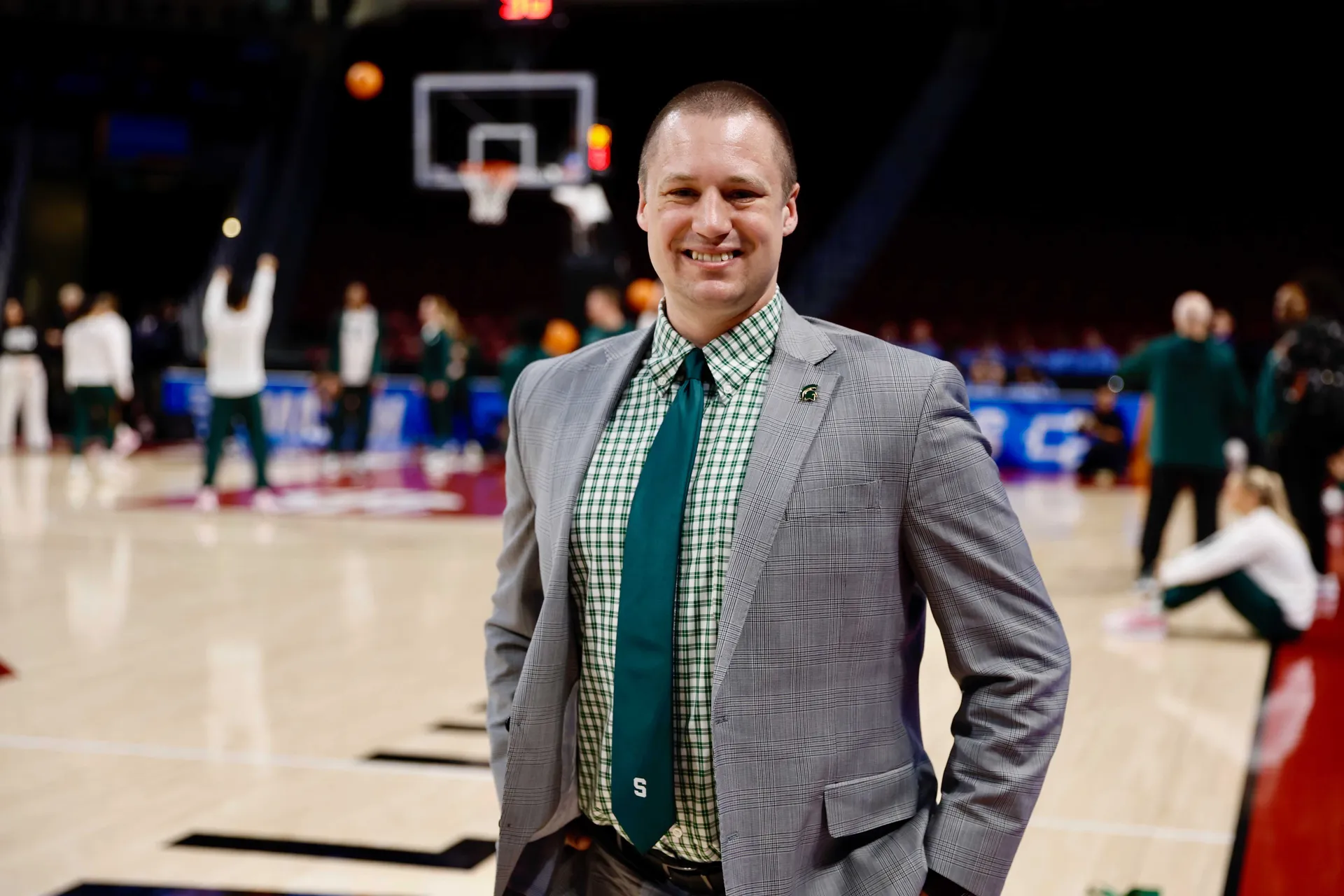
FEATURE: From cassette tapes to Spartan Stadium, Dalton Shetler has spent his life preparing to be heard
Long before his calls reached Michigan State fans across the country, Shetler discovered that a broadcaster could preserve a moment, connect a community, and make listeners feel as though they were there
The first broadcast was never supposed to leave the gym.
Dalton Shetler was a freshman at Eastside High School in Butler, Indiana, sitting in the bleachers with a few junior varsity teammates while the varsity basketball team played. The boys began entertaining themselves by calling the game, imitating the voices they knew from television and video games, particularly Kevin Harlan’s calls from NBA 2K.
Frank Hudson, the father of Eastside’s varsity basketball coach, was sitting nearby. Eventually, he turned around.
“Do you enjoy doing that?” Hudson asked.
Honestly, Shetler did not know. He and his friends were only messing around.
Hudson returned for the next game carrying a cassette recorder and a pair of headphones.
“Try calling the game,” he said.
Shetler did, beginning a journey that would take him from a tiny Indiana community to the Michigan State radio booth, where he has become the voice of Spartan women’s basketball, called Michigan State football games, and emerged as one of the most recognizable voices on the Spartan Radio Network.
The cassette tapes taught Shetler that a voice could preserve a moment, carry a team beyond the walls of its gym, and connect people to something they loved - and he has spent the rest of his life trying to do exactly that.
“I want you to feel like you’re at the game,” Shetler said. “Feel the energy, feel everything about it. I want that to come through the radio.”
That philosophy began taking shape during Eastside’s 2009-10 basketball season, one of the most successful in school history. Shetler kept recording the games, but Hudson’s initial encouragement soon became something more structured.
Hudson’s wife, Nancy, listened to each recording and sent Shetler as many as two pages of feedback afterward. She identified areas for improvement, offered constructive criticism, and pointed toward established broadcasters such as Clark Kellogg as examples he could study.
While Frank Hudson had placed the recorder in Shetler’s hands, it was Nancy Hudson who began teaching him how to use it.
The games were never carried by a radio station, but the recordings developed an audience anyway. Copies were burned onto CDs and distributed to players and families throughout the community.
“That was one of the first points where I noticed how much this profession - or this practice - can reach to so many different people,” Shetler said. “Everybody was very excited to get a copy of that. That’s where I realized, when you’re a voice of a team, you connect with a lot of people in a pretty unique way.”
The discovery felt natural for a boy who had spent much of his childhood narrating sports, even when the competition existed only in his imagination.
Shetler grew up in Spencerville, Indiana, a community of only a few hundred people. His family lived on 40 acres, and sports filled his childhood. He played football, basketball, and baseball, watched the stars on television, and absorbed the voices bringing the games into his home.
There was Don Fischer calling Indiana basketball and Jack Nolan behind the microphone for Notre Dame. Nationally, Mike Tirico became an early influence because of his versatility and ability to make almost any sport or event understandable and comfortable for the audience.
In more recent years, Shetler has studied Detroit Lions broadcaster Dan Miller, whose high-energy delivery resembles the enthusiasm Shetler naturally brings to his own work. He has also found qualities to appreciate in broadcasters such as Joe Tessitore.
Shetler has never viewed finding his voice as the moment when he stopped listening to everyone else. He continues studying them, borrowing ideas, and considering different approaches without attempting to become an imitation of any one of them.
He is comfortable sounding like himself.
“I’m just authentically me,” Shetler said. “I’m comfortable in me and what I’m trying to do on a broadcast, what my style is, what my delivery is. But I’m never going to stop learning from all the greats in our profession.”
Even before Shetler knew those names, however, he was creating his own sports productions.
He and his friends sometimes ran football routes in the backyard against imaginary opponents. They would beat the “ghosts” by 100 points, retreat to the living room, turn an ottoman into a podium, and hold their own postgame news conferences.
The competitiveness was real, even when the opposition was not.
By high school, Shetler recognized that his physical gifts would take him only so far. He dropped football and baseball and committed himself year-round to becoming the best basketball player he could be. His competitiveness occasionally needed to be restrained, as it was after his mother caught him berating others over their performance in a backyard wiffleball game.
Her intervention stayed with him.
“I kind of stepped back, and I was like, ‘Yeah, there aren’t newspaper articles written about this wiffleball game, huh?’” Shetler said. “This isn’t that big of a deal. We are supposed to be kind of having fun.”
Shetler never lost the desire to win, but he learned to direct it inward.
His stepfather, Brian Kinner, helped cultivate that pursuit of excellence after entering Shetler’s life when he was 10. Kinner had served in the Marine Corps and won a top gun award for tanks. He admired teams such as the New York Yankees because he was drawn to organizations that represented sustained excellence.
“As he says, the Marines are the best of the best,” Shetler said. “That’s always how he kind of lived his life. Trying to be the best of the best and the absolute best I can be, a lot of that came from him.”
Shetler carried that drive to Goshen College, where he walked onto the basketball team. His playing career produced more opportunities to attempt late-game half-court shots than to become a central figure in the rotation, but Goshen gave him something far more consequential: opportunities behind a microphone.
He completed college in three years and estimates he worked approximately 300 broadcasts during that time. He studied under professor and mentor Jason Samuel, gained experience through internships, and helped Goshen earn national recognition for its broadcasting program.
During Shetler’s junior and final year, New York Knicks owner and Madison Square Garden executive James Dolan helped Goshen students travel to New York for national collegiate broadcasting awards. Shetler interviewed Dolan, and Goshen returned with multiple honors. Its station has been named the country’s best college radio station while competing against much larger institutions.
Shetler had once approached one of his professors with a straightforward proposition.
“I will give you every bit of me,” he said. “I’ll pour every ounce of what I’ve got. Can you get me to ESPN?”
Samuel encouraged him to reconsider the destination.
“Forget ESPN,” he told Shetler. “You should try to be the voice of a team.”
Shetler did not immediately understand why. Then he began accepting assignments that allowed him to remain with the same teams throughout a season.
He got to know the coaches and players. He became invested in their development and success. He met the same supporters at coaches shows and other events, slowly becoming part of the community surrounding a program.
“That was the epiphany I had,” Shetler said. “Being the voice of a team was my ultimate pinnacle. That was the dream job, the dream goal for me.”
His work also confirmed that he could create the experience he had imagined as a high school freshman.
During college, a group of game officials listened to one of Shetler’s broadcasts while driving. They later told him that hearing it made them feel as though they were inside the arena.
Shetler still considers that one of the greatest compliments he has received.
To him, sports carries a form of energy that few other experiences can reproduce. It can manufacture an adrenaline rush, send a crowd through the roof, and expose athletes and fans to the lowest moments of disappointment, sometimes within seconds of one another.
A broadcaster’s job is to capture those emotions without manufacturing them.
“Sports is this one opportunity that gives you an adrenaline rush and energy unlike anything else that we have,” Shetler said. “How do we capture that energy? What are those feelings, the ‘oh my gosh’ moments, the through-the-roof excitement moments, even the low of lows? How do we get those feelings communicated and captured to the fans and the listeners?”
After graduating, Shetler began working for the Regional Radio Sports Network in Mishawaka, Indiana, under another mentor, Paul Condry. The network primarily covered high school sports and smaller college programs.
Three months after finishing college, Shetler traveled to Chicago to cover the 2016 Big Ten Football Media Days. While setting up a camera on a television platform, he encountered Wendy Hart, then a vice president with the Spartan Sports Network and the wife of longtime Michigan State basketball voice Will Tieman.
An equipment problem gave them time to introduce themselves and talk. Once the news conferences began, Shetler approached the microphone and asked Indiana coach Kevin Wilson a question.
When he returned, Hart told him it was a good question.
Shetler later asked Ohio State coach Urban Meyer another. Hart complimented him again.
An ambitious young broadcaster might have handed her a business card. Shetler did not. He returned to Indiana and resumed working.
Hart went searching for him.
Because reporters had to identify themselves and their organizations before asking questions, Hart listened to the news conference recording, recovered Shetler’s name and employer, found the network’s telephone number, and called his workplace.
The Spartan Sports Network needed a host for Michigan State men’s basketball. Hart invited Shetler to interview.
“The way I see it, I worked my tail off through college and tried to be the best I could possibly be, and God opened a door with that interaction,” Shetler said. “I was ready to step through that door.”
Shetler had no family connection to Michigan State, no professional network waiting to receive him, and no obvious path from Spencerville to East Lansing.
Still, Michigan State was not entirely unfamiliar.
Kinner, his stepfather, admired excellence wherever he found it. Tom Izzo’s demanding coaching style, sustained success, and appreciation for the military made him one of the figures Kenner respected most.
Kinner coached Shetler in basketball, attended clinics led by Izzo, and once returned home with portions of Michigan State’s playbook for his stepson to study.
Years later, Kinner drove Shetler to East Lansing for his interview with the Spartan Sports Network.
Before they left, the two walked through the Breslin Center together, looking around in awe.
“We just walked all around the Breslin in awe that we had made it there,” Shetler said.
He had not made it yet, at least in the professional sense. He still had to interview, earn the job, and prove that a 21-year-old from a family with no broadcasting background belonged at Michigan State.
But, in a profession where the hardest part is getting the invite to try, the playbook he once studied had led him to the building where it had been written.
Shetler was hired by Michigan State and arrived in September 2016. He hosted pregame, halftime, and postgame programming for men’s basketball, conducted locker-room interviews, wrote daily programming, and contributed to football broadcasts. He later became the lead producer and host of the network’s morning show.
His first live appearance came from Hawaii on Nov. 11, 2016, before Michigan State played Arizona in the Armed Forces Classic.
Shetler was 21 years old. Barely a year removed from college, he had traveled to Honolulu and was being paid to talk about Big Ten basketball.
“I remember taking that trip and looking around, and you talk about pinch-me moments,” he said. “I’m getting paid to be in Hawaii. I mean, just a year ago, I was in college doing whatever. Now I’m being paid to talk basketball in Hawaii.”
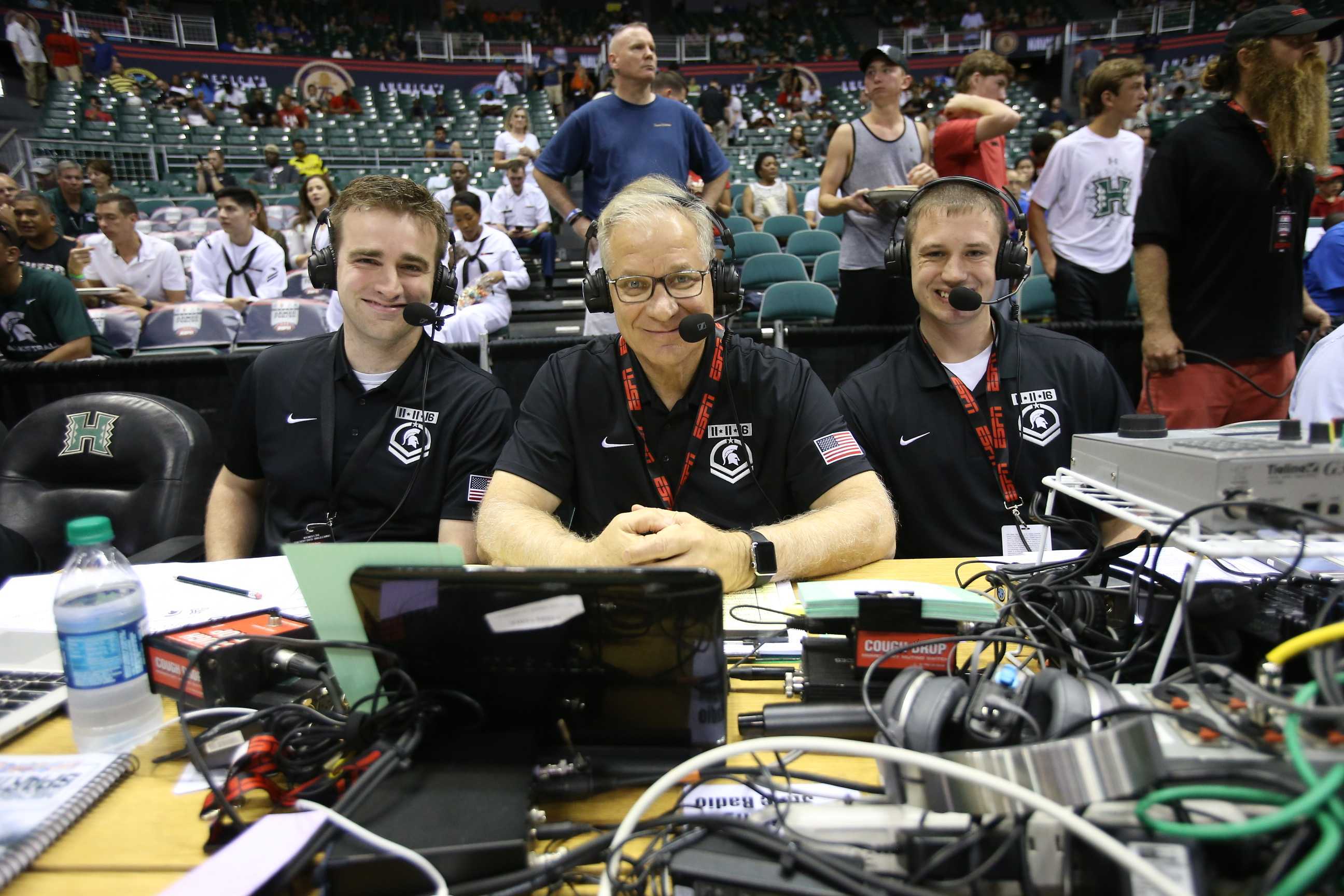
A young Dalton Shetler at his first ever MSU broadcast, in Hawaii at the Armed Forces Classic, on the right, next to Kevin Pauga (left) and Will Tieman (center). (Courtesy photo)
He knew how he wanted to greet the audience back home. He would begin with “aloha.”
Then the broadcast began.
The nerves of a 21-year-old making his Spartan Radio Network debut took over, and Shetler welcomed the audience with a verbal typo - “alo-hi” - instead.
It was an imperfect opening, but Shetler recovered, continued, and began turning an opportunity he could scarcely believe he had received into a place where he belonged.
Michigan State was also becoming far more than his employer.
Shetler had met his future wife - Madison Willard - at Eastside High School, despite the two athletes initially moving in different social circles inside a school of roughly 90 students per class. She played volleyball, basketball, and softball, while her father served as the school’s athletic director and coached softball.

Shetler on the right with his girlfriend at the time (now wife), Madison (Willard) Shetler, at their high school prom. (Courtesy photo)
They remained together while attending separate colleges – Dalton at Goshen and Madison studying accounting at Ball State – and continued their relationship across the distance.
On Jan. 29, 2017, less than five months after Shetler joined the Spartan Radio Network, Michigan State defeated Michigan, 70-62, at Breslin Center.
After the rivalry victory, Shetler brought Madison onto the court at midcourt. Through the arena’s public-address system came George Strait’s “Check Yes or No,” a song about two people falling in love as children and remaining together through the years.
Then Shetler proposed.
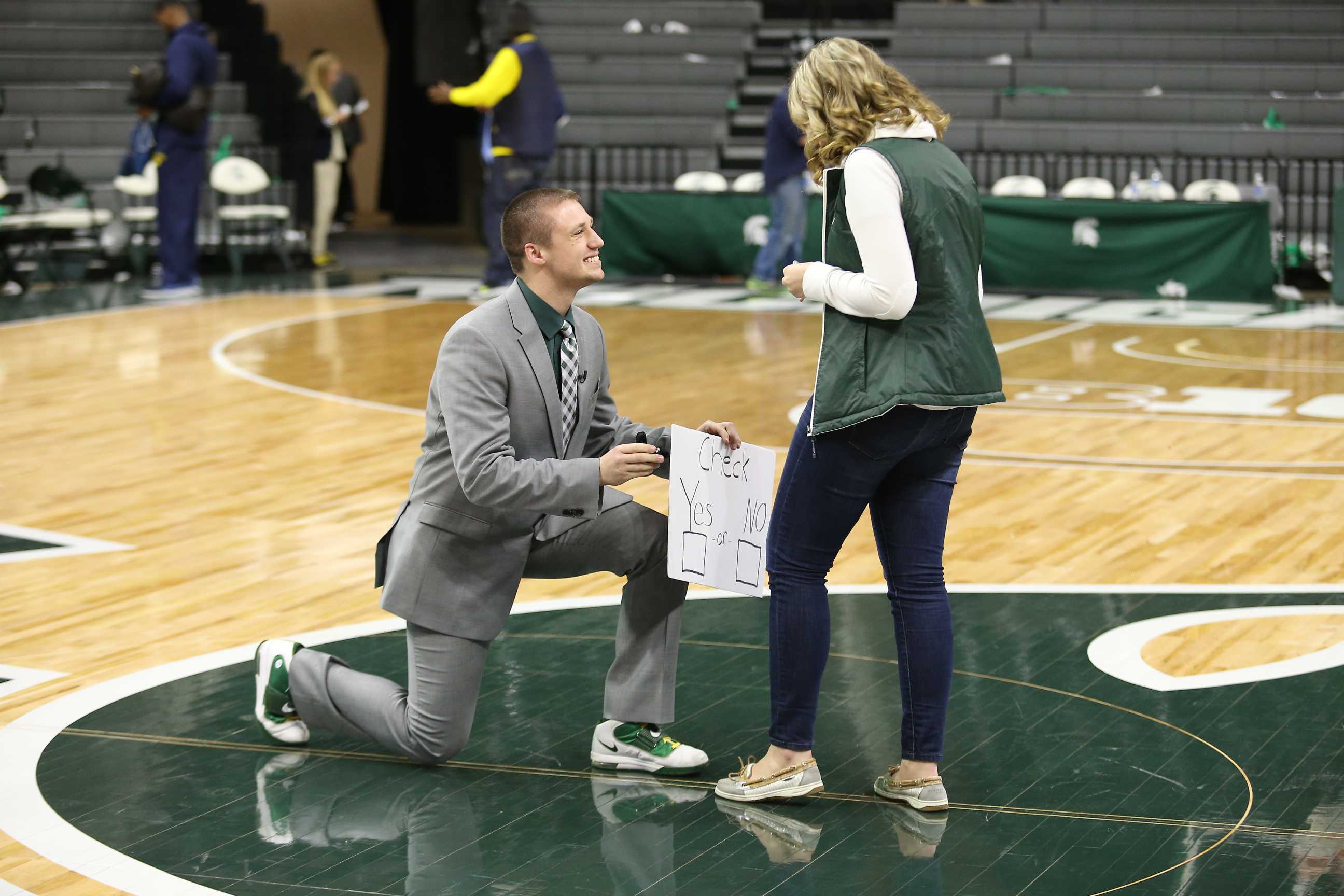
(Courtesy photo)
The Breslin Center had given him his first major professional opportunity. Before he completed his first basketball season at Michigan State, it also became part of his family’s story.
They have now been married eight years, and their son, Marshall, is approaching his first birthday.
Shetler warned his wife when they were young that broadcasting would demand nights, weekends, travel, and substantial portions of his time and energy. He asked whether she was prepared to pursue the dream with him.
She said yes again.
“I don’t know if I could say enough about the sacrifice that (Madison) has made,” Shetler said. “She’s always been supportive of me and this dream. She really is a rock star. None of this would be possible without her.”
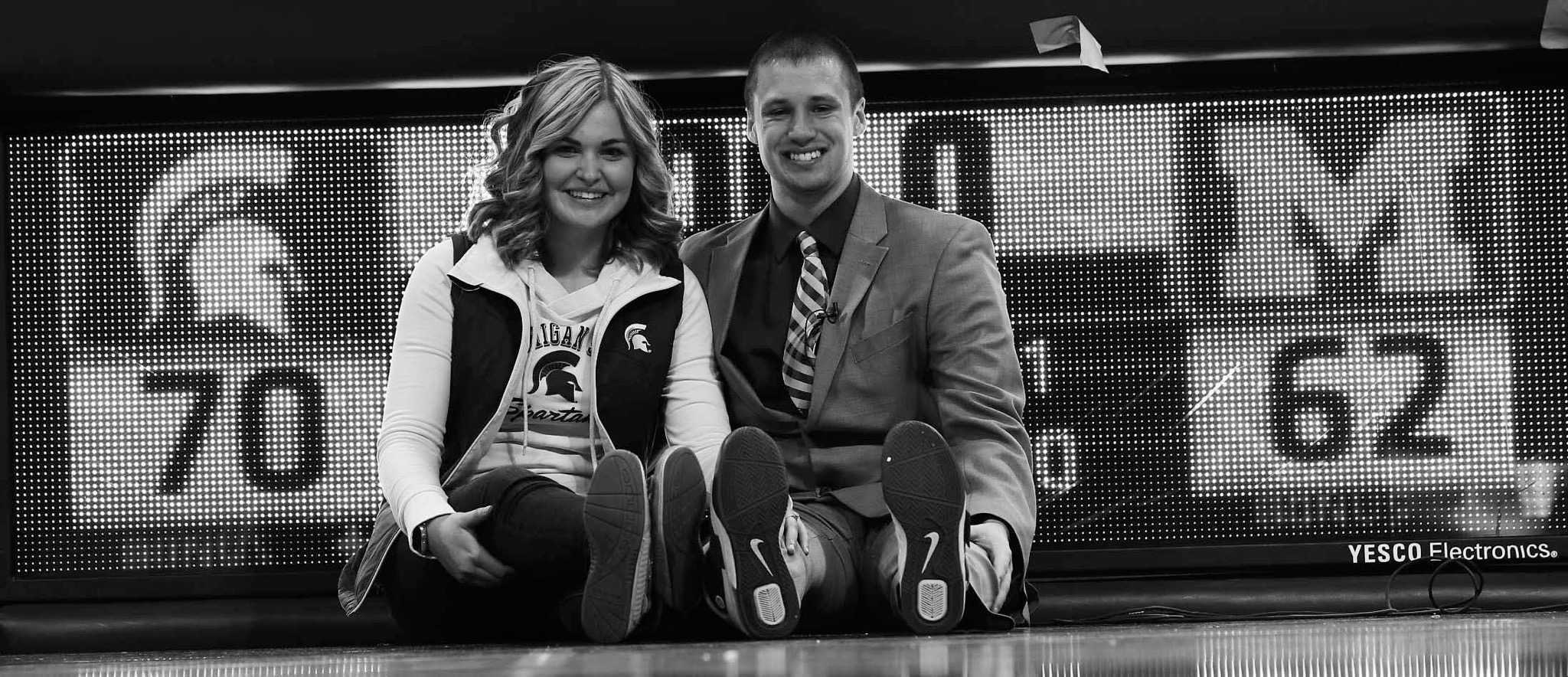
(Courtesy photo)
Shetler’s professional relationship with Michigan State also began to deepen.
A year or two after his arrival, a possible scheduling conflict threatened to place Tieman’s football responsibilities opposite a men’s basketball assignment. Network leaders were trying to determine which event Tieman should cover.
They told Shetler to be ready.
The conflict never produced the opportunity, but the conversation revealed something important. Michigan State believed Shetler might be capable of stepping into a Big Ten play-by-play role if needed.
“That’s where I really first felt, even though it didn’t come to fruition for me in that exact moment, ‘Oh, they must trust me to want to give me an opportunity like that,’” Shetler said.
He responded the way he always had. He kept his head down, continued working, and prepared for the next opening.
When longtime women’s basketball broadcaster Keaton Gillogly departed Michigan State to become the voice of Montana State football and men’s basketball, Shetler wanted the job.
He interviewed with Spartan Sports Network general manager Otis Wiley and then-Michigan State coach Suzy Merchant. The network had already reviewed résumés and listened to applicants’ work. By the time Shetler left the meeting, he believed a consensus had formed.
He was going to become the voice of Michigan State women’s basketball.
Shetler sat in his car and became overwhelmed.
“I love the game of basketball so much,” he said. “That’s where I realized I could do play-by-play at the Big Ten level for a basketball program on a giant stage like this. That was one of those dream-come-true moments for me.”
During the interview, Merchant asked Shetler about his catchphrase.
He did not have one.
Shetler experimented with different words until a listener named Carole attended a coaches show after a Michigan State victory. She told him she especially enjoyed the way he called made baskets with “Ring it up.”
The phrase gave her goosebumps. It made her feel something.
Shetler had found his call because a listener told him which one brought her closer to the game.
That exchange reflected the underlying purpose of his work. Shetler views himself as a conduit between a program and the people who care about it. His relationships with coaches and players help him understand what Michigan State is trying to accomplish, while his responsibility to the audience requires him to describe honestly what is happening.
The access allows him to explain the intention behind the performance.
“When somebody is willing to give you their emotions, their time, their thoughts, to put those together in a way that actually represents them, I think there’s a giant responsibility in that,” Shetler said. “I feel a giant responsibility to Michigan State fans to be able to get to know those stories, those thoughts, those feelings of the players that they root on and allow them to be a little bit closer to those players.”
The importance of those relationships is among the greatest lessons Shetler has learned from Hart and Tieman.
Under their leadership, the network prioritized relationships with its affiliates, business partners, teams, and audience. Michigan State reinforced the same lesson.
Shetler had heard people use the phrase “Spartan family” before he arrived in East Lansing. Every school describes itself as a family. Within weeks, however, he began to understand why Michigan State might be different. During events such as Grind Week, former players returned from professional careers and lives around the country to reconnect with the program and one another.
The relationships endured because people continued investing in them.
“The biggest thing I’ve learned here is relationships matter the most,” Shetler said. “Everybody says their family is different, but it took maybe a couple of weeks before I realized, ‘Oh, no.’ The family culture at Michigan State is different, legitimately, than anywhere else I’ve ever covered or experienced.”
The enthusiasm listeners hear from Shetler is genuine, but the spontaneity is supported by meticulous preparation.
He evaluates his broadcasts, searches for repeated words, and studies moments he believes he could have handled differently. For basketball games, he creates word-bank cards containing different verbs for passing, dribbling, driving, making shots, and missing them. The cards give him options when the speed and emotion of the game threaten to narrow his vocabulary.
The same preparation helped create the defining call of his Michigan State football experience to date.
When George Blaha traveled to Springfield, Massachusetts, for his induction into the Naismith Memorial Basketball Hall of Fame, Shetler was asked to call Michigan State’s 2025 home game against Boston College.
He spent the week conducting what he described as a crash course in football preparation. On game day, the magnitude of the assignment was visible throughout East Lansing.
Fans surrounded the stadium. Tailgates filled the campus. Each scene reminded Shetler how many people cared about what would happen inside Spartan Stadium, along with how many more would depend upon him to carry it to them.
The game went into double overtime. By then, Shetler said, every play had become “the game.”
Boston College scored first in the second overtime, but Michigan State stopped the Eagles’ 2-point attempt, leaving the Spartans behind, 40-34.
Chiles answered with a 3-yard touchdown run, tying the score at 40. Michigan State then lined up for a 2-point conversion that would either win the game or send it into a third overtime.
Every element of the moment had to reach the audience: the score, the stakes, the formation, the motion, and the movement of the football.
Chiles faked the handoff, rolled to his right, and threw back across the field. Kelly caught the pass in the back left corner of the end zone.
“Oh my, Omari!”
Michigan State had won, 42-40.
The call spread across social media. To listeners, the phrase sounded born from the instant. In one sense, it was. In another, Shetler had been preparing for it all week.
One section of the game notes surrounding his spotting chart was devoted to Kelly. Shetler had written “Oh my, Omari” as its heading.
He never consulted the page during the winning play. By then, he had studied the material so thoroughly that the words were available when the moment demanded them.
“Preparation leads to the ability to execute in those moments,” Shetler said.
Shetler later called Michigan State’s game at Iowa and has handled two complete men’s basketball games, along with 3 minutes and 49 seconds of another. Each opportunity has expanded the audience familiar with his work and encouraged speculation about what his future might eventually hold.
When told that some people consider him an heir apparent to Blaha, Shetler did not treat the suggestion as an expectation.
He thought about Blaha’s nearly five decades calling Michigan State football, his 50 years as the voice of the Detroit Pistons, and the place his voice occupies within the history of Michigan sports.
“To even just be in the same breath as somebody like George Blaha, he’s woven into the culture of the state of Michigan and sports in the Mitten State,” Shetler replied to the suggestion. “I don’t take any of that lightly. That is something that really overwhelms me and seriously humbles me when I hear that.”
Shetler has never tried to chart his future by predicting when another chair might become available. He has concentrated on the one entrusted to him, believing that excellent work will prepare him for whatever opportunity arrives next.
That philosophy has guided him from Eastside High School to Goshen College, from a small regional network in Indiana to the Breslin Center and Spartan Stadium. Yet when Shetler considers how far he has traveled, his thoughts do not remain in the broadcast booth for long.
They return to the bleachers at Eastside High School.
They return to the freshman who had been handed a cassette recorder and a pair of headphones, but had no way of knowing at the time that his voice would travel beyond that small Indiana gym.
Frank Hudson gave him the recorder. Nancy Hudson taught him how to improve. Jason Samuel helped him understand that his dream could be bigger than reaching ESPN. Paul Condry gave him opportunities, Wendy Hart went searching for him, and Michigan State eventually trusted him with its teams and its most important moments.
Before all of them, however, there was his mother.
Shetler was an only child. He would become the first person in his family to graduate from college and the first to enter broadcasting, but there was no roadmap showing him how to do either. There were periods when his mother worked three jobs at once, pouring everything she had into giving her son opportunities she could not guarantee would lead anywhere.
She could not know that the boy who talked constantly would someday make a living with his voice. She could not know that the child conducting postgame news conferences behind an ottoman would eventually describe victories from inside Spartan Stadium. She could not know that the cassette recorder in the high school bleachers would lead him to Big Ten basketball, viral football calls, and a place within the Michigan State family.
She only knew her son needed a chance.
So she did what it took to give him one.
When Shetler eventually decided to pursue broadcasting, his mother recognized the logic immediately.
“He’s always talked and never would shut up,” she said, “so thank God he found something that actually worked for that.”
The line is funny, but its deeper meaning has become clearer since Shetler became a father himself.
He now understands more fully what it means to invest yourself in a child’s future without knowing where that investment will lead. He understands the nights, the exhaustion, and the decision to continue giving when there is no promise that the dream will come true.
His mother worked the jobs. She carried the burden. She made sure her only child could keep moving toward whatever future his abilities, effort, and faith might allow him to reach.
He reached the microphone.
His voice has now carried Michigan State victories across the state and beyond. Fans know when Shetler implores the Spartans to “Ring it up.” They replayed “Oh my, Omari” after Michigan State’s double-overtime victory over Boston College. Some have begun imagining how his voice might become part of the program’s future.
Ask Shetler what the freshman in the bleachers would think about the man behind the Michigan State microphone, however, and the broadcaster who makes his living finding words for emotional moments suddenly struggles to find them.
“That one almost gets me a little emotional,” he said.
Then he paused for a bit longer than normal.
“He wouldn’t believe it," Shetler said, finally finding the words. "I don’t think there’s any way he would believe it.”
Shetler thought about being the first in his family to graduate from college. He thought about entering a profession in which he had no family connections and building a career that had never been laid out for someone like him.
Then he thought about his mother.
“My mom sacrificed everything,” Shetler said. “Doing so much, just pouring everything into me to give me a shot.”
His voice began to break.
“To think I’ve made something of that shot and what my mom must feel,” he said, “that brings me a lot of joy.”
The young man in the Eastside bleachers needed someone to recognize something in his voice. He needed another someone to listen to the tapes and teach him how to make the next one better. He would eventually need mentors who challenged him, broadcasters who trusted him, and a wife who embraced the sacrifices required by his dream.
But before the cassette tape could turn into a career, Dalton Shetler needed a mother willing to do whatever it took to help her son reach the microphone.
She was.
And he did.