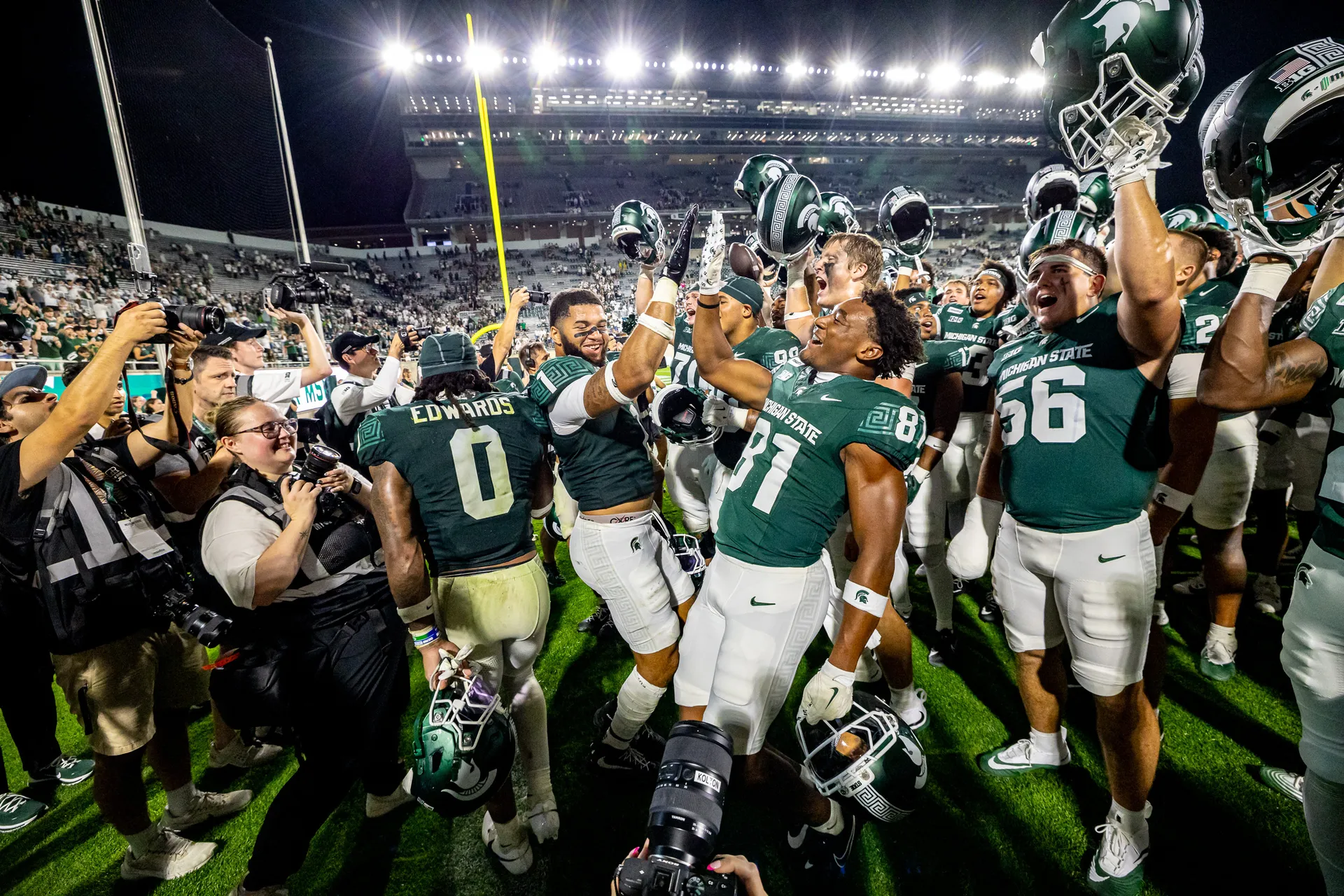
I joined Matt Sheehan on the latest episode of Locked On Spartans (watch the entire episode below) to take a deeper look at Michigan State’s season-opening victory over Toledo.
Matt entered our conversation increasingly concerned about the Spartans’ red-zone offense. Michigan State ran 14 plays inside Toledo’s 20-yard line, including nine runs and five passes. Excluding Cam Edwards’ 2-yard touchdown, five of the Spartans’ eight other rushing attempts gained 2 yards or fewer.
One way that analysts measure whether an offense remains on schedule rather than simply counting total yards is by looking at their success rate. When looking at this stat, a first-down play is successful if it gains at least 50% of the yards needed for another first down, while a second-down play must gain at least 70%. On third or fourth down, the offense must convert. By that measure, only three of Michigan State’s 14 red-zone plays were successful against Toledo. Sheehan noted that MSU's resulting 21.4% success rate was roughly half last season’s national red-zone average of approximately 42%.
Those numbers are not particularly encouraging, but I am not prepared to sound the alarm after one game. The Spartans did enough positive things inside the red zone to suggest their problems are correctable, particularly as offensive coordinator Nick Sheridan reveals more of his playbook.
The larger question is whether the offensive line can give Sheridan conventional answers when Michigan State needs only a yard or two.
Milivojevic protected scoring opportunities
Alessio Milivojevic’s performance provided one of the strongest reasons for optimism.
His placement on a potential touchdown pass to Rodney Bullard Jr. was excellent, even though Bullard could not complete the catch. On that play and several throws toward the sideline, Milivojevic put the ball where either his receiver would catch it or nobody would.
That quality is especially valuable near the goal line, where a turnover can erase an entire drive. Milivojevic did not try to manufacture plays that were unavailable. When Toledo conceded a short completion, he took it. When a throw needed to be placed near the boundary, he kept it away from danger.
If a quarterback consistently protects the football and Michigan State has a reliable kicker in Liam Boyd, the Spartans will give themselves opportunities to win games.
An old football maxim told to me by my high school coach (as I was mostly watching from the bench) says that if every possession ends with a kick – a punt, field goal, or extra point – a team will win quite a few games. That is not necessarily a formula for an explosive offense, but it can be a path toward meaningful improvement because you have effectively eliminated turnovers.
This Michigan State team is not presently being measured by prognosticators against the College Football Playoff field or the top of the Big Ten. The immediate question is whether they can turn some of the close losses of recent seasons into victories and reach six or seven wins.
Within that framework, Friday’s red-zone performance was imperfect, but hardly catastrophic.
Edwards created yards that were not always available
Edwards also provided reasons for encouragement.
His touchdown was largely an individual effort. He made one defender miss, absorbed a glancing blow from another, and powered through a third.
Some of his best runs elsewhere in the game came when the original design broke down. Michigan State might block a play in one direction, only for Edwards to recognize a cutback lane, reverse course, and create 12 or 15 yards beyond what initially appeared available.
That ability is valuable, although the Spartans would prefer not to depend upon Edwards to rescue so many plays.
The offensive line remains a concern. Michigan State struggled to consistently create movement in the red zone and between the 20s. Conner Moore was beaten across his face a couple of times , and left tackle Ben Murawski also had some difficult snaps before leaving the game. Nick Sharpe generally appeared to understand his assignments but was driven backward into the backfield more frequently than Michigan State would want.
It will be worth following Toledo’s defensive front as the season progresses. The Rockets may have several legitimate players who will create similar problems for other opponents. If they do, Michigan State’s performance against them will become more understandable.
If they do not, the offensive line could remain a significant limitation.
The short-yardage approach offered an important clue
Matt asked whether Michigan State intends to use the Wildcat throughout the season or whether it was simply a Week 1 wrinkle...