

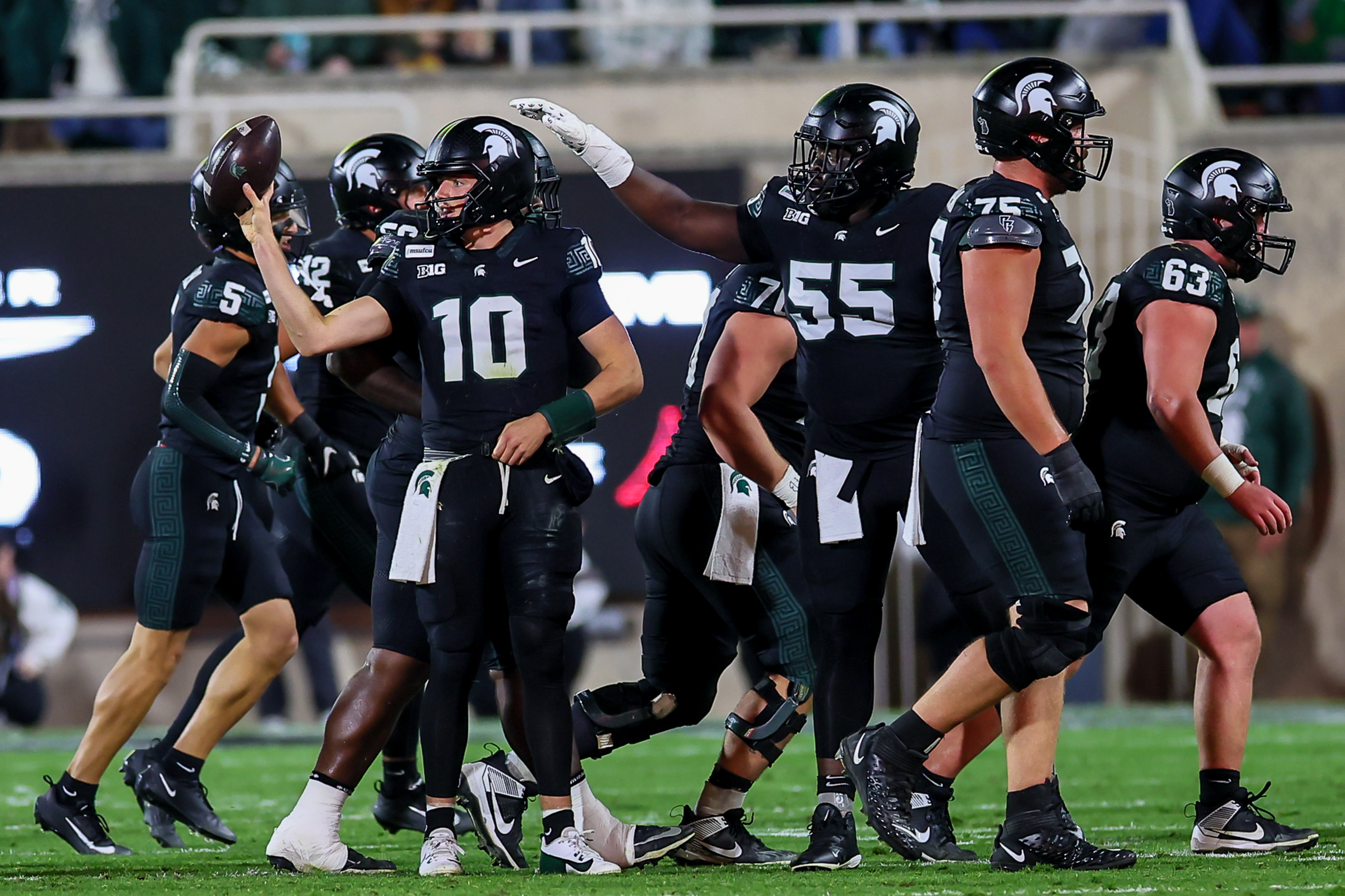
Michigan State has one game left to find an offensive performance that has been missing for much of Pat Fitzgerald’s first season, and the Spartans will try to do it with another unsettled quarterback situation.
Alessio Milivojevic is out for Saturday’s finale at Rutgers, while Cam Fancher is listed as questionable on Friday’s Big Ten availability report. Freshman Kayd Coffman could be in line for his third career start and second in a row.
Rutgers has significant questions of its own. Quarterback AJ Surace and running back Antwan Raymond, the Big Ten’s leading rusher, are both questionable after helping the Scarlet Knights rally for a 25–24 victory at Penn State last Saturday.
Both teams enter the finale at 3–8. Michigan State is 1–7 in Big Ten play, while Rutgers is 2–6. Saturday’s game at SHI Stadium in Piscataway, New Jersey, is scheduled for 4:15 p.m. ET on Big Ten Network, with kickoff listed at 4:16.
For Michigan State, the finale carries two purposes: giving its seniors a winning sendoff and giving its returning players something to carry into the offseason.
“As I talked to the guys earlier in the week in our team meeting, it’s finish and foundation,” Fitzgerald said during his Wednesday radio show.
For most seniors, Saturday will be their final football game. Fitzgerald wants the Spartans to approach that opportunity with an appreciation for what those players have contributed and what a victory could provide the team coming back.
“This group of seniors have done a great job laying that foundation, and there’s nothing better to springboard the offseason than a win in the last game,” Fitzgerald said.
Coffman could get another start
Delivering that finish will require more production from an offense averaging 17.7 points and 288.3 yards per game.
Coffman completed 10 of 19 passes for 106 yards and an interception in Michigan State’s 45–7 loss to Oregon last Friday. The Spartans finished with 205 yards, leaving promising first-half possessions unrewarded before the Ducks pulled away.
A 13-play, 57-yard possession ended with a missed 46-yard field goal. Michigan State’s defense kept the game within reach for much of the first half, but Oregon finished an 85-yard drive with a touchdown on a fake field goal with two seconds remaining before halftime.
The Spartans went into the locker room trailing 17–0 and did not score until their first possession of the third quarter, when Jaziun Patterson capped a 13-play, 67-yard drive with a 1-yard touchdown run.
Michigan State needs more of those sustained possessions to produce points Saturday, whether Coffman makes another start or Fancher is available to return. Fancher completed 14 of 22 passes for 134 yards and a touchdown against Washington before missing the Oregon game.
The supporting cast remains limited.
Tight end Jayden Savoury, Michigan State’s second-leading receiver, is out for a fourth consecutive game. Receiver Rodney Bullard and tight end Brennan Parachek are questionable.
Chrishon McCray leads the Spartans with 42 catches for 437 yards, but the passing game has struggled to generate consistent yardage. Michigan State averages 181.8 passing yards per game and 10.15 yards per completion.
Rutgers has allowed opponents to convert 45.2% of their third downs, giving the Spartans an opportunity to extend possessions if they can avoid the negative plays and mistakes that have repeatedly stalled drives.
An opportunity on the ground
Patterson’s return against Oregon gave Michigan State an experienced option in a backfield that has been reshuffled throughout the season.
Cam Edwards suffered a season-ending injury against Nebraska. Patterson subsequently missed three games, and Marvis Parrish has been sidelined since getting hurt on Michigan State’s opening series at UCLA. Edwards and Parrish remain out for the finale.
Patterson leads the Spartans with 353 rushing yards and six rushing touchdowns, but Michigan State averages just 106.5 rushing yards per game. Rutgers allows 187.6, making the ground game one of the clearest opportunities for improvement.
An effective rushing attack would help Michigan State manage its quarterback situation and create more favorable passing downs. Center Trent Fraley has been a consistent presence amid the changes around him, starting all 11 games and playing a team-high 713 offensive snaps.
Rutgers allows 31.5 points and 410.8 yards per game, although its defense played a substantial role in the comeback at Penn State. The Scarlet Knights held the Nittany Lions to four first downs and 114 yards after halftime, and linebacker Sean Allison finished with 12 tackles, two fourth-down stops, and a fumble recovery.
Rutgers’ comeback comes with availability questions
Raymond and Surace were central to the dramatic finish that snapped Rutgers’ four-game losing streak.
With the Scarlet Knights trailing Penn State 24–17 and six seconds remaining, Surace completed a pass to Raymond, who lateraled to Ben Black for a touchdown as time expired. Surace then found Clay Thevenin for the winning two-point conversion on the next snap.
Rutgers had trailed 16–0 in the first half before rallying for its first victory over Penn State since 1988.
Fitzgerald said the Scarlet Knights’ response to that deficit stood out, particularly the passion they showed while finishing the comeback. Matching that intensity on Rutgers’ senior day will be part of Michigan State’s challenge.
“We need to play our best game of the year and play our cleanest game. And most physical game,” Fitzgerald said.
Raymond rushed for 101 yards on 23 carries in the win. He enters the finale with 911 yards and eight touchdowns on 185 attempts, averaging 4.9 yards per carry.
His availability could substantially affect the matchup against a Michigan State defense allowing 137.8 rushing yards per game. The Spartans will be without linebackers Jordan Hall and Brady Pretzlaff, safety Devin Vaught, and cornerback Tyran Chappell. Defensive lineman Ben Roberts and safety Michael Richard are questionable.
Surace has thrown for 1,025 yards, nine touchdowns, and seven interceptions this season. If he cannot play, Rutgers has another option in Dylan Lonergan, who is listed as probable and has passed for 1,066 yards and 10 touchdowns.
The Scarlet Knights are already without injured receiver KJ Duff, whose 45 catches, 774 receiving yards, and nine touchdown receptions lead the team. Offensive lineman Kwabena Asamoah is also out, while Friday’s report moved linebacker Abram Wright from questionable to out and added defensive back Kevin Levy to the out list. Defensive back Sage Clawges and linebacker Joey Kopec improved from questionable to probable.
Finishing possessions and the season
Neither defense has consistently gotten off the field on third down. Michigan State allows a 43.3% conversion rate, while Rutgers allows 45.2%.
That makes possession-ending plays particularly significant. Rutgers won the turnover battle 2–0 at Penn State, while Michigan State finished minus-two against Oregon. For a Spartan offense averaging fewer than 18 points per game, surrendering possessions leaves little room to recover.
Michigan State leads the all-time series 10–6 and is 5–2 in Piscataway, but Rutgers has won the last two meetings. The Scarlet Knights closed the 2024 regular season with a 41–14 victory in East Lansing.
To reverse that result, Michigan State needs to establish enough of a running game to support its quarterback, limit Rutgers’ offense, and turn trips into scoring range into touchdowns. Those have been recurring challenges throughout Fitzgerald’s first season, and Saturday offers one final opportunity to put them together.