
INSIDER: The man who knows exactly how Pat Fitzgerald builds winning football programs
Michigan State chief of staff Jacob Schmidt spent nearly two decades watching Pat Fitzgerald transform Northwestern and is now helping recreate that blueprint in East Lansing
Jacob Schmidt knew before almost anyone else was willing to say it out loud.
He knew before the phone calls started, before the jobs opened, and before the speculation about whether Pat Fitzgerald would ever lead another college football program. The day Northwestern fired Fitzgerald, Schmidt already believed he knew how the story would eventually continue.
“The second he got fired,” Schmidt said. “That’s the truth.”
That is not the answer of a casual former player or an administrator searching for his next opportunity. It is the answer of someone who had lived inside Fitzgerald’s program, watched him lead through nearly every phase of his adult life, and believed the ending in Evanston was never going to be the end of his coaching career.
Schmidt looked at his wife that day and told her what he believed was coming.
“A couple years away from going somewhere new,” he remembered saying. “He’s going to be on the other side of a Big Ten stadium coaching a new team, and I want to be a part of it.”
Now he is.
Schmidt is Michigan State football’s chief of staff, a title that may sound vague from the outside but carries significant meaning inside a modern college football program.
He is part administrator, part organizer, part culture carrier, and part institutional memory for a head coach trying to build something familiar in a place that is new.
For Michigan State fans, Fitzgerald is the face of the new era. He is the former All-American linebacker with the neck roll, the two-time national defensive player of the year, and the longtime Northwestern head coach who arrived in East Lansing and immediately seemed to understand the emotional language of the place - toughness, family, physicality, work, and pride - because they are traits he comes to work with every day.
Schmidt may be one of the people who best understands how those words become more than slogans.
In an interview earlier this summer with Jack Ebling on The Drive with Jack, Schmidt offered a detailed look at his relationship with Fitzgerald, the rise of Northwestern football, and the work now underway at Michigan State. The full interview can be heard here.
Schmidt has already seen Fitzgerald build, lead, and win in a place where many assumed sustained success was not possible.
Now, in East Lansing, he is helping Fitzgerald take on a different but related challenge: restoring a Michigan State program that has already proven it can compete at the highest level, but has been searching for the leadership, structure, and belief needed to return there.
That is what makes Schmidt’s story so important. He is not simply following Fitzgerald to another stop. He is bringing with him a firsthand understanding of how Fitzgerald’s blueprint works.
Schmidt’s relationship with Fitzgerald began during the recruiting process, at the intersection of a small-town dream and a Big Ten opportunity.
Schmidt grew up in Rhinelander, Wisconsin, deep in the Northwoods, closer in feel to Iron Mountain than to the metropolitan centers that often produce major college football players. He was a Wisconsin kid who had been to Camp Randall many times, grown up around Big Ten football, and dreamed of playing at that level.
He was - by his own description - a 5' 9" just-fast-enough guy from the Northwoods of Wisconsin.
That kind of player has to be honest with himself. Football may work. It may not. Schmidt wanted to use the sport to earn the best degree he could, knowing there was no guarantee his playing career would unfold the way he hoped.
Northwestern offered that opportunity.
It also offered Pat Fitzgerald.
When Schmidt visited Evanston in 2007, Fitzgerald was still new as a head coach and unusually young for the position. He was only 31 after taking over the program following Randy Walker’s death, but Schmidt saw someone who felt less like a distant executive and more like a coach close enough in age and energy to become a big brother.
“I met this really charismatic, energetic 31-year-old who I looked at,” Schmidt said, “and I was like, man, you could be my big brother.”
Schmidt sensed genuine energy around Northwestern, driven by a group of young coaches who believed they could build something lasting at a program that had experienced enough success to dream bigger, but not enough to take winning for granted.
He accepted the opportunity as a walk-on, stayed long enough to earn a scholarship, developed into a contributor, and eventually became an Academic All-American.
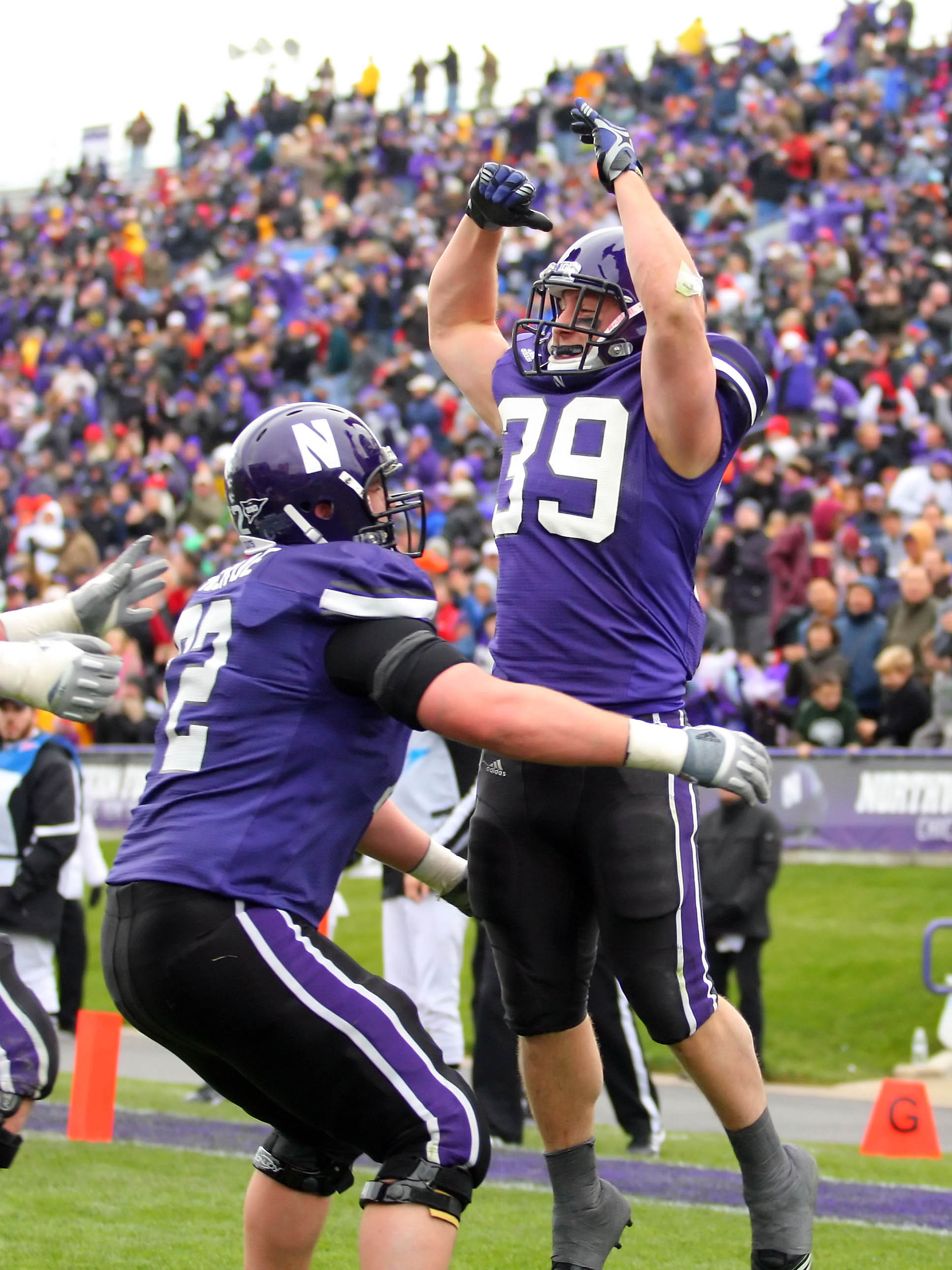
Nov 19, 2011; Northwestern Wildcats running back Jacob Schmidt (39) celebrates his touchdown in the second half at Ryan Field. Credit: Dennis Wierzbicki-USA TODAY Sports
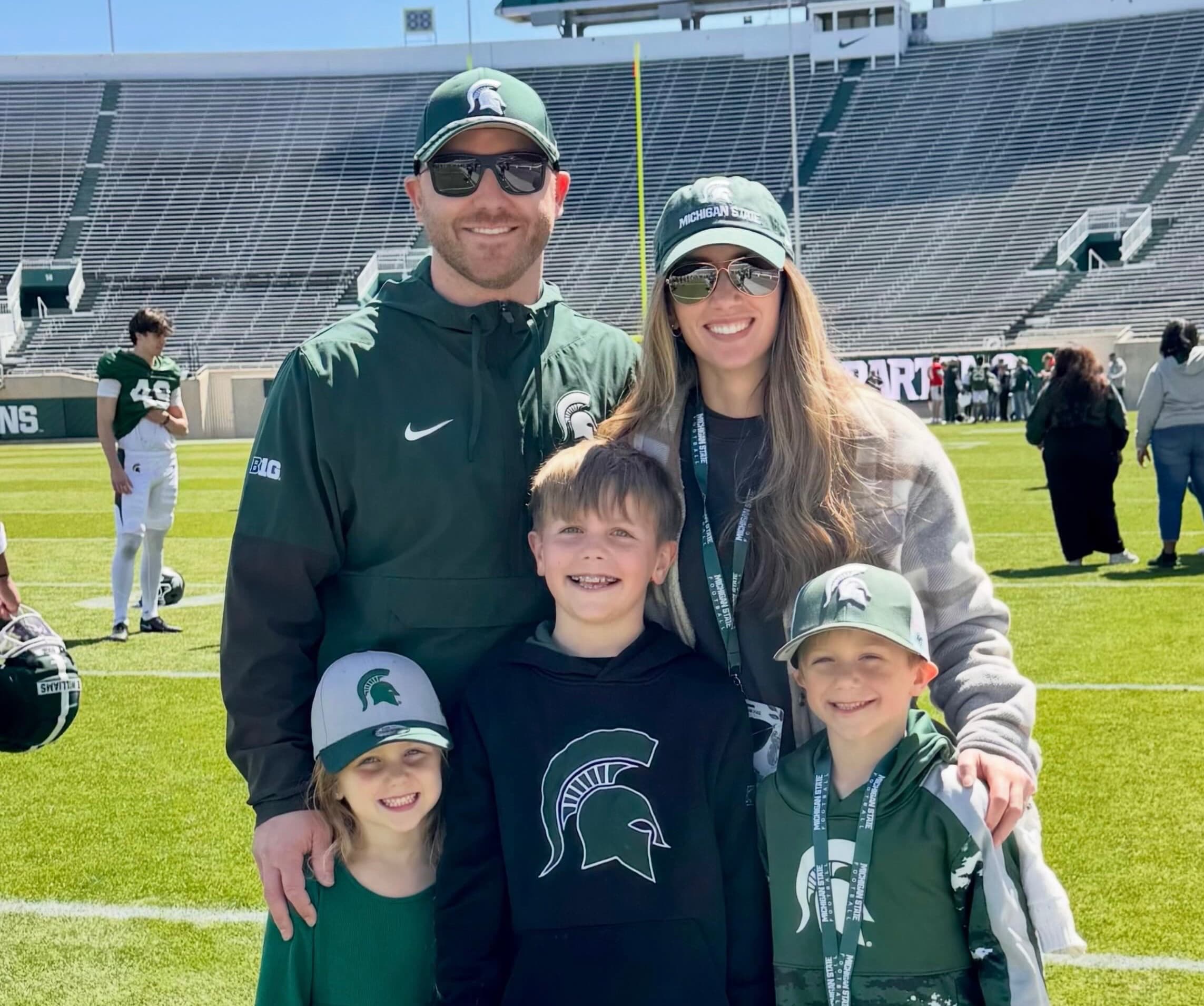
Looking back, Schmidt calls his decision to attend Northwestern one of the best choices of his life, second only to marrying his wife, Hallie.
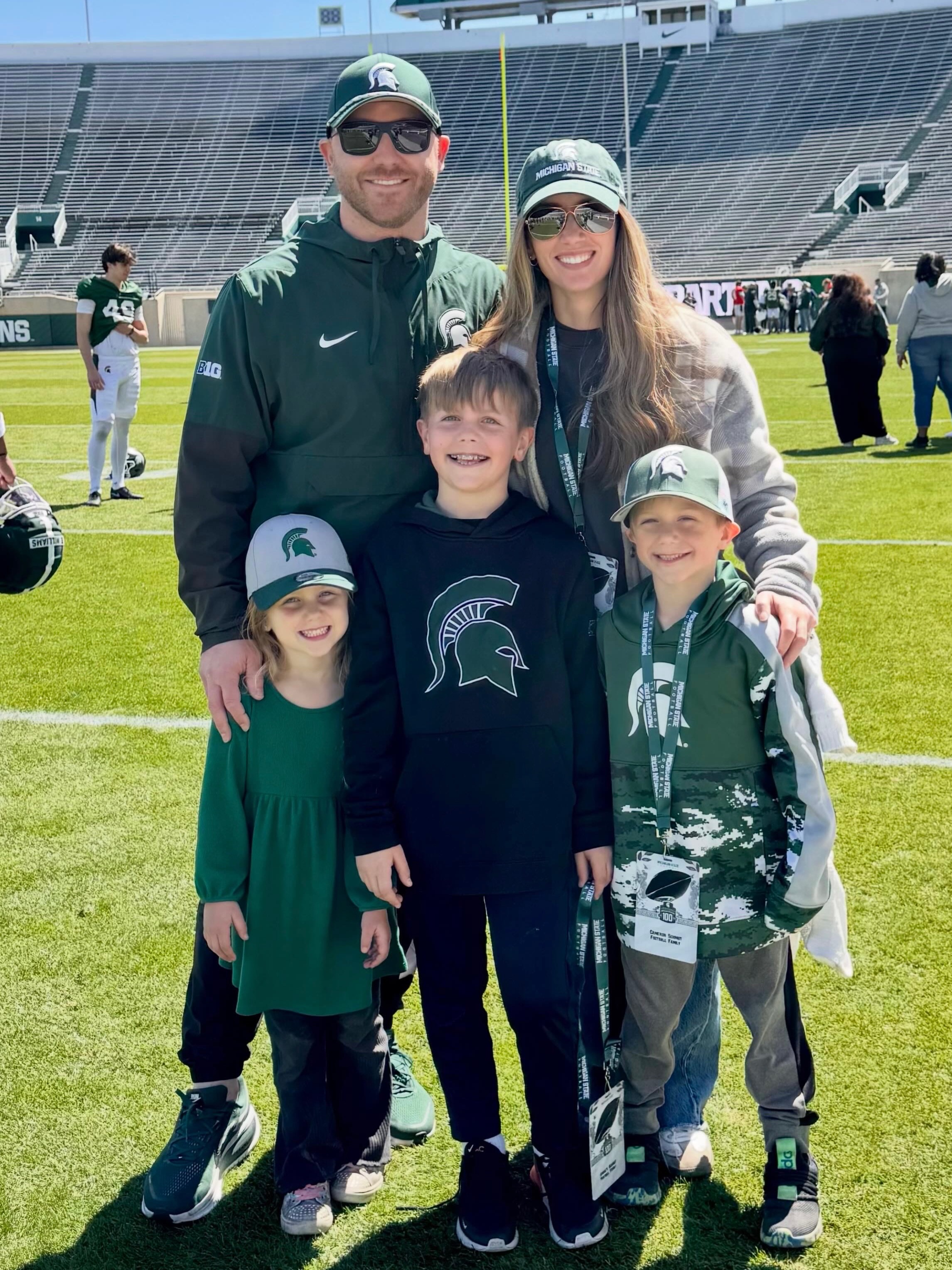 (courtesy photo)
It would be easy to dismiss that as a sentimental reflection from a former player, but in his case, it helps explain nearly everything that followed.
Northwestern gave Schmidt an elite education. Fitzgerald provided a model of leadership and program-building. Football became the foundation of his professional life.
Over time, Schmidt became one of the people who understood not only what Fitzgerald wanted to build, but also the relationships, standards, and institutional support that allowed it to work.
Fitzgerald’s Northwestern tenure is often reduced to its most visible achievements: the unlikely rise, the bowl appearances, the Big Ten West championships, and the transformation of Northwestern into a legitimate conference contender under a former Wildcats star who once seemed destined to remain there forever. But Schmidt remembers more than the finished product.
He remembers the recruiting decisions, the player development, the push for better facilities, the growing confidence among donors, and the administrative alignment that allowed the program to gain momentum. He saw a school long viewed as an outlier in the Big Ten gradually embrace football success without abandoning the qualities that made it distinct.
Northwestern, Schmidt readily admits, was always different.
“It’s the outlier in the Big Ten,” he said. “It’s different in a great way.”
With approximately 8,000 undergraduates, elite academics, and a profile more commonly compared to Vanderbilt, Stanford, Duke, or Notre Dame than the large public universities that define most of the Big Ten Conference, Northwestern could not simply copy the programs around it.
The challenge was not to run from that difference; it was to win through it. Fitzgerald helped Northwestern believe that. More importantly, he helped Northwestern prove it.
The Wildcats went to 10 bowl games in Fitzgerald’s 17 seasons, won two Big Ten West championships, and finished his tenure with four consecutive bowl victories. They became, for a generation of recruits, something different from what they had been when Schmidt was growing up.
“When I was a kid, you didn’t think of Northwestern as a winner,” Schmidt said.
By the time Fitzgerald’s program was rolling, the players being recruited to Evanston did.
That transformation did not happen only because Fitzgerald gave emotional speeches or embodied toughness from his playing days. It happened because the right people were recruited, developed, and retained. It happened because donors believed investment could produce results and because the university gradually accepted that winning football could belong at Northwestern.
Schmidt saw that process from the inside.
He also saw how Fitzgerald’s own history powered it.
Before he was the head coach who remade Northwestern, Fitzgerald was the player who helped change its trajectory.
He was the linebacker from the mid-1990s teams that lifted the Wildcats from national irrelevance to Pasadena. He was the hard-charging star with the neck roll, the player still associated with Gary Barnett’s “Take the Purple to Pasadena” breakthrough, and the face of a football awakening that gave Northwestern something to build on for decades.
Fitzgerald is quick to credit the players around him.
“He calls himself the best unblocked linebacker in the history of college football,” Schmidt said.
That is self-deprecation, but it also reveals something important about Fitzgerald. He understands the image and the mythology attached to his playing career, but he also understands football is never built by one person.
Still, his pedigree matters.
“He brings that with him in everything he does,” Schmidt said. “Come to a team meeting. Come to a workout. You feel it. Our guys feel it.”
That is one of the central bets Michigan State is making. Fitzgerald does not have to convince players he understands football sacrifice. He lived it. He does not have to manufacture credibility when he talks about toughness. He embodied it. He does not need to fake energy, either. Schmidt joked that Fitzgerald does not require much caffeine because the octane is already there.
The larger question is whether that energy can be converted into structure.
That is where Schmidt enters the picture.
When Fitzgerald was hired at Michigan State, the transition moved quickly.
Schmidt described it as a Thanksgiving weekend blur. One phone call became two. Fitzgerald was introduced in East Lansing on Tuesday. By the following weekend, Schmidt was in town.
“This place fits him,” Schmidt said. “It fits us.”
He does not describe East Lansing as a massive adjustment. He described it as a return to something recognizable.
To Schmidt, the area feels blue-collar, authentic, and more grounded than the pace of Chicago, while also offering the kind of community where he can raise a family and see Michigan State’s presence woven into everyday life. He notices it at his son’s baseball games, where green-and-white hats in the stands remind him that the passion surrounding the program extends well beyond Saturdays in Spartan Stadium.
Michigan State football has traditionally been at its best when it has clearly understood its identity. The program’s strongest modern stretches were built through evaluation, development, toughness, defensive discipline, offensive physicality, and a fan base that took pride in making Spartan Stadium an exhausting place for opponents to play.
Schmidt knows that history from the other sideline.
He described Michigan State as a “power of the Big Ten” and recalled that whenever Northwestern faced the Spartans during Fitzgerald’s tenure, the Wildcats expected “a physical fight that was going to go four quarters.”
That is the version of Michigan State Fitzgerald and Schmidt are trying to restore - not simply through messaging or imagery, but through the structure and daily standards of the program.
Schmidt said fans should expect a disciplined, energetic team that runs the ball, wins in the trenches, and plays with the attitude and physicality that have long defined Michigan State football. It is the same toughness Fitzgerald invoked during his introductory press conference when he said toughness was born in East Lansing.
Schmidt also made clear that this is not simply a nostalgia project. Fitzgerald did not arrive in East Lansing trying to recreate Northwestern. Every new head coach needs trusted people, and Fitzgerald brought some, including Schmidt. But he did not simply empty Evanston and transplant the old operation to Michigan State.
He started with a blank slate.
“He had an idea of what he wanted to build,” Schmidt said.
The staff-building process became one of the earliest tests of Fitzgerald’s approach.
There was urgency, but Schmidt said Fitzgerald was methodical. The objective was not merely to hire coaches who understood football. At the Big Ten level, anyone receiving a serious interview can coach. The deeper question was whether those coaches were the right people for the program Fitzgerald wanted to create.
“The right people first,” Schmidt said.
That principle is central to Fitzgerald’s program-building philosophy. Football competence is expected. Human alignment becomes the separator.
You've reached the paywall. Subscribe to support Spartans Illustrated and our unique storytelling. What comes next in this article is the blueprint: Schmidt explains how Fitzgerald built winning programs, why Michigan State’s staff was assembled the way it was, what makes Fitzgerald different behind closed doors, how his relationship with Tom Izzo fits into the larger vision and why Schmidt believes the Spartans are rebuilding from the inside out with far more than a new head coach.
