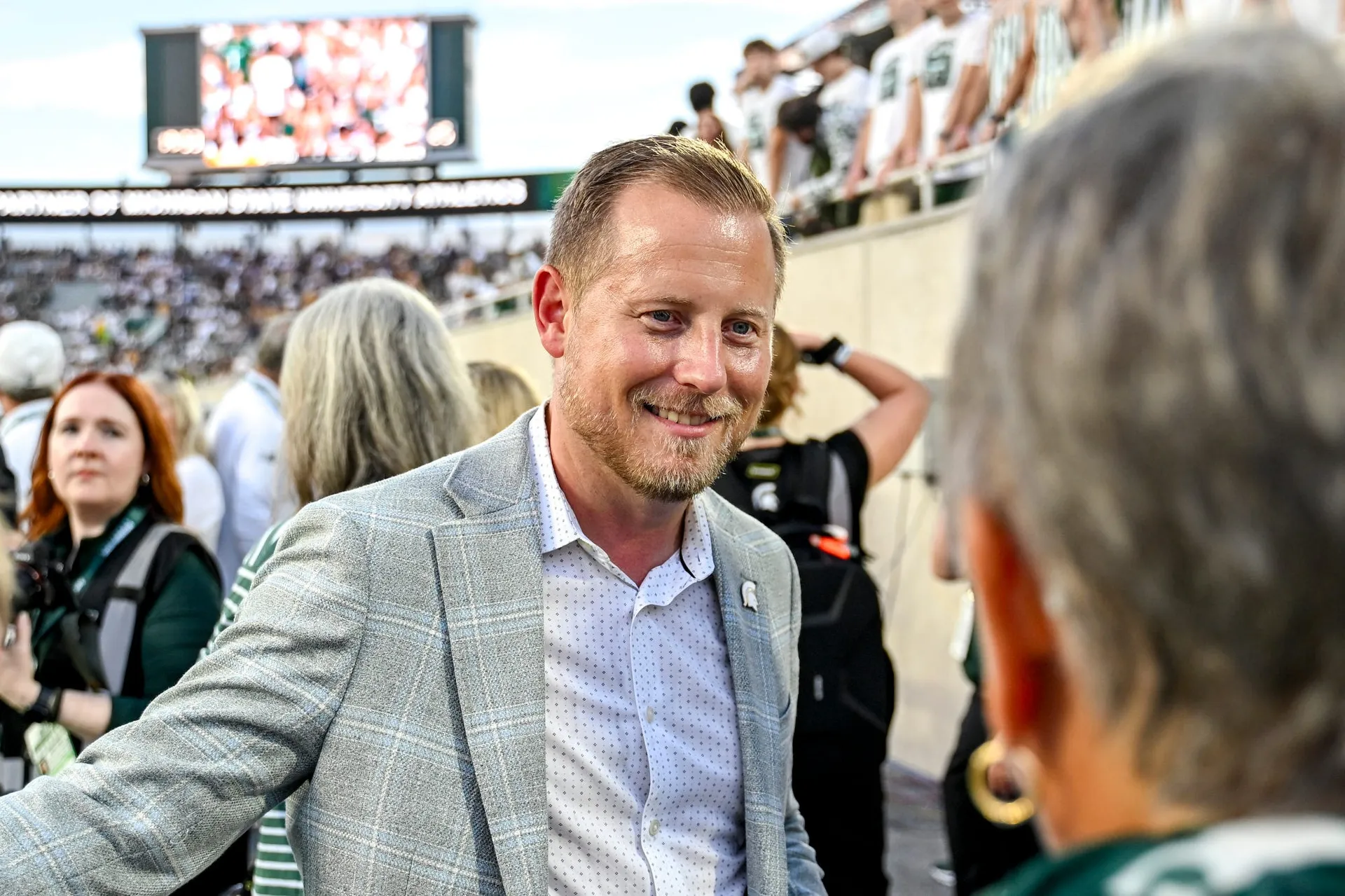
Michigan State has spent much of the 2026 football season discovering how narrow the difference can be between competing in the Big Ten and winning in it. New athletic director Dan Bartholomae is working to change that equation, and the resources to begin doing so are already coming together.
With a historic $401 million donor commitment helping establish the financial foundation, additional major gifts on the horizon, and a strategy to move Michigan State into the upper third of the Big Ten in roster spending, Bartholomae is putting together a plan designed to produce something the Spartans have struggled to achieve in recent years: sustained success.
During a wide-ranging interview with Jack Ebling on The Drive with Jack last week, Bartholomae confirmed that Michigan State already has money available to jump-start football roster development, with much of that initial investment expected to come from the commitment made by Greg and Dawn Williams. He also revealed that more major fundraising announcements are approaching, offered a candid assessment of the Big Ten's escalating financial competition, and provided new details about the planned $500 million transformation of Spartan Stadium.
For a Michigan State team sitting at 2-6, the implications extend well beyond this season. Pat Fitzgerald has begun establishing the culture, accountability, and consistency that Bartholomae believes are essential to winning. Now the university is working to provide the depth, talent, and infrastructure necessary to turn those close calls into victories.
But Bartholomae's ambitions go considerably further than one aggressive offseason. He is developing a financial strategy intended to sustain competitive roster spending for the next five to ten years, while simultaneously addressing stadium modernization, fundraising priorities, and the overall fan experience.
His comments also offered an unusually revealing look at the cooperation among Michigan State's athletic leadership, including Fitzgerald, Tom Izzo, and university President Kevin Guskiewicz, and why Bartholomae believes the university is positioned to capitalize on its considerable potential.
The result is an emerging blueprint for Michigan State's future, one built around substantial new resources, long-term financial stability, and a shared commitment to turning those investments into wins.
The Williams gift will help jump-start roster development
One of the most consequential portions of the interview concerned Michigan State's financial position and the resources available to improve its football roster.
The historic $401 million commitment announced by Greg and Dawn Williams in December 2025 transformed the financial conversation surrounding Spartan Athletics.
Of that commitment, $290 million was designated for the FOR SPARTA fundraising initiative, another $100 million was committed as an investment in Spartan Ventures, and $11 million was directed toward academic and other university initiatives.
But Bartholomae cautioned against assuming that the entire commitment represents money immediately available for the athletic department to spend.
"I've never come across a gift where I had a pile of money that was just sitting in front of me," he said.
Major gifts are structured around schedules, designated purposes, and agreements involving donors and university leadership.
Still, Bartholomae confirmed something Michigan State fans have been eager to hear: The resources to begin improving the football roster are already available, and the Williams commitment will play a significant role.
"Certainly, as you can imagine, we've got some resources on hand to jumpstart the roster, and a lot of that is going to come from that gift," Bartholomae said.
He did not identify a specific dollar amount available for the next roster-building cycle, but he made clear that discussions about funding involve Fitzgerald, donors, and university leadership.
The important distinction is that Bartholomae does not want to spend aggressively for one season without establishing the financial capacity to sustain that investment.
His planning horizon extends well beyond the 2027 roster.
"We're not just looking at next year," he said. "We're looking five to ten years down the road as well."
That approach reflects one of the central challenges of the modern college football economy.
Michigan State needs to become more competitive in roster spending quickly, particularly in a Big Ten where several programs have established enormous financial advantages. But an expensive one-year spending spree would accomplish relatively little if the university could not maintain those investments in subsequent seasons.
Bartholomae is trying to establish a repeatable funding model rather than a temporary financial surge.
For Fitzgerald, that means the university's commitment to building a winning program involves more than expressions of confidence. The athletic director is actively working to provide the resources necessary to compete at a higher level.
Where Michigan State intends to rank in the Big Ten spending race
Bartholomae also offered an interesting perspective on the increasingly public discussion about football roster payrolls throughout the Big Ten.
Ebling referenced reports suggesting some programs are spending more than $50 million, with others clustered around $40 million and additional schools operating at considerably lower levels.
Bartholomae said he has reviewed some of the publicly circulated figures, along with other aggregate information available to him since arriving in East Lansing.
His assessment was that the reported amounts are generally inflated, although the relative positions of the programs appear reasonably accurate.
"The dollars are higher," he said of the published estimates, "but in terms of where people are in the pecking order, I've found that to be close to what I believe the truth to be."
Rather than establish an arbitrary spending target, Bartholomae prefers to divide the conference into thirds.
The first objective for a program outside the middle third is to reach that level as quickly as possible. From there, the goal becomes establishing the resources necessary to compete consistently in the upper third.
"And once you're in the top third, I do believe that that gives you the best chance," he said.
That doesn't mean spending the most automatically produces the most victories.
Bartholomae emphasized that a successful football operation also requires investment in coaching staffs, support personnel, facilities, and other infrastructure.
But his philosophy is straightforward: A program expecting to compete for championships must provide resources consistent with those expectations.
For Michigan State, the practical question becomes how quickly Bartholomae and Spartan Ventures can establish that level of support, and how effectively Fitzgerald can turn those investments into a more competitive roster.
The athletic director offered no precise payroll target or timetable for reaching the conference's top third.
He did, however, leave little ambiguity about the destination.
More major gifts are coming, but donors can expect a clearer plan
Bartholomae also provided encouraging news about Michigan State's fundraising momentum.
Following the historic Williams commitment and the more recent $10 million pledge from longtime supporters Joe and Julie Serra, additional announcements are approaching.
"There will be more announcements in short order," Bartholomae said.
He did not identify the donors or the amounts involved, but he described the response from Michigan State supporters as a source of considerable encouragement.
That momentum comes as Bartholomae works to sharpen the direction of FOR SPARTA, the university's $1 billion athletics fundraising initiative.
Rather than relying exclusively on unrestricted contributions that give the athletic director broad discretion over spending, Bartholomae wants to identify specific priorities and explain their importance to potential donors.
His philosophy is that donors should understand what the university intends to accomplish, what resources are required, and how their contributions can advance those objectives.
He identified three fundamental priorities when evaluating athletic department investments: improving the student-athlete experience, directing resources toward areas with demonstrable returns, and supporting programs with credible plans for competitive success.
Football is at the center of that strategy.
Bartholomae believes a successful football program generates greater interest, financial contributions, and institutional enthusiasm that ultimately benefit other sports.
He described football as the rising tide that lifts the rest of the athletic department.
That doesn't mean other programs will be neglected. Instead, he sees football investment as a means of strengthening Michigan State's overall financial position.
In the immediate future, he identified two priorities that will remain central to the fundraising conversation regardless of how the broader campaign evolves.
"The stadium's really important. Roster development's really important," Bartholomae said.
Beyond those two areas, he intends to spend additional time with coaches, student-athletes, donors, alumni, students, and faculty before establishing a more detailed set of campaign priorities.
The message to potential donors is that Michigan State is ready to invest now, but its new athletic director also wants to provide a more fully developed long-term plan.
Bartholomae was particularly candid about the importance of transparency in that process.
He explained that when coaches or staff members come to him seeking assistance, he expects to receive the complete picture of the situation rather than only the information supporting their requests.
He intends to approach donors with similar openness, explaining what he has learned, what needs improvement, and how Michigan State plans to address those issues.
And while some priorities have already become clear, he acknowledged that developing a comprehensive plan for the entire athletic department will require more than his first six weeks on the job.
Spartan Stadium is 95% designed – and Bartholomae intends to influence the rest
The future of Spartan Stadium represents another enormous component of Michigan State's financial strategy.
Plans developed before Bartholomae's arrival envisioned a renovation costing approximately $500 million, with construction targeted to begin in 2027 and completion projected in 2029.
Those earlier projections, however, do not mean every decision has been finalized.
Asked whether he could describe what Spartan Stadium would look like in 2030, Bartholomae acknowledged that important portions of the design remain under discussion.
He estimated that the project was approximately 95% designed when he arrived at Michigan State.
That leaves a relatively small portion of the process in which he can make changes, but he intends to take advantage of it.
"When I walked in the door we were at 95%, so I got 5%," Bartholomae said. "And I'm going to take as much of that 5% as I possibly can to make sure that this project is successful and really speaks to our fan base."
Some of the unresolved discussions concern premium seating and related stadium experiences. Other portions of the project are transitioning from design work into construction documentation.
Bartholomae did not commit to a revised construction or completion date during the interview, although he anticipates being able to share more information about the stadium in 2027.
His comments suggest that the broad direction of the renovation remains in place, but that the final product will still reflect decisions made under his leadership.
And while the stadium represents an enormous financial commitment, Bartholomae rejected the suggestion that Michigan State must choose between improving its facilities and paying for a championship-caliber roster.
Both investments are necessary.
That position is particularly significant because the success of the stadium project will depend, at least in part, on generating the type of football interest and financial support that can be strengthened by winning.
Bartholomae wants those investments to reinforce one another rather than compete for attention.
The fan experience is getting a closer look
Not every improvement being considered involves hundreds of millions of dollars. Bartholomae also described a growing list of concerns surrounding the experience of attending Michigan State athletic events, including problems that fans have raised for years.
Connectivity inside Spartan Stadium is one example.
Ebling relayed complaints about unreliable Wi-Fi and cellular service, including concerns from media members trying to work during games.
Bartholomae acknowledged connectivity as one of several recurring themes emerging from his conversations with fans.
Food and beverage service, getting into and out of the stadium, and accessibility throughout the concourses have also drawn attention.
The athletic director said Michigan State conducts fan surveys and that he personally reached out to approximately 800 people with more specific questions about what the university is doing well and where improvements are needed.
He is looking for recurring patterns rather than responding to every complaint independently. The objective is to identify four or five significant problems and develop lasting solutions.
He acknowledged that some issues require immediate fixes. But he wants to avoid an approach that addresses individual complaints without considering the broader stadium experience.
The process is also extending beyond football.
Bartholomae attended his first basketball game at the Breslin Center during last Tuesday night's exhibition against UConn and said he walked around the arena making observations of his own.
That approach suggests fans can expect their concerns to remain part of the athletic department's planning process, even as the university pursues much larger initiatives.
It also reflects a broader philosophy Bartholomae has emphasized since his arrival: Michigan State needs leadership capable of making decisions that remain effective beyond a single season or administrative tenure.
"I'm not going anywhere," Bartholomae said while explaining his desire to develop lasting solutions.
For an athletic department that has experienced considerable leadership turnover, that emphasis on consistency is particularly relevant.
An example of alignment behind the scenes
One of the more revealing moments of the interview involved something that happened before Tuesday night's basketball game.
Michigan State was preparing to host UConn in an exhibition that drew approximately 15,000 fans.
Before the game, Bartholomae participated in a small donor presentation focused on the Spartan Stadium construction project.
Two other prominent figures attended.
Tom Izzo was there, despite being approximately 90 minutes away from coaching his basketball team.
So was Pat Fitzgerald, who was in the middle of preparing for Michigan State's upcoming road game against UCLA.
Bartholomae viewed their participation as a demonstration of the cooperation he wants throughout the athletic department.
It also provided a tangible example of the relationship between Michigan State's most prominent coaches and its new administrative leadership.
Fitzgerald, Izzo, Bartholomae, and university President Kevin Guskiewicz have repeatedly discussed the importance of institutional alignment. All four were present in the media room for Fitzgerald's press conference following MSU football's three-point loss to Northwestern a week ago Saturday.
In practical terms, institutional alignment means more than supporting one another in public statements. It means participating in fundraising, helping advance initiatives outside individual programs, and presenting a consistent direction to donors and supporters.
Bartholomae, who arrived from Western Michigan after previously working at Oregon State and Pittsburgh, believes that cooperation is essential for Michigan State to capitalize on its opportunities.
He also sees the accessibility of Izzo and Fitzgerald as an institutional strength.
Michigan State's supporters want leaders they can approach, communicate with, and relate to, he said. For Bartholomae, that makes the university's relationship-driven culture a natural fit. And it contributes to his confidence in the people surrounding him as he works to reshape the athletic department's future.
Giving Fitzgerald the resources to turn close calls into victories
The immediate circumstances surrounding Michigan State football remain difficult.
The Spartans are 2-6, have yet to win a Big Ten game, and just lost to undefeated, ninth-ranked UCLA Saturday at the Rose Bowl.
Even with improvement in recent weeks, Michigan State has been unable to finish games against Illinois and Northwestern that were within reach.
The 38-37 overtime loss to Illinois and the 24-21 defeat against Northwestern offered reminders of how little can separate victory from defeat in a competitive conference.
They also demonstrated why building the program's depth and overall talent level must remain a priority.
Injuries have compounded the roster limitations Fitzgerald inherited, creating additional challenges as the Spartans navigate a difficult schedule.
Bartholomae acknowledged how different the conversation might be if Michigan State had made a couple of additional plays in those contests.
But his confidence in the program's direction isn't based solely on the narrow losses or the possibility of a different record.
It comes from what he has observed in Fitzgerald's approach to rebuilding the program. The athletic director said he has been particularly impressed by Fitzgerald's consistent handling of accountability, regardless of a player's standing within the program.
Whether dealing with a starter, a highly regarded recruit, or a player receiving significant compensation, Bartholomae said Fitzgerald maintains the same expectations for preparation, practice, and performance. And despite the many complications of his first season, Fitzgerald has resisted the temptation to explain away his team's struggles.
"There is no panic. There are no excuses," Bartholomae said. "And, you know, frankly, in my opinion, a guy who very easily could point to the challenges he inherited, I've never heard him say it once."
Bartholomae believes that consistency is especially important for a program that has experienced repeated coaching changes and struggled to establish sustained momentum.
He also views Fitzgerald as a particularly strong fit for Michigan State.
The athletic director described the university as a relationship-driven institution that values accessibility and personal connections, characteristics he believes Fitzgerald possesses.
Much like Izzo, Fitzgerald has embraced the responsibility of connecting with donors, supporters, and the broader Michigan State community. That ability to represent the university beyond the football field is an important part of Bartholomae's assessment.
And although Bartholomae didn't hire Fitzgerald, he left no doubt about the decision he would have made had he been Michigan State's athletic director during the coaching search.
"Of course. Yeah, I mean, without question," Bartholomae said when asked whether Fitzgerald was the type of leader he would have selected.
The endorsement was emphatic, but its significance is better understood in the context of everything else Bartholomae discussed during the interview.
Michigan State is developing a financial strategy designed to sustain competitive roster spending. Major donors are stepping forward. Spartan Ventures is intended to provide additional revenue opportunities. The university is preparing for a stadium transformation, and its athletic leadership is working to establish a common direction.
There is still considerable work ahead, and Bartholomae has been careful not to promise an immediate transformation.
But he is also signaling that the constant turnover and changing direction of recent years cannot continue if Michigan State expects sustained success. The coming months will help determine how much progress the university can make on the financial side of that equation.
Additional fundraising announcements are expected. Work continues on the long-term allocation of the Williams commitment. The direction of FOR SPARTA is becoming more defined, and Spartan Stadium remains a major piece of the university's plans.
Most importantly for Fitzgerald, Michigan State's athletic director is working to translate those resources into meaningful roster improvements.
Bartholomae sees a coach who has already demonstrated the leadership, accountability, and organizational qualities necessary to rebuild a winning program. Now he intends to help provide the personnel and infrastructure capable of translating those qualities into results on Saturdays.
The ultimate measure of that strategy will be whether Michigan State can build a roster capable of competing with the Big Ten's best and convert its extraordinary fundraising potential into consistent success.
For Bartholomae, the question of who should lead that effort has already been answered.
"I've seen enough at this point without question to know that from X's and O's, CEO of the program, leadership, and fit standpoint, we have the right guy here without question," Bartholomae said. "We want him to be here. He is a huge part of the future, and we're going to win a lot of games together."