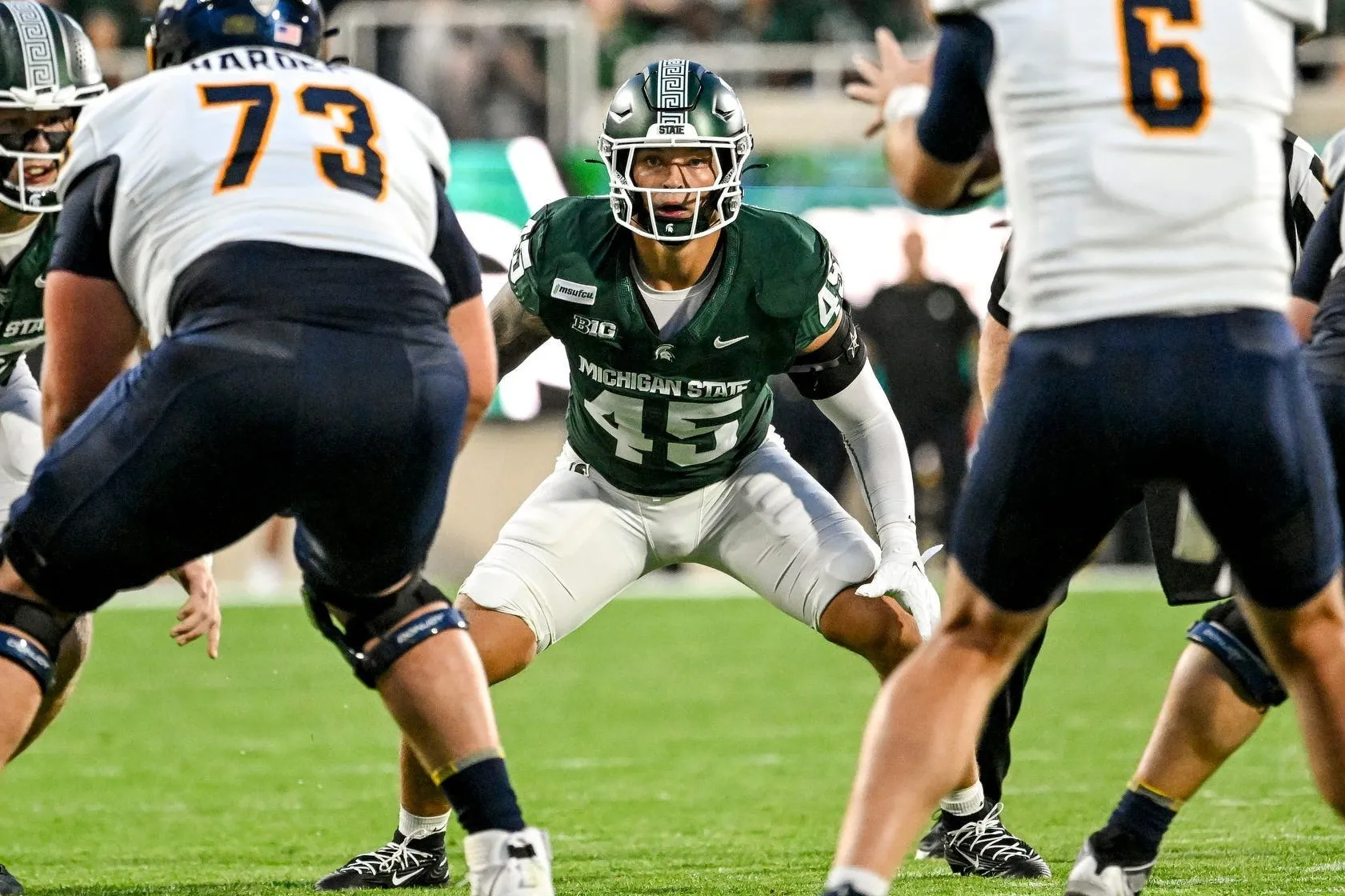
When Brady Pretzlaff ran out of the tunnel for his first start at Michigan State, Jeff Pretzlaff did not see only the 20-year-old linebacker wearing green and white.
He saw the little boy throwing a football in their backyard. He saw the third-grader beginning to play the game that had shaped their family. He saw the high school linebacker who arrived before sunrise for summer workouts in Gaylord, hours before everyone else.
Then he looked at his wife, Molly.
Her teary eyes matched his own.
“I’m like, ‘Why are we crying right now?’” Jeff said. “It was just so emotional to see.”
The moment would have been meaningful under any circumstances. For the Pretzlaffs, however, it came nearly a year after Brady had been helped from the same field with the shoulder injury that ended his 2025 season.
Jeff and Molly had watched him undergo surgery, endure months of rehabilitation, and struggle with being on the outside of the team looking in. They had seen football taken away from someone who had spent most of his life preparing to play it at this level.
Now, it had been given back.
“It was actually so surreal to see it,” Jeff said. “Our whole life, we’re a football family. I coach football, so Brady’s been raised around football. To actually see him on that field, you get all these flashbacks going through your mind, when he’s in third grade playing football. He’s worked so hard for it, and then to finally see him get that chance, I was just so happy for him.”
Brady had kept his father updated throughout preseason camp. He was receiving extensive work with the first-team defense at Sam linebacker, a position that can become more prominent depending on the opponent’s personnel and game situations.
The family believed Brady had positioned himself for a rotational role there. But then the coaches told him they wanted to start him at Will linebacker, giving him the opportunity to play a more consistent role.
That was the surprise.
“He was like, ‘Dad, you can’t tell anybody,’” Jeff said.
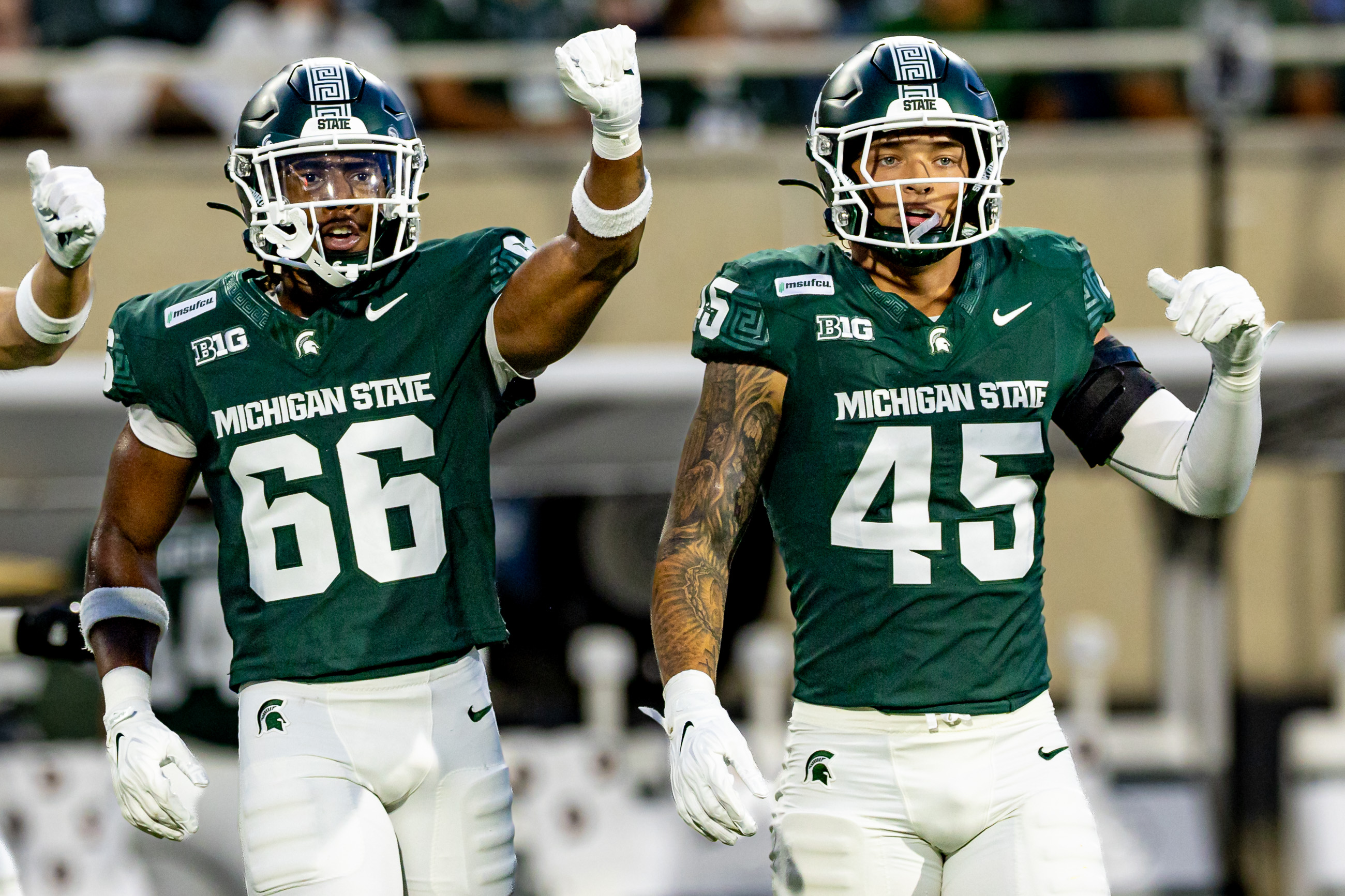
Photo credit: Marvin Hall/Spartans Illustrated
Jeff honored the request, watching and waiting without letting anyone know that his son - who had appeared in only seven games during his first two seasons - was about to make his first start for the Spartans.
Brady entered his redshirt sophomore season with 11 career tackles, including two tackles for loss, and two pass breakups. He had shown promise during limited opportunities, but his chance to establish himself in Michigan State’s linebacker rotation the previous season ended abruptly.
The shoulder had already been bothering him before the 2025 season. An MRI did not reveal a major injury, although doctors saw what appeared to be the beginning of a slight labrum tear.
Surgery was an option that they considered, but undergoing the procedure might have kept Brady out until the middle of the season. He wanted an opportunity to play and demonstrate what he could contribute, so he decided to postpone surgery and hope the shoulder would hold up.
It lasted three games.
Against Youngstown State, the labrum tore. Jeff recognized what had happened almost immediately.
“As soon as I saw it, I’m like, ‘Oh, no,’” he said. “I was sitting by my wife, and we definitely knew what it was.”
Brady had recorded a season-high three tackles, including a tackle for loss, against Youngstown State before the injury ended his year. Because it occurred in the third game, though, he retained the season of eligibility.
The timing offered a small consolation, but it did little to ease the immediate disappointment.
Surgery repaired the labrum, and doctors remained confident Brady would recover physically. The more difficult part was being separated from the daily life of the team.
Jeff described his son as feeling as though he were “on the outside looking in.” His family experienced some of the same detachment. They attended fewer games, and the season no longer carried the same rhythm it had when Brady was playing.
“I think the hardest moments for him were the day-to-day of not being involved with the team as much,” Jeff said. “He felt like he was kind of on the outside looking in. That’s what he said a lot, too. Now he’s just so happy to be back in it.”
The time away also allowed Brady to confront how closely his identity had become connected to the sport.
“A lot of us put our identity fully in football, and I learned that that can be an issue because, you know, I went down, I got hurt,” Brady said. “And then it’s like, ‘Well, if I’m fully a football player, what am I without it?’ That’s where I really leaned on my faith.”
Jeff did not see his son endure a crisis of faith or identity, but rather he saw Brady gain a clearer understanding that football was part of his life without defining all of it.
Brady had already developed a strong personal faith, but the injury provided more time to deepen it. He also benefited from teammates who gather regularly for Bible study and reinforce the idea that their value extends beyond football.
“I don’t think he was really wrestling with it,” Jeff said. “I just think it really showed him, even though he wasn’t playing football, he was still who he was. It was a positive thing. It showed him that he’s not just a football player.”
By spring practice, Brady was participating in noncontact activities, including seven-on-seven drills. He received full clearance after the spring and entered preseason camp without restrictions.
The repaired shoulder now feels better than it did even before the injury. Brady recently told his father that he had not felt this healthy since approximately his freshman year of high school.
Still, the final psychological test could not occur in a training room.
Brady needed to get hit.
He admitted feeling nervous before the opening series against Toledo. His previous game had ended with him being helped from the field, and now he was making his first start in front of more than 70,000 people.
“I’d be lying if I said that leading up to it, I wasn’t worried that, ‘Hey, maybe it’s going to feel weird,’ or something like that,” Brady said. “But something I learned is once you’re out there and get that first crack of the pads, it’s really like riding a bike. It all comes back to you. And then at that point, I was just playing football. I wasn’t thinking about my shoulder at all.”
After the first few collisions, Brady told his father he knew he was back. The worry faded, his instincts returned, and he began flying around the field.
Jeff spent much of the game viewing Michigan State’s defense through the eyes of a coach. A longtime high school coach and former defensive coordinator at Gaylord, he watched the defensive line, studied the linebackers’ reads, and examined how Rossi’s rebuilt unit functioned together. But he would constantly return to just being a dad. Watching his boy, out there, living out his dream. He had stopped coaching at the high school level so that he could be here - for these moments - and not miss any of it.
Brady did not treat his first start as an arrival. After reviewing the film, he found encouraging moments and others that required correction. That evaluation reflected the “reload” mentality emphasized by linebackers coach Max Bullough.
“Good play, bad play, next play,” Brady said. “Coach Bull is big on the whole reload mindset. Whatever happens, reload, get back to the spot and get ready to play another snap.”
Bullough carries particular credibility with Brady, a lifelong Michigan resident who watched the former Michigan State linebacker play in East Lansing. Brady was thrilled when Bullough was named to Pat Fitzgerald’s staff.
Bullough can explain the defense from a coach’s perspective while also helping his players understand what they will experience on the field. His background as an All-American linebacker at Michigan State and an NFL player allows him to anticipate what Brady will see once a concept leaves the whiteboard.
Jeff described defensive coordinator Joe Rossi as a “mad scientist” capable of designing an intricate defense. Bullough can then translate Rossi’s plan into the reads, movements, and situations the linebackers will encounter.
Brady told his father that Bullough had prepared him for specific things Toledo would do. Once the game began, they unfolded just as Bullough had described.
Brady also continues to benefit from Rossi, whose relationship with him predates their time together at Michigan State.
That connection began when Rossi was at Minnesota and wanted to evaluate the rising prospect from Northern Michigan in person. Film had captured Brady’s production, but Rossi had not watched him move through a workout.
Rossi flew into Traverse City, rented what Jeff remembers as a two-wheel-drive van, and headed toward Gaylord as a winter storm approached.
Jeff assumed the visit would be canceled. Rossi came anyway.
After putting Brady through a workout, Rossi became stuck in the parking lot.
“I said, ‘Brady, there go your Division I dreams,’” Jeff recalled. “‘It’s all over because of the snow.’”
Rossi eventually escaped the parking lot, spent the night near Traverse City, and flew out the following morning. The trip remains part of the relationship between coach and player, with Rossi occasionally reminding Brady what he endured to evaluate him.
More important to the Pretzlaffs was the confidence Rossi placed in Brady.
A scholarship offer from Central Michigan had first demonstrated that Brady might be able to play at the Division I level. Rossi’s interest convinced him he could compete at an even higher level.
When Brady later considered Michigan State under former coach Jonathan Smith, the family discovered Rossi was also coming to East Lansing. The alignment felt almost providential.
“It’s like we always talk about God’s plan,” Jeff said. “It just worked out how it was supposed to work out. We’re so lucky.”
Rossi’s retention under Fitzgerald was significant for the same reason. The Pretzlaffs view him as more than the architect of Michigan State’s defense. They believe he cares about Brady beyond what he can provide on Saturdays.
“Coach Rossi has been a guy I’ve been committed to since I was about 16, and it wasn’t even at this school when I did that,” Brady said. “But he obviously has a huge role in my athletic development, my career, and outside of football as well. So when he came back, that was huge to me – very important.”
Now in his third season at Michigan State, Jeff thinks that Brady’s greatest growth might be found in how much of the field he can process before the ball is snapped. He said that Brady always possessed an instinct for finding the football. As a senior at Gaylord, he recorded 126 tackles, 31 tackles for loss, and eight sacks while helping the Blue Devils finish 11-1 and advance to the Division 3 state quarterfinals.
At Michigan State, the responsibilities have multiplied. Brady must understand the defensive call, communicate checks with the defensive line and secondary, recognize offensive shifts, and adjust accordingly.
Jeff can see his son beginning to put the entire picture together.
“He’s a ballplayer,” Jeff said. “He’ll make plays, and he can find the ball. But now, seeing him put that whole package together, where he’s communicating on the field, is fun for me to see develop.”
Away from football, Jeff has watched his son mature just as quickly.
Brady, a finance major, has used some of his NIL earnings to invest in rental property rather than make lavish purchases. He owns two houses near campus, lives in one while renting additional rooms, and manages the other as a short- and longer-term rental.
He balances those responsibilities with classes and Big Ten football.
“Sometimes I wonder who’s the dad and who’s the son,” Jeff said, with a laugh.
Brady remains a product of Gaylord in other ways. He loves hunting, fishing, and escaping outdoors. Jeff describes him as a down-to-earth, small-town kid who remembers when he was the one waiting with a football and marker, hoping a college player would stop to sign an autograph.
During the Spartan Walk before the Toledo game, Jeff watched most of Michigan State’s team continue toward the stadium while Brady remained behind, stopping to sign autographs for children along the route.
“Growing up, he was the kid asking for autographs, so he understands that,” Jeff said, remembering back to the time when the roles were reversed. “In my mind, I still see that kid holding the ball with the marker himself, and now that’s him. He’s the one signing for them.”
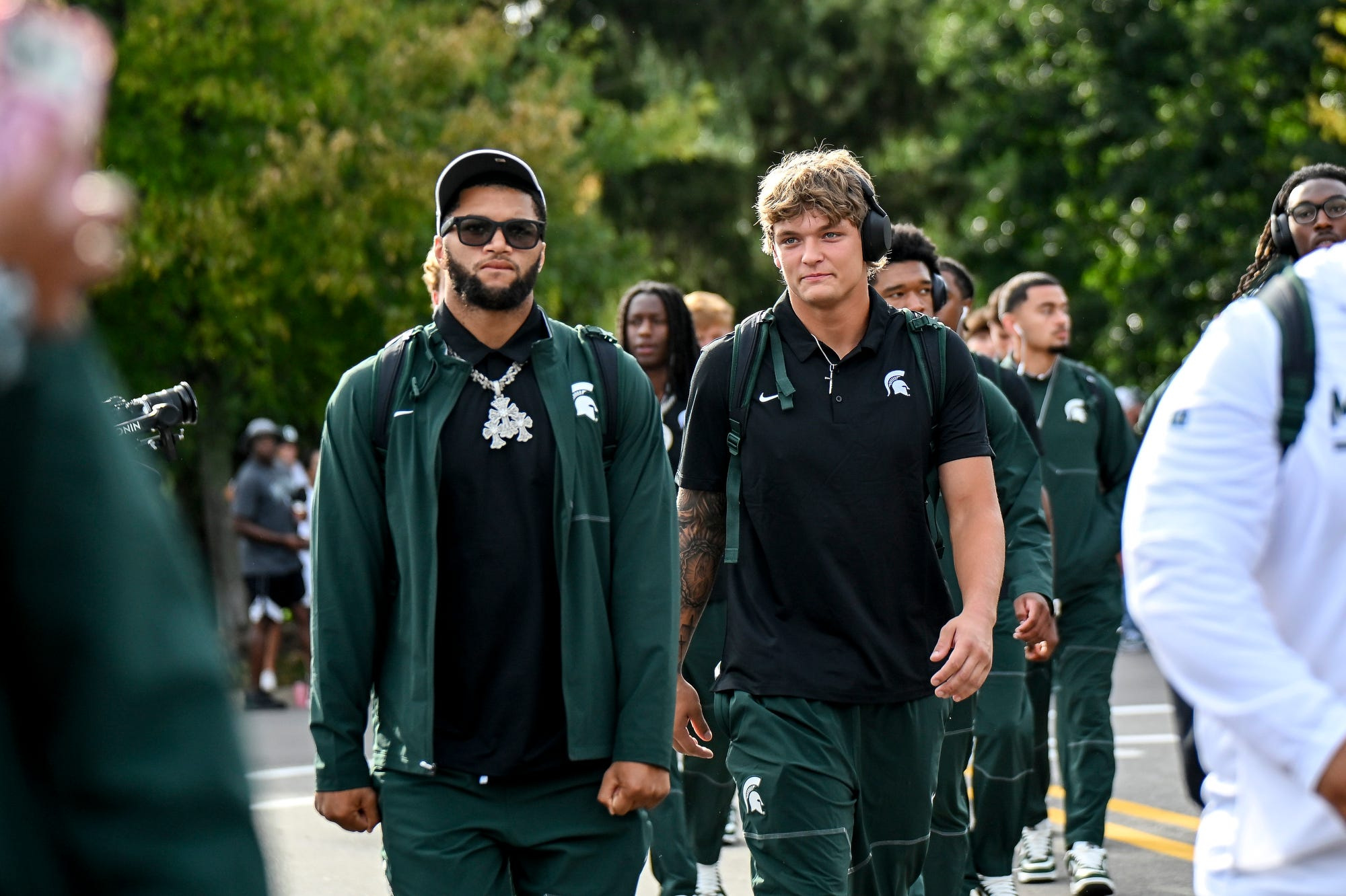
Photo credit: USA TODAY Network via Reuters Connect
His hometown of Gaylord has embraced his journey. Jeff encounters people at gas stations who recognize the Michigan State stickers on his truck and ask about the local player competing for the Spartans. He sometimes carries on the conversation for a bit before letting the stranger know that he's talking to the local player's dad. Even devoted Michigan fans now tell him they watch Michigan State games because they want to see Brady.
Brady believes a small town instills “a different level of grit.” His father sees the same quality in him – a blue-collar work ethic that cannot be manufactured once the game becomes difficult.
That foundation helped Brady endure the months outside the team. It brought him back stronger, more appreciative, and determined to keep the opportunity he had earned.
“They cracked the door for him,” Jeff said. “Now he says that he wants to kick that door open and show them why he should stay on the field.”
After the Toledo game, Jeff met his son just outside the Spartan Stadium tunnel and told him how proud he was.
Brady immediately began talking about the tackles he had missed.
Jeff reminded him that all linebackers miss tackles. Ray Lewis missed tackles. Brian Urlacher did, too. Everyone who plays linebacker eventually takes a wrong step, makes a bad read, or fails to finish a play.
The missed tackles were not what Jeff would remember from that evening. The last time he had watched Brady leave the field at Spartan Stadium, his son was being helped off with an injured shoulder. This time, Brady walked off the field on his own after a victorious beginning to Michigan State’s season.
Jeff’s most vivid memory of the evening came just after his son had finished the game and sung the fight song with his teammates in the southeast corner of Spartan Stadium, accompanied by the Spartan Marching Band.
Brady's grandmother, mother, and father were waiting in the stands behind the Michigan State bench when he ran over.
Molly leaned over the concrete wall and slapped her son’s hand.
Then Brady locked eyes with his father.
“He looks at me, and we’re both just like, ‘We can’t believe it,’” Jeff said. “We kind of give the little father-son head nod. It gives me chills even talking about it.”
That nod lasted barely a second as the commotion swirled around them. But within it was a flood of memories for both.
In Brady’s eyes, Jeff saw the little boy looking up at him while they threw a football in the backyard. He saw his high school linebacker getting up before sunrise for summer workouts, and his now-adult son who had left home to pursue something neither could fully imagine yet at the Big Ten university downstate.
In his father’s eyes, Brady could see the years of coaching coming to fruition, the comfort his dad had provided when his shoulder gave out, and the strength he had poured into his life to help make him the man now standing on the Spartan Stadium grass.
In that moment, no words were necessary. Whatever one might have said, the other already knew.
Jeff nodded. Brady nodded back.
Then Brady turned and continued toward the tunnel – walking off the field under his own power this time, healthy again after his first start for Michigan State – while his parents beamed from the stands, perhaps with a few more tears starting to form in their eyes.