Why Pat Fitzgerald called Mike Hankwitz as his Michigan State debut approached
The former Northwestern defensive coordinator spent 13 seasons beside Fitzgerald, and his recent visit to East Lansing offered a revealing look at the coach now leading Michigan State
A little more than a week before Pat Fitzgerald opened his first preseason camp at Michigan State, he picked up the phone and called Mike Hankwitz.
The two men had not seen each other in a couple of years. Hankwitz had been retired from coaching for nearly six. Fitzgerald was days away from beginning the most important football season of his second act.
Still, there were questions Fitzgerald wanted answered.
So he invited the defensive coordinator who had spent 13 seasons beside him at Northwestern to East Lansing.
“I learned a lot from other people,” Hankwitz said. “So I thought if I could help him in any way, I’d be glad to.”
Hankwitz drove down from northern Michigan, walked back into a Big Ten football building and soon found himself talking defense with Michigan State coordinator Joe Rossi. They discussed schemes, scouting, and, perhaps most importantly, the thinking behind some of the decisions Hankwitz had made over a career that lasted 51 years.
Later, after the football conversation was over, Hankwitz walked outside.
That was when the trip became something else.
He wandered around Spartan Stadium, where he had first watched Michigan State football as a kid during the Duffy Daugherty era. He made his way toward Munn Ice Arena, then over to Jenison Field House, where memories of high school basketball and another lifetime came rushing back.
“It’s just fun kind of refreshing my memory,” Hankwitz said.
There was something almost perfectly circular about the visit.
More than 60 years after Hankwitz first came to East Lansing as a kid to watch the Spartans, he had returned because Pat Fitzgerald still wanted to know what he thought about football.
In a series of conversations with Spartans Illustrated, Hankwitz has described Fitzgerald as a head coach who listens, seeks out ideas, trusts the people working for him, and never assumes he has learned everything there is to know. Then, with his first preseason camp at Michigan State approaching, Fitzgerald invited a retired coach in his late 70s back into the building and asked him to share whatever knowledge five decades in football had left behind.
For Hankwitz, that was entirely consistent with the Fitzgerald he knew.
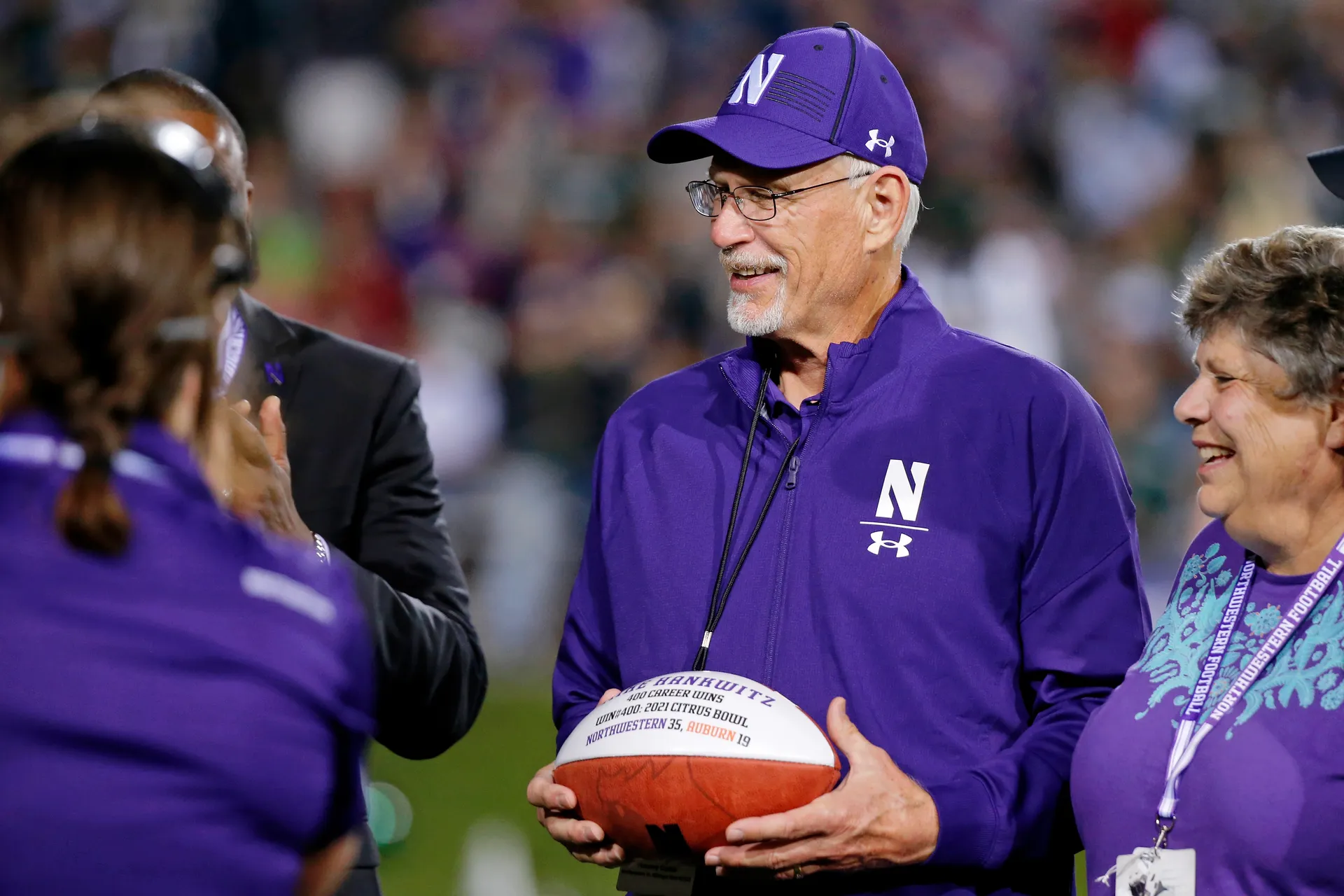
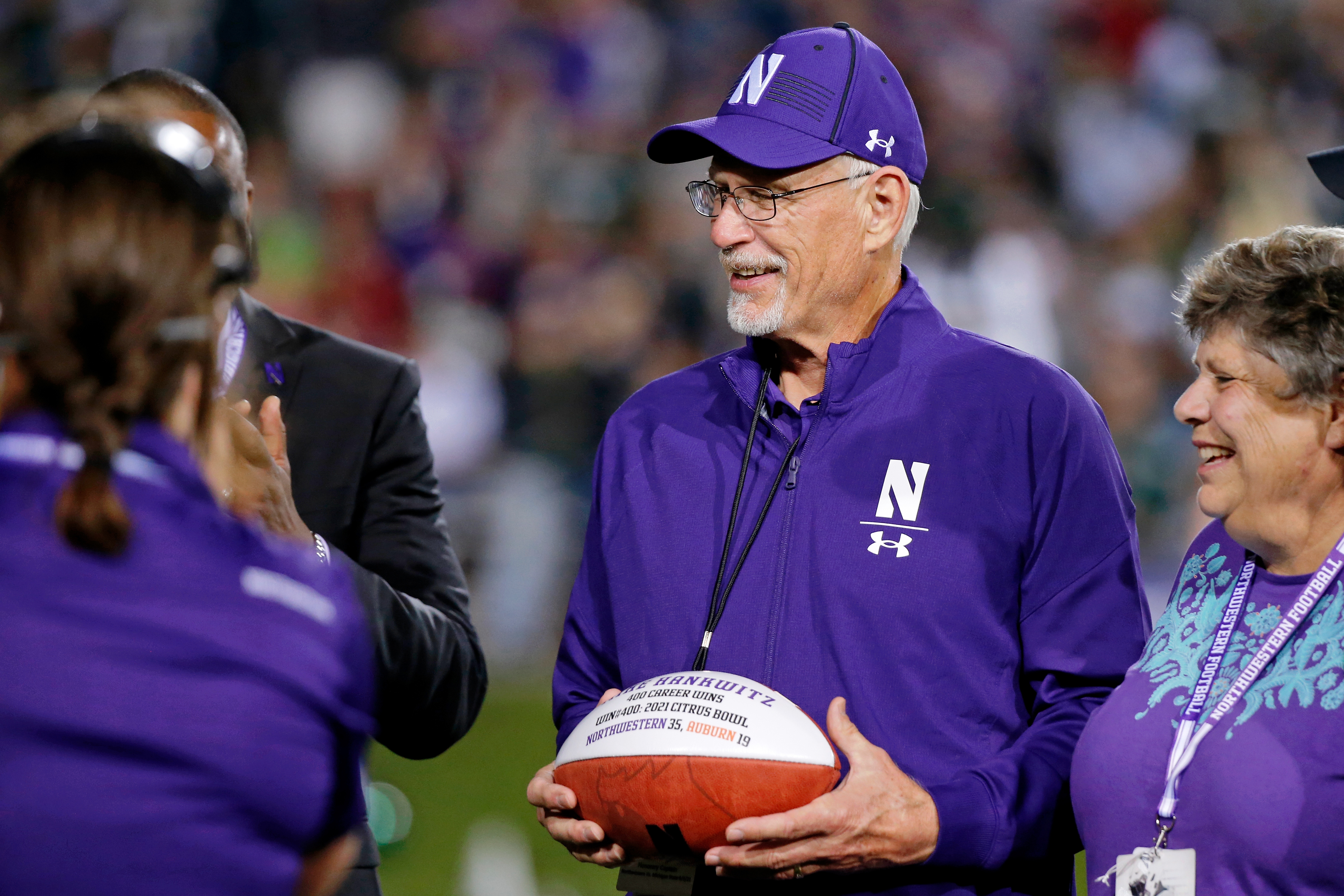 Sep 3, 2021; Evanston, Illinois, USA; Honorary captain Mike Hankwitz is introduced during the game between the Northwestern Wildcats and the Michigan State Spartans at Ryan Field. Credit: Jon Durr-USA TODAY Sports
A connection to Michigan State that began long before Fitzgerald
Long before Hankwitz became one of the most respected defensive coordinators in college football, he was a kid from northwestern Michigan climbing onto a school bus bound for East Lansing.
He grew up in Scottville, Michigan, about a 15-minute drive east of Ludington along U.S. 10, in a town famous for its clown band. Yes, seriously. Look it up.
He played at Mason County Central, where the football program had a strange blend of Michigan and Michigan State built into its identity. The school colors were maize and blue, like Michigan. The nickname was the Spartans. The fight song, as Hankwitz remembers it, sounded more like Michigan State.
“Kind of a weird mix,” he said.
His high school coach would take the football team to Michigan State games after the season ended. The trip to East Lansing could take roughly three hours in those days, and the players would ride down together before settling into seats in the end zone at Spartan Stadium.
This was Daugherty’s Michigan State, when the Spartans were among the dominant programs in college football. Hankwitz remembers the stadium, the double decks, and the crowds, but one of the memories that has survived most clearly has almost nothing to do with football.
On one of those trips, his coach stopped at McDonald’s.
Hankwitz had never seen one.
“The cool thing was we stopped at a McDonald’s one time,” he said. “It was the first time any of us had seen a McDonald’s. We had a Burger Chef (up north), but big deal.”
Another trip to Lansing for high school athletics apparently produced a similar experience. Hankwitz remembers being around the state track meet in the early 1960s and his team stopping at McDonald’s afterward.
“We thought, ‘Wow, this is so cool,’” he said. “Probably bought like five hamburgers, three fries, you know, just thinking how great this was.”
The stories fit Hankwitz.
He spent 51 years in college football, coached in major conferences, worked for some of the most recognizable figures in the sport, coordinated elite defenses, and experienced championship games and bowl victories. Yet when he talks about the path that carried him through the profession, the memories that seem to matter most are often about the people and places surrounding the football.
East Lansing is one of those places.
Hankwitz eventually went to Michigan after the Wolverines recruited him and Michigan State did not, a fact that still makes him careful when talking too fondly about the Spartans. During his latest conversation with Spartans Illustrated, he joked that he did not want any of his old Michigan teammates to think he had become “a deserter.”
He has never hidden the fact that he liked Michigan State, though.
“A lot of people from our side of the state went to State,” Hankwitz said. “I always liked Michigan State. I just didn’t get recruited by them.”
Had the Spartans offered him a scholarship, he acknowledged that the decision could have become much more complicated.
“Oh yeah,” he said. “No question.”
Instead, his football life took him somewhere else, then almost everywhere else, eventually carrying him back to Michigan State for a reason he could never have imagined when he was sitting in those end-zone seats watching Daugherty’s teams.
The call that started 13 years together
Hankwitz’s relationship with Fitzgerald began when Hankwitz unexpectedly found himself looking for a job.
He had joined Bret Bielema’s staff at Wisconsin, where the Badgers went 12-1 and won the Capital One Bowl in their first season together. Another winning season followed, but after the 2007 campaign, Bielema decided to make a change at defensive coordinator.
Hankwitz was stunned.
The explanation did not make much sense to him, and the firing frustrated him. He had been around football long enough to understand the instability of the profession, but that did not make the moment easier.
Then Fitzgerald called.
Northwestern was still recovering from the sudden death of Randy Walker in 2006. Fitzgerald had been elevated to head coach at 31 years old, charged with leading his alma mater after losing the man he had worked under and expected to continue learning from.
Hankwitz already knew something about Northwestern. He had worked with Gary Barnett at Colorado, and Barnett had previously wanted him to come along when he took the Northwestern job. Hankwitz had stayed in Colorado, where he was already a coordinator, but continued to follow what Barnett and Northwestern were doing.
So when Fitzgerald reached out years later, Hankwitz was interested.
“I was very impressed with him,” Hankwitz said. “I knew his reputation as a player.”
Fitzgerald believed Northwestern was positioned to start moving forward again. Hankwitz believed Fitzgerald could get it there.
“I just had total confidence in him when we talked,” he said.
That decision ended up defining the last 13 seasons of Hankwitz’s career.
Northwestern went 9-4 during their first year together. Some difficult seasons followed, including two 5-7 finishes that still bother Hankwitz because so many of the losses were close. There were also some of the greatest seasons in Northwestern history, including the 2018 team that won the Big Ten West and beat Utah in the Holiday Bowl.
By then, Hankwitz’s wife had started asking a reasonable question.
How much longer did he really want to do this?
He was already in his 70s, had coached for decades and had just helped Northwestern win a division championship and another bowl game. It would have been an easy place to walk away.
Then Northwestern went 3-9 in 2019.
Hankwitz came home after the final game, and his wife looked at him.
“You’re not stopping,” he remembers her saying.
His answer came immediately.
“How can I on that?”
So he returned for another season.
Then COVID arrived.
Northwestern had already begun spring practice when the university shut things down. Exams went remote, classes went remote and, eventually, the Big Ten announced that it would not play football in the fall.
Hankwitz could barely stand it.
He described himself as “fit to be tied,” uncertain whether he would have to wait another year or whether there would even be another season for him at all.
Fitzgerald kept telling him not to get ahead of himself.
“You don’t know what’s gonna happen,” Hankwitz remembers him saying.
Eventually, the Big Ten reversed course. Northwestern returned to football and produced one of the best seasons of Fitzgerald’s tenure. The Wildcats won the Big Ten West, gave Ohio State a serious challenge in the conference championship game and beat Auburn in the Citrus Bowl.
That became Hankwitz’s last game.
“I was just so excited that I could get one more year in,” he said.
After 51 years in coaching, he left with a division championship season and a bowl victory. More importantly, he left feeling grateful for where he had spent the final 13 years.
“I couldn’t have asked for a better place to fit for 13 years,” Hankwitz said. “It’s a long time to be at one place, but it was so enjoyable. I was just blessed to be able to finish like that.”
Much of that enjoyment, he said, came from working for Fitzgerald.
The freedom to coach
Ask Hankwitz what distinguished Fitzgerald as a head coach, and he keeps returning to one word: trust.
“I think he was pretty much the same person,” Hankwitz said. “He sought input. He let you coach.”
That was important to Hankwitz, who had already spent decades developing his own ideas about defense before he arrived at Northwestern. Fitzgerald wanted to know what his assistants thought and was not shy about offering feedback of his own, but Hankwitz never felt as though he had been hired for his expertise only to have the head coach micromanage it.
“He was one of the best I worked with that way,” Hankwitz said.
He remembers Fitzgerald communicating constantly with the staff and making an intentional effort to build relationships away from football. There were gatherings at Fitzgerald’s house, including St. Patrick’s Day celebrations, and occasional trips together, such as outings to Cubs games.
The gestures were not elaborate, but they made an impact inside a profession where staffs can spend nearly every waking hour together for months at a time.
Hankwitz also noticed how readily Fitzgerald shared credit.
“He was quick to give credit when offense did well or defense did well,” Hankwitz said. “I really enjoyed working for him because I thought he cared about the staff and worked hard to show that.”
That same willingness to trust people helps explain why Fitzgerald wanted Hankwitz back in a football building this summer.
The sport has changed enormously since Hankwitz retired. Rossi already has his own defense and his own ideas. The value in Hankwitz’s visit was the thinking behind five decades of decisions.
Hankwitz remembers Fitzgerald encouraging that kind of exchange throughout their time together. Coaches were expected to seek out other people, study what was changing around the sport and bring useful ideas back into the building.
When analytics became increasingly prominent, Northwestern began studying them. Fitzgerald wanted information about fourth-down decisions, red-zone football, field position, and other situations that could help the staff make smarter choices.
“He encouraged us to reach out to different people to exchange ideas,” Hankwitz said.
That curiosity may matter more now than at any point in Fitzgerald’s career as college football changed dramatically while he was out of coaching. NIL became a central part of roster construction. The transfer portal became a year-round reality. Revenue sharing arrived. Retaining players became nearly as important as finding them.
Hankwitz never believed Fitzgerald would spend his time away ignoring those changes.
“He got a master’s in coaching,” Hankwitz said. “In the NIL world, he got a PhD.”
The line was delivered with a laugh, but Hankwitz was making a serious point.
“That would be him,” he said. “He wasn’t gonna just sit there and assume he had everything under control. He was gonna keep researching.”
Michigan State is already seeing evidence of that mindset.
Fitzgerald has spoken about how sports science influences the structure of preseason camp, including the rhythm between demanding practices and recovery days. He has spent considerable time putting the Spartans into carefully designed situations, with specific scores, field position, time remaining, and timeout combinations.
That, too, sounds familiar to Hankwitz.
Seeing the game before it happens
Hankwitz remembers Fitzgerald as a head coach who was always thinking a possession or two ahead.
During games, Fitzgerald largely allowed Hankwitz to run the defense. He rarely inserted himself into play calling simply to make his presence felt.
“He was very into the game,” Hankwitz said. “He would rarely interfere. I don’t remember him interfering.”
What Fitzgerald did provide was context. If Northwestern was approaching a part of the field where the offense would be operating with four downs instead of three, Fitzgerald would let Hankwitz know. If a particular game situation was likely to affect how the next possession should be handled, he wanted his coordinator thinking about that before it arrived.
“He was always thinking ahead, in my mind,” Hankwitz said. “Managing the whole game and keeping you informed so you didn’t get caught up in the moment.”
That habit is easy to recognize in the way Michigan State has practiced this August.
Fitzgerald has devoted considerable time to two-minute situations, overtime football, and other scenarios that force players to process more than the play call. The score, the clock, the number of timeouts, and field position all matter - and the objective is to make those circumstances familiar before they arrive with 75,000+ people watching.
Hankwitz watched Fitzgerald prepare teams that way for years. He also watched him balance that seriousness with a side of his personality that Michigan State players have already experienced.
Football could still be fun
At the end of Fitzgerald’s first spring at Michigan State, players spun around bats, tried to run straight and ate hot dogs as part of a competition that looked ridiculous by design.
Hankwitz knew exactly where it came from.
“That was always an ending of our spring practice,” he said.
Fitzgerald had used variations of the tradition at Northwestern. Hankwitz remembers players looking forward to it because it marked the end of weeks of hard work and gave everyone permission to laugh for a little while.
That attitude extended beyond one spring competition.
There was ice cream. There were team-building exercises. There were moments built into the schedule simply because Fitzgerald wanted players to enjoy being around one another.
Hankwitz believes that was intentional.
College football asks enormous amounts of young players. Their days are structured, their performances are constantly evaluated, and the physical demands are relentless. Fitzgerald could be highly demanding, Hankwitz said, without allowing the environment to become permanently grim.
The coach demanding physical football and precise situational execution is the same coach who is perfectly comfortable ending spring practice with players stumbling around after spinning on a bat. Hankwitz sees both images as essential pieces of Fitzgerald.
When everything changed at Northwestern
Hankwitz’s affection for Fitzgerald becomes most apparent when the conversation reaches the subject that could have complicated their relationship more than anything else: the way Fitzgerald’s Northwestern career ended.
It still bothers him.
Fitzgerald was fired in July 2023 after allegations of hazing within the football program surfaced, ending a relationship with Northwestern that had stretched from his playing career through 17 seasons as its head coach. Hankwitz, who had retired more than two years earlier, watched the situation unfold from outside the program.
What he was reading and hearing did not resemble the coach he had worked beside for 13 years.
“He worked his tail off to have a great rapport with his players and put them first,” Hankwitz said.
That conviction comes from years of watching Fitzgerald interact with players when there were no television cameras around. Hankwitz remembers an open-door policy and a head coach who made an effort to know the people on his roster beyond what they could contribute on Saturdays. When players had problems, Fitzgerald tried to help. When they struggled, he tried to encourage them. When circumstances required him to advocate for them within a university whose academic standards made recruiting particularly complicated, Hankwitz remembers him doing that, too.
“He worked hard to get to know kids and try to help them and encourage them,” Hankwitz said.
Those memories made Fitzgerald’s firing particularly difficult for Hankwitz to accept.
He believes his former boss received “a raw deal,” a phrase he still uses more than three years later when discussing what happened at Northwestern.