Years after Tom Izzo helped him through brain surgery, an MSU student got to say thank you
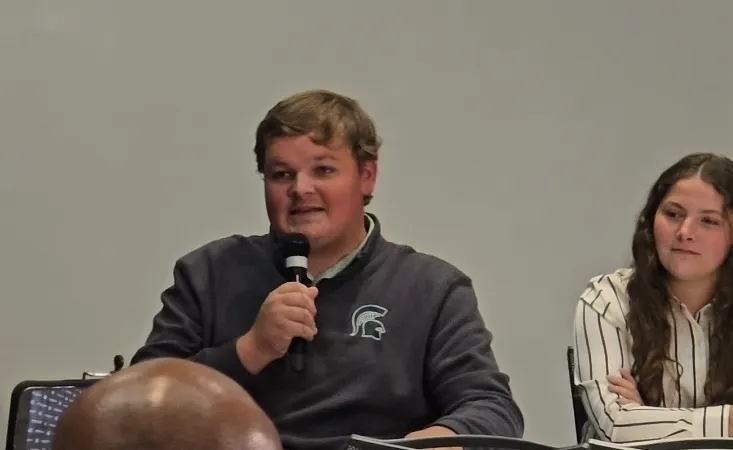
At Izzo's media day press conference, Elliott Hammon had a chance to tell Izzo what his encouragement meant to him
Elliott Hammon had been waiting for the chance to ask his question. When it finally came, his heart was pounding hard enough that he could feel it.
The Michigan State journalism junior was sitting to the left of Tom Izzo, preparing to speak to a coach whose video message he had kept on his phone for nearly five years. Hammon had watched that video more than once since receiving it in a hospital before brain tumor surgery. Sometimes, he returned to it simply because he needed a lift.
Now he could tell Izzo what it had meant.
The room was full for Izzo’s opening press conference at Michigan State basketball media day, an annual gathering that draws reporters from across the state and the Midwest.
MSU professor L.A. Dickerson has made a tradition in recent years of bringing her sports journalism students, and Izzo makes a point of acknowledging them and - near the end - giving them an opportunity to ask questions.
When that opportunity came, Hammon raised his hand. He thought afterward that he might have raised it a little too high. He was the first student to ask a question, and he had chosen something personal to share in a room full of people whose work he hoped to do someday.
He reminded Izzo of the video encouragement he had received and a chance encounter at a Memphis Grizzlies game while undergoing treatment at St. Jude Children’s Research Hospital.
“When people tell you that you mean so much to them, what goes through your head?” Hammon asked. “And I know that you’ve heard that so many times from so many different people – but how does that impact you?”
Izzo paused to gather himself emotionally.
Throughout the press conference, Hammon had watched him answer questions immediately. This one required a few seconds. For the student waiting on the other end of it, that hesitation became one of the most meaningful parts of the exchange.
Then Izzo answered.
“It’s better than winning.”
Hammon is 20 now, a junior studying journalism with a concentration in sports. He grew up in Frankfort, near Traverse City, in a community small enough that his high school graduating class had 33 students.
His father attended Michigan State, and Elliott grew up following the Spartans. He remembers some of Kirk Cousins’ final season. Connor Cook became another familiar figure from the teams he watched as a boy.
In December 2021, those connections took on a meaning he could not have anticipated.
Hammon had a noncancerous brain tumor and needed surgery. In the days before the operation, friends with connections to Michigan State’s athletic program helped bring some familiar faces to his phone.
Izzo sent a video. So did Suzy Merchant, Cousins, Cook, Malik Hall, Mateen Cleaves, and Mark Dantonio. Hammon also received a text message from Riley Bullough, whose own roots were in Traverse City.
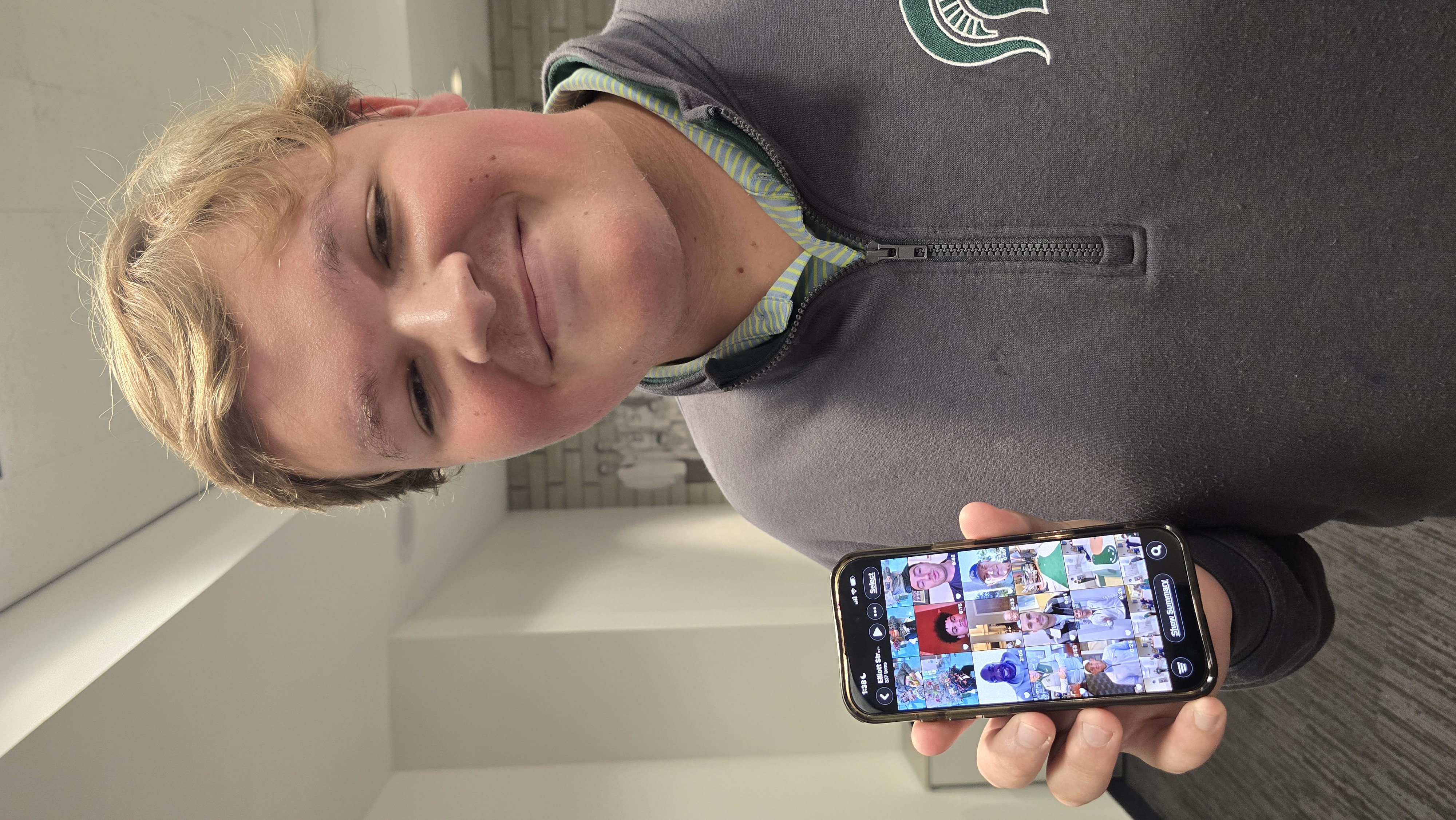
Elliott Hammond. Photo credit: David Harns/Spartans Illustrated
The messages came from people who had no personal history with him. They knew a young Michigan State fan was facing something frightening, and they took the time to offer encouragement.
“In the deepest, darkest times of my life,” Hammon told Spartans Illustrated after the presser, “there are other people that have never met me, never knew my name ... and are now sending me videos and texts of support and prayers.”
He thought about those messages after surgery. He kept them as he recovered. He still has them.
“They took that time out of their day,” Hammon said. “Even if it was 15 seconds ... that’s in my phone forever.”
The following spring, Hammon and his mother, Sue, spent six weeks in Memphis at St. Jude while he underwent radiation treatment. Someone they knew in the Grizzlies’ front office helped them get tickets to a game.
Before the game, they were walking around the concourse looking for food when Hammon spotted Izzo, A.J. Hoggard, Hall, and Izzo’s son, Steven.
He wanted to go over immediately.
Hammon introduced himself, and they recognized him. He and his mother posed with Hoggard, Hall, and Steven for a photograph that he still has.
Tom Izzo took the picture.
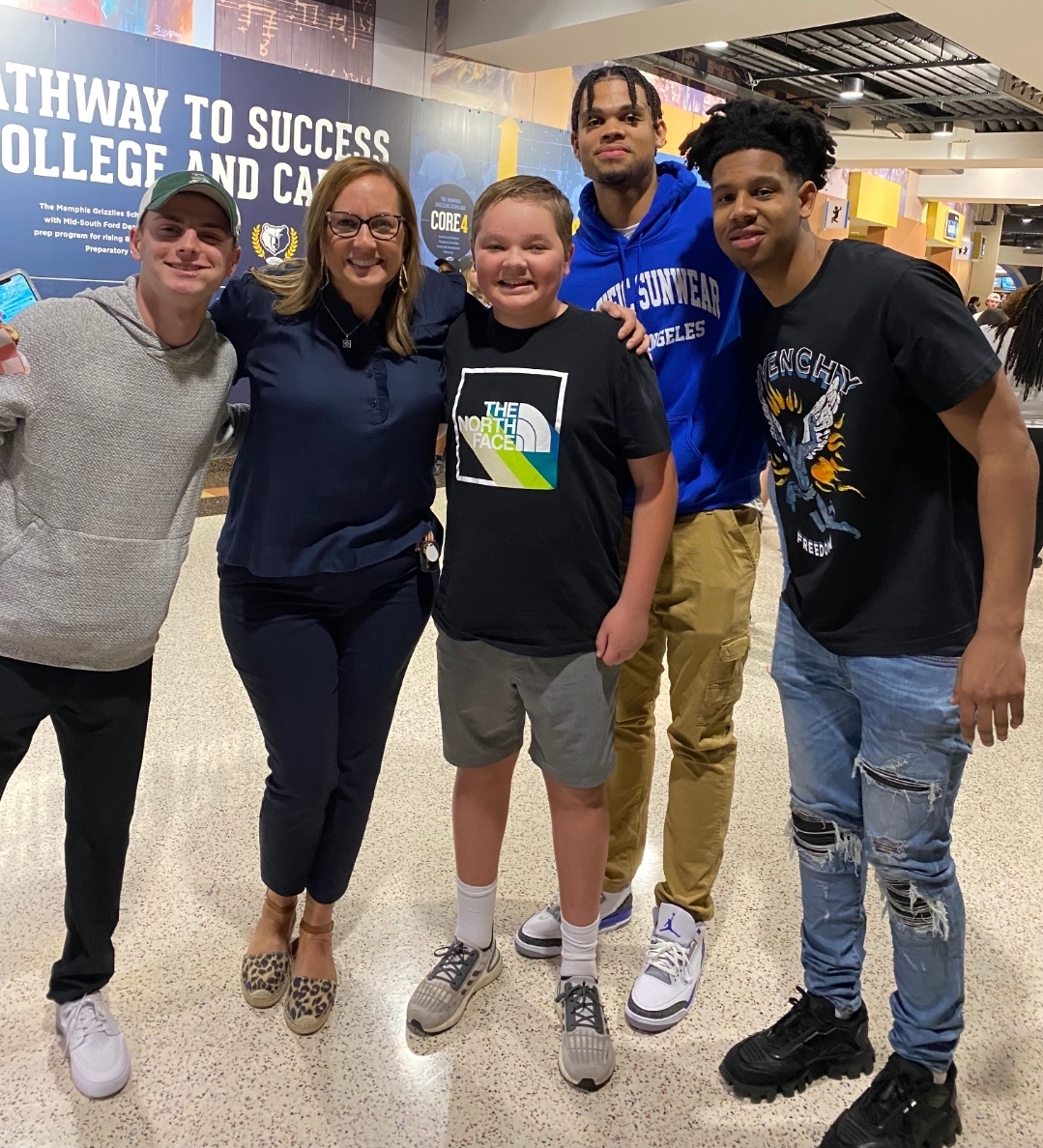
Courtesy photo
Years later, Hammon would sit in front of the coach and explain into a microphone what those moments had meant to him. In Memphis, Izzo had helped preserve one himself, stepping behind the camera to photograph a teenager and his mother during their weeks away from home for treatment.
Looking at that picture now, Hammon sees how much has changed. He estimates he stood about 5-foot-6 or 5-foot-7 then. Today, he is 6-foot-5.
The difference goes well beyond his height.
Hammon is attending the university he grew up cheering for, studying for a career in sports, and working camera assignments through Spartan Vision. He is a golfer whose dream job would put him on the course as a PGA Tour analyst, though he is exploring where journalism and broadcasting might take him.
He describes himself as healthy. His follow-up MRI scans have shown no growth and some decrease in size, he said, although he continues to live with lasting side effects from surgery.
Driving to class and going through an ordinary day as a college student are privileges he appreciates.
“I’m really thankful to be here right now,” he said after the press conference.
About a week before media day, Dickerson told her students about the upcoming opportunity to attend.
Almost immediately, Hammon thought about what he wanted to ask. He was unsure whether he would get the chance, but when Izzo opened the floor to the students, his hand went up.
There was a thank-you he wanted to deliver, and there was something he wanted to understand. He knew what Izzo’s encouragement had done for him. What did it feel like for Izzo to hear that?
“It’s probably, you know, sooner or later what you’ll get remembered for,” Izzo said after telling Hammon it was better than winning.
“Unfortunately, usually it’s later, but what people think of you, how you can inspire people, whether it be your players, whether it be the student section, whether it be the donors or alums. I mean, that’s why I’m here.”
Izzo connected his answer to his decision to spend his career at Michigan State.
“Some people jump around and go to different jobs and, you know, I want to be the part of the fabric of this place,” he said. “And I want to be a guy that people can come to, you know, and so it’s a privilege.”
Hammon had asked about the impact of hearing from people whose lives Izzo had touched. Izzo described being able to help them as a privilege of his own.
“It’s a privilege, if that visit or that phone call or that tape helped you, that’s awesome,” Izzo said. “Thank you.”
Hammon remembers how personal the answer felt. He remembers Izzo pounding his heart, signifying respect and love to the young man behind the microphine. He remembers the coach coming over afterwards, shaking his hand, and asking whether he was healthy.
He told him he was.
For the first few seconds after Izzo approached him, Hammon said, he could barely breathe. Later, as Izzo left the small gathering of students, he gave Hammon another handshake.
Some of the words were harder to recall afterward. Hammon was still absorbing the experience of having asked the question at all.
“I couldn’t believe how just personal his answer was,” he said. “It was amazing.”
For a young journalist, there was confidence to take from the moment, too. Hammon had spoken first among his classmates, in front of an accomplished coach and a room full of experienced reporters, and asked something that produced a revealing answer.
He knew he had stumbled over a few words. He also knew he had done what he came to do.
Years earlier, Izzo had recorded a message for a teenager awaiting surgery, with no way of knowing how often that teenager would watch it or how long he would keep it.
Now that teenager was a Michigan State student sitting in front of him, healthy enough to pursue the future he wanted, explaining that he still had the video.
Hammon had finally been able to say thank you.
Izzo wanted him to know the feeling was mutual.
See the whole exchange (and the original Izzo video) here: