
Week 1 of the 2026 college football season is in the books, and plenty has already happened. There were big upsets, narrow escapes, surprising blowouts, and clock controversies, and that was just in the Big Ten.
The Michigan State Spartans opened the season Friday night with a 10-point home win over Mid-American Conference contender Toledo Rockets. The Spartans started fast, struggled in the red zone, suffered a few defensive breakdowns, fell behind, and then rallied in the fourth quarter to secure a victory that was almost comfortable.
In the end, the Spartans beat the Rockets by essentially the same margin the oddsmakers projected. Overall, it was a fine performance, and we learned quite a bit about the 2026 Michigan State team.
Quarterback Alessio Milivojevic was sharp, completing more than 75% of his passes. New running back Cam Edwards showed speed and elusiveness while finishing just shy of 100 yards. The run blocking appeared improved, and the wide receiver committee consistently found openings in the defense.
The red-zone failures were frustrating, but they also revealed that new kicker Liam Boyd is capable and reliable.
On defense, the Spartans allowed three touchdowns, but more than 75% of Toledo's 273 total yards came on just five explosive plays.
Still, Spartan fans have plenty of reasons not to be completely pleased. The pass protection was spotty, the running game faded in the second half, pass coverage could be a concern, and the wide receiver room appears to lack a true game-breaker. Above all, a performance against a MAC opponent does not necessarily translate against teams of Notre Dame's or Oregon's caliber.
On balance, however, it was OK. I am feeling strangely fine.
After all, not everyone in Michigan enjoyed a double-digit win over a MAC contender this weekend. Then again, not every Big Ten fan got to rush the field after beating an in-state directional school as a 26.5-point favorite, either.
Week 1 Betting Results
For readers unfamiliar with the series, here is a quick primer. Each week during the college football season, I present my computer's recommended wagers in my Bad Betting Advice column. After the games, I recap the results and offer a few observations from around the country.
Figure 1 compares each game's final margin with the opening point spread for Week 1 of 2026.
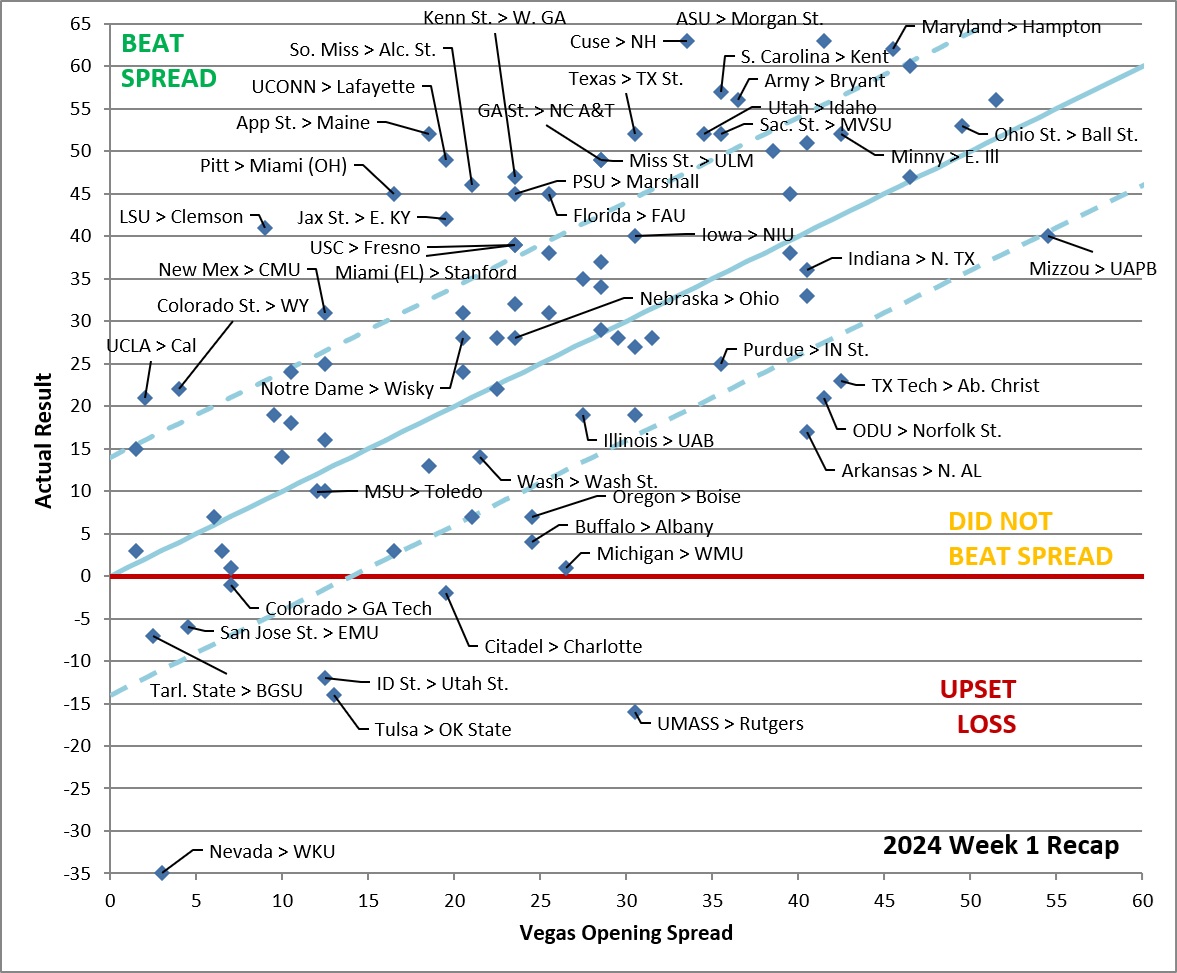
Figure 1: Week 1 results showing actual point differentials relative to the opening spread.
Each data point represents one game. Its position above or below the solid diagonal line shows whether the favored team covered the opening spread. The farther a point sits from the center diagonal, the greater the deviation from the spread.
The two dotted diagonal lines represent one standard deviation from the mean, or just over 14 points from the opening spread. In other words, roughly one-third of college football games finish about two touchdowns away from the opening line. Favorites outside those dotted lines either overachieved or underachieved by a significant margin.
A total of 28 favorites overachieved in Week 1 by beating the spread by more than 14 points, although more than half blew out FCS opponents. Notable overachievers included LSU, Arizona State, South Carolina, UCLA, USC, and Miami.
On the other side, seven favorites won but underperformed the spread by at least 14 points including Michigan, Arkansas, Old Dominion, Texas Tech, Oregon, and Missouri.
In either category, the result may reveal as much about the underdog as the favorite. As the season unfolds, we will learn whether these performances reflected one team's surprising strength, the other's unexpected weakness, or a little of both.
The data points below the solid red line in Figure 1 represent favorites that lost outright. Table 1 summarizes those eight upsets and compares them with last week's computer picks.
Table 1: Week 1 upsets based on the opening line, compared with last week's upset projections.
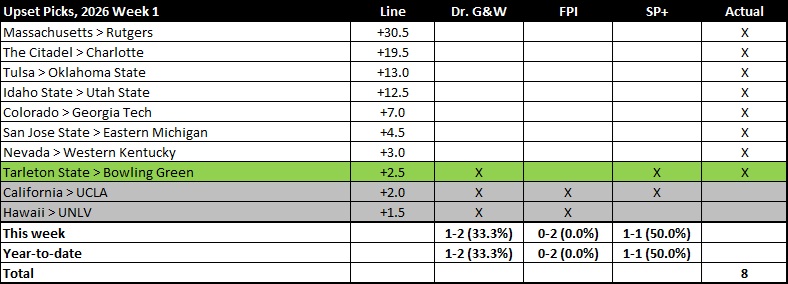
There were eight upsets in Week 1, closely matching my computer's projection of 8.7. Three involved FCS teams beating Group of Six opponents, including the computers' only correct upset pick: Tarleton State over Bowling Green.
Colorado (+7) upset Georgia Tech, and Tulsa (+13) upset Oklahoma State, but the week's biggest shock came Thursday night when UMass went into Piscataway and beat Rutgers, which opened as a 30.5-point favorite.
Upsets involving spreads of about 30 points are rare. I count only five bigger upsets in college football since 2001, the most recent coming in 2021, when Bowling Green (+31) beat Minnesota.
The odds of such an upset are about 1.5%, roughly equivalent to a No. 16 seed beating a No. 1 seed in the NCAA basketball tournament. An upset of this magnitude occurs about once every four or five years in college football.
As the accounting at the bottom of Table 1 shows, my algorithm went 1-2 (33%) on upset picks. FPI finished 0-2, while SP+ went 1-1 (50%).
Table 2 summarizes the computers' highlighted picks against the opening spread.
Table 2: Results of the highlighted Week 1 picks against the opening spread.
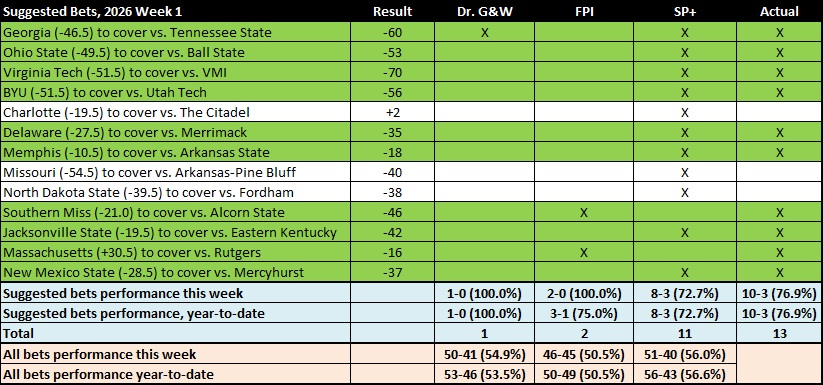
I was unsure how the computers would perform in the first year that games against FCS opponents counted among the official picks, but the early returns were strong.
Combined, the three systems went 10-3 (77%) against the opening spread, including a perfect 1-0 from my computer and a 2-0 record from FPI.
Across all 91 games, my picks went 50-41 (55%) against the spread. FPI finished 46-45 (50.5%), while SP+ edged my computer at 51-40 (56%).
Table 3 shows the Week 1 results for point-total wagers.
Table 3: Results of the recommended Week 1 point-total wagers.
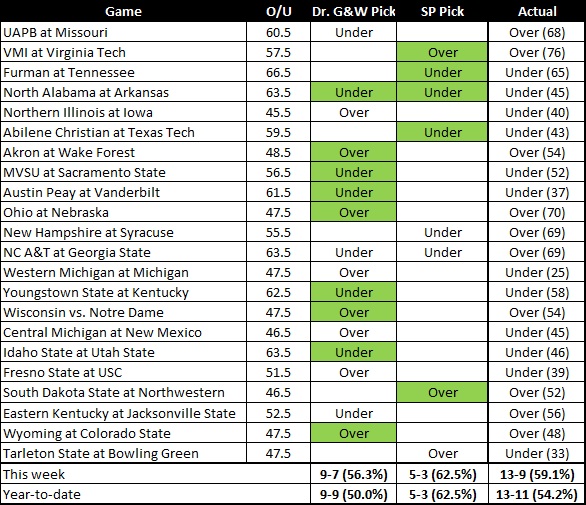
Like the picks against the spread, my revised point-total evaluation strategy had a strong first full weekend. So far, the new methodology appears to have all worked out.
Overall, the highlighted picks went 13-9 (59%). SP+ went 5-3 (63%), while my computer went 9-7 (56%), bringing its year-to-date mark to .500.
So far, so good. Only time will tell whether it is made to last.
Updated Big Ten Odds and Expected Wins
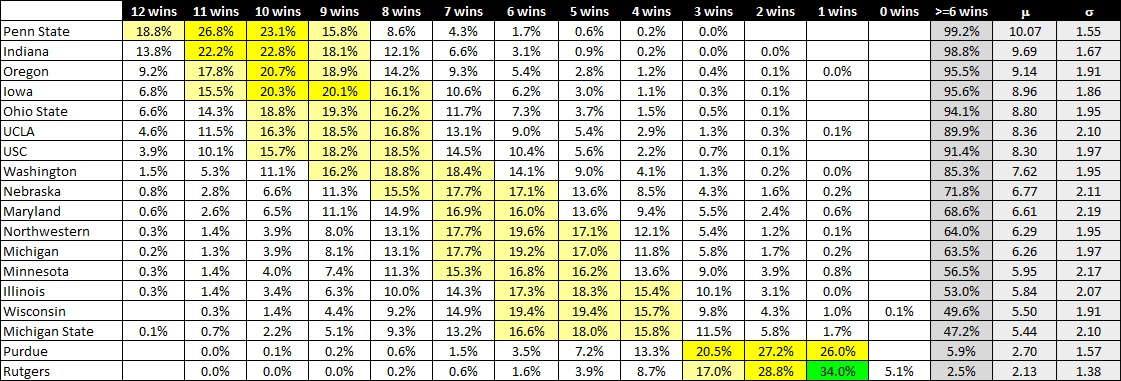
After Week 1, I reran the full-season Monte Carlo simulation using updated power ratings and their current uncertainty. Table 4 shows the latest Big Ten outlook, and Table 5 shows the conference's updated win-distribution matrix.
All rankings listed beside teams refer to my computer's power ratings, not national polls.
Table 4: Updated Big Ten rankings, expected wins, strengths of schedule, and season odds after Week 1.
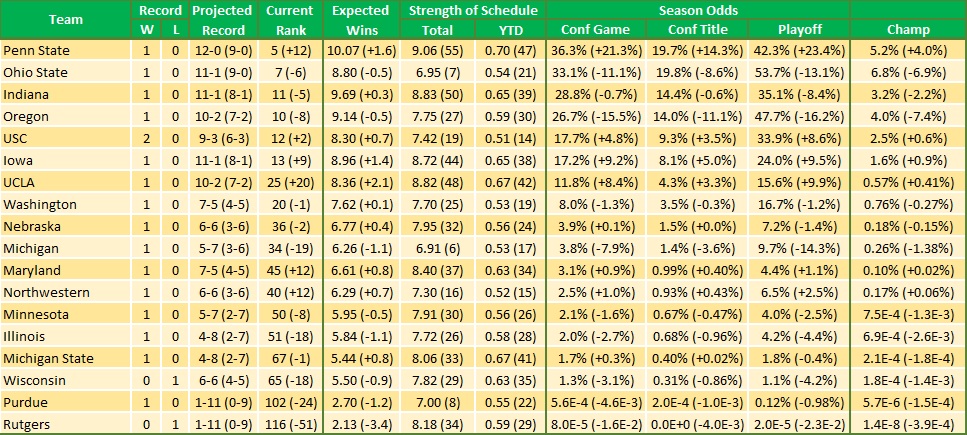
Table 5: Updated Big Ten win-distribution matrix after Week 1.
It is easy to overreact to one weekend, but some Big Ten teams clearly had better openers than others.
Penn State, UCLA, USC, and Maryland covered by double digits. Iowa, Minnesota, Nebraska, Northwestern, and Ohio State also covered, but by smaller margins. All nine either improved their conference outlook or gained reason for optimism.
The other half of the conference fared worse. Illinois, Indiana, Washington, and Wisconsin missed the spread by four to nine points. Purdue and Oregon missed it by double digits. Rutgers and Michigan, however, began the season in nightmare fashion.
Never you mind whether the Wolverines deserved one more second to complete their escape against Western Michigan. The first 60 minutes still happened, and despite the final score and an ending that appeared to stretch past closing time, the Broncos looked like the better team.
That result dropped Michigan to No. 34 in my national power ratings and lowered the Wolverines' expected win total to 6.26, with a 64% chance of reaching a bowl. The outlook could be even worse because my model still weighs preseason ratings heavily.
I am not sure about you, but I am completely pleased with that. It might even bring a not-so-secret smile to my face.
Overall, my model gives Penn State (20%) and Ohio State (20%) the best odds to win the Big Ten. Indiana (14%) and Oregon (14%) are close behind, with USC (9%) and Iowa (8%) still in the hunt.
Reevaluating Michigan State's Remaining Schedule
The Spartans 10-point win over Toledo was a touch below the opening spread of 12 points, but was a push based on the spread at kickoff. Michigan State had the most expected the result of any Big Ten team.
When the dust all settled, the Spartans' expected win total on the season improved to 5.44. Michigan State's chances to get to the six wins needed to reach bowl eligibility ticked up to 47%.
Figure 2 below gives my computer's updated projections for the point spreads and victory odds for the Spartans' remaining 11 games. As a reference, the projected odds from my preseason calculations are shown in Figure 2 as a reference.
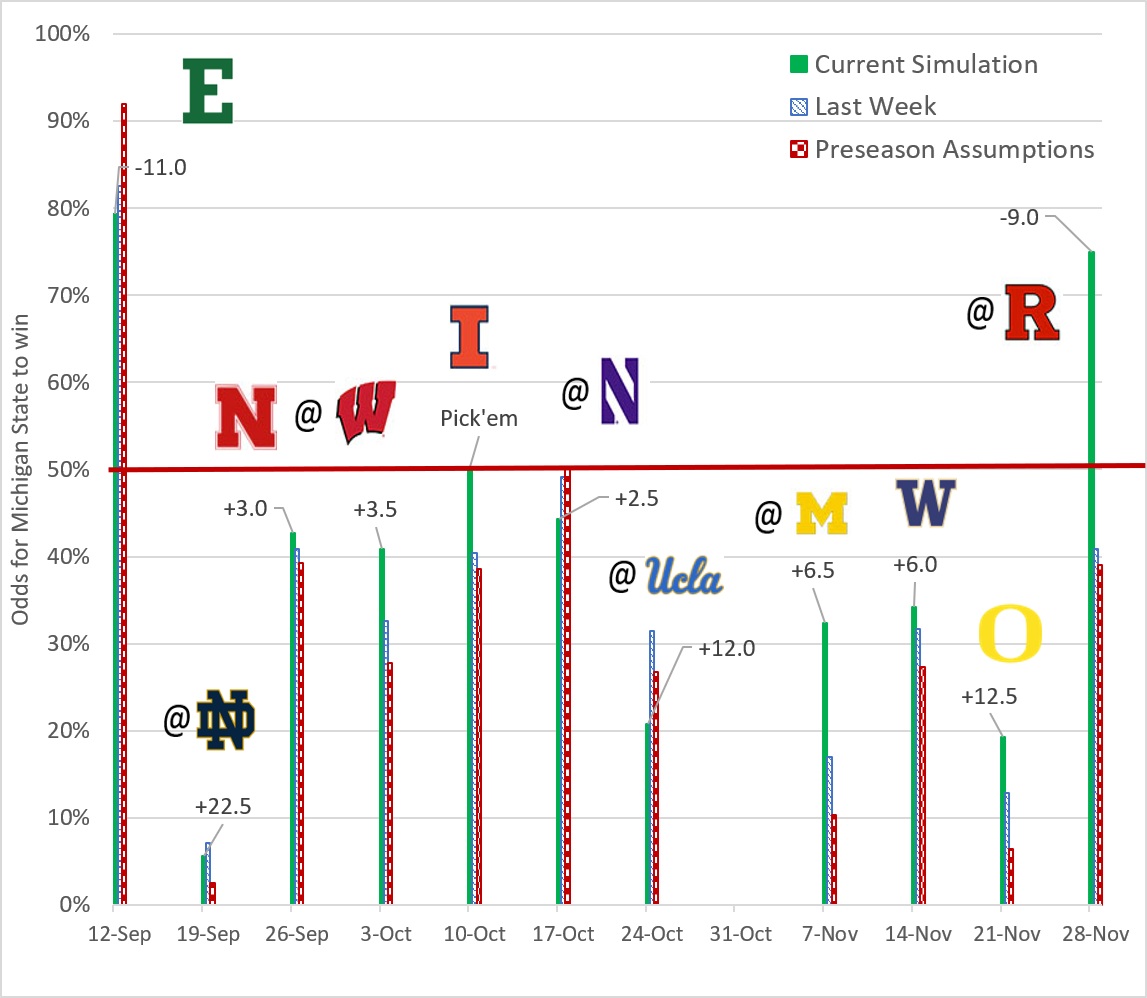
Figure 2: Updated odds and spread projections for Michigan State's remaining games, following 2026, Week 1 and based on a 50,000-cycle Monte Carlo simulation. The odds calculated last week are shown as a reference.
After only one week, the 2026 schedule already looks different. A few future opponents appear stronger than expected, but most look slightly weaker.
Michigan State is a heavy favorite next weekend against Eastern Michigan (-17, slightly higher than my model projects), while the road game at Notre Dame (-22.5) remains a likely loss.
But the projected spreads in the next three games all moved in MSU's direction. The games against Nebraska (-3) and at Wisconsin (-3.5) moved closer to toss-ups, and the home game against Illinois is now projected as a pick'em.
The November slate also projects to be slightly easier. The lines for games at Michigan (-6.5) and against Washington (-6) are now under a touchdown, while Oregon (-12.5) is favored by just over 10 points in East Lansing.
After last week's debacle against UMass, Rutgers now projects as a 9-point home underdog in the Spartans' season finale.
The only games that look more difficult are the midseason trips to Northwestern (-2.5) and UCLA (-12). The UCLA projection moved the most after the Bruins' surprisingly strong performance against California.
My model still has the Spartans as the projected favorite in three more games this season, but the odds of springing a few upsets along the way have certainly improved.
Other Notes from Around the Country
To close, here is a quick look at the rest of the opening weekend across college football.
In the SEC, all 16 teams won, but “semi-pro” LSU's 51-10 demolition of Clemson was the most significant result. The Tigers rose to No. 4 in my power ratings, and my computer now gives No. 3 Texas (24%) and LSU (21%) the best odds to win the conference.
In the Big 12, Texas Tech (19%) remains the favorite, but a lackluster performance against Abilene Christian dropped the Red Raiders to No. 23 in my power rankings. Kansas State (19%) made the biggest move after scoring 71 points against Nicholls, although it is difficult to draw much from that result.
In the ACC, Miami (48%) remains the overwhelming favorite and climbed to No. 2 in my power ratings. Virginia (13%) has the conference's second-best odds after opening with a 26-point win over N.C. State in Week 0, although the Cavaliers were idle in Week 1.
SMU (7%) also deserves a closer look after the Mustangs survived the Labor Day night road test at Florida State.
In the Group of Six, the field looks much different than it did a week ago. Several old favorites and a few new faces are already asking, "Will this be my year?"
Boise State lost a closer-than-expected game at Oregon but remains my highest-ranked team and the most likely to claim the Group of Six playoff berth from the new-look Pac-12.
Several other teams started well. Memphis and Tulsa impressed in the American Conference, while new FBS member North Dakota State is my top-ranked Mountain West team.
In the Sun Belt, Georgia Southern is a team to keep an eye on, and James Madison opened with a win over Conference USA's Liberty.
Western Michigan, of course, came one second from a monumental win over Michigan. If the Broncos run the table and win the MAC, they could receive serious consideration for the 12th playoff spot.
Against all odds, we have reached closing time for today. Stay tuned to Spartans Illustrated for more analysis and a fresh batch of Bad Betting Advice right around the corner.