
Three was a magic number on Saturday night in Ann Arbor. Yes, it was, it was a magic number.
Who needs touchdowns when you can slowly grind the Wolverines into paste three points at a time? 3, 6, 9, 12, 15. Steadily, the lead began to grow, all thanks to No. 37 Liam Boyd, the Spartans’ kicker extraordinaire and resident magician.
Although the Spartans were without one, two, and even three running backs, No. 32 Kenneth Williams and Brandon Tullis conjured 127 yards on 35 carries, or 3.6 yards per attempt.
When the Spartans needed to pick up yards through the air, “big play” No. 13 Chrishon McCray led the way with 92 yards on six catches (that’s three times two).
Three-and-outs? The Spartans didn’t have any, but Michigan had three. Magical. On five of the Wolverines’ seven other possessions, they held the ball for no more than four plays before a punt or a turnover.
Turnovers? The Spartans forced four. That’s one more than the magic number!
Michigan State also dominated on third down, converting nine times (that’s three times three) in 20 tries. Michigan converted just two of 10.
Even when Michigan finally got on the scoreboard in the final seconds, a failed 2-point conversion left the Wolverines stuck on six points (that’s two times three).
With a 9-point lead (that’s three times three) and just over 90 seconds left to play (that’s three times 30), I knew the Paul Bunyan Trophy was headed home.
It was a magical feeling indeed to see the Spartans dominate the Wolverines in all three phases of the game in the Big House.
Coming into Saturday’s big rivalry game with the skunk bears from Ann Arbor, I was not at all confident. If Pat Fitzgerald’s team had been fully healthy (or close to it), I thought the Spartans could keep things competitive.
But when I saw the injury report midweek, my optimism faded. With Jordan Hall, Ben Roberts, and the top three running backs all still out, things seemed grim. When I learned that tight end Jayden Savoury, one of the Spartans’ leading pass catchers, was also suddenly out, and that quarterback Alessio Milivojevic was questionable, the outlook turned downright dire.
But I am an optimistic person by nature, and three things did give me hope in my body, heart, and brain.
First, the Michigan State offensive line was healthy and stocked with grown men in their early 20s. It is always helpful to have strong bodies.
Second, both Kenneth Williams and Brandon Tullis had shown potential and heart in the run game, and the wide receiver room was also fairly healthy.
Third, with two weeks to prepare for life without the defense’s two best players, there was a chance that defensive coordinator Joe Rossi could use his brain to scheme ways to limit the anemic Michigan offense, especially with a freshman quarterback at the helm. A few turnovers would help, too.
As the evening’s events unfolded, those three things all came together like the legs of a tripod. It was like drawing a trio of threes in a hand of poker.
Now, with the past behind them, a magical present, and a future of just three games, the Spartans have new life. Despite the still-unsightly 3-6 record, the final three games are all winnable. That means a 6-6 record and a postseason berth are still possible.
Does that seem far-fetched? Perhaps, but I’m telling you, there is something about the number three. Maybe it really is magic.
Week 10 Betting Results
Let’s review last week’s Bad Betting Advice, beginning with Figure 1. For an explanation of how to read it, see the Week 1 edition of Against All Odds.
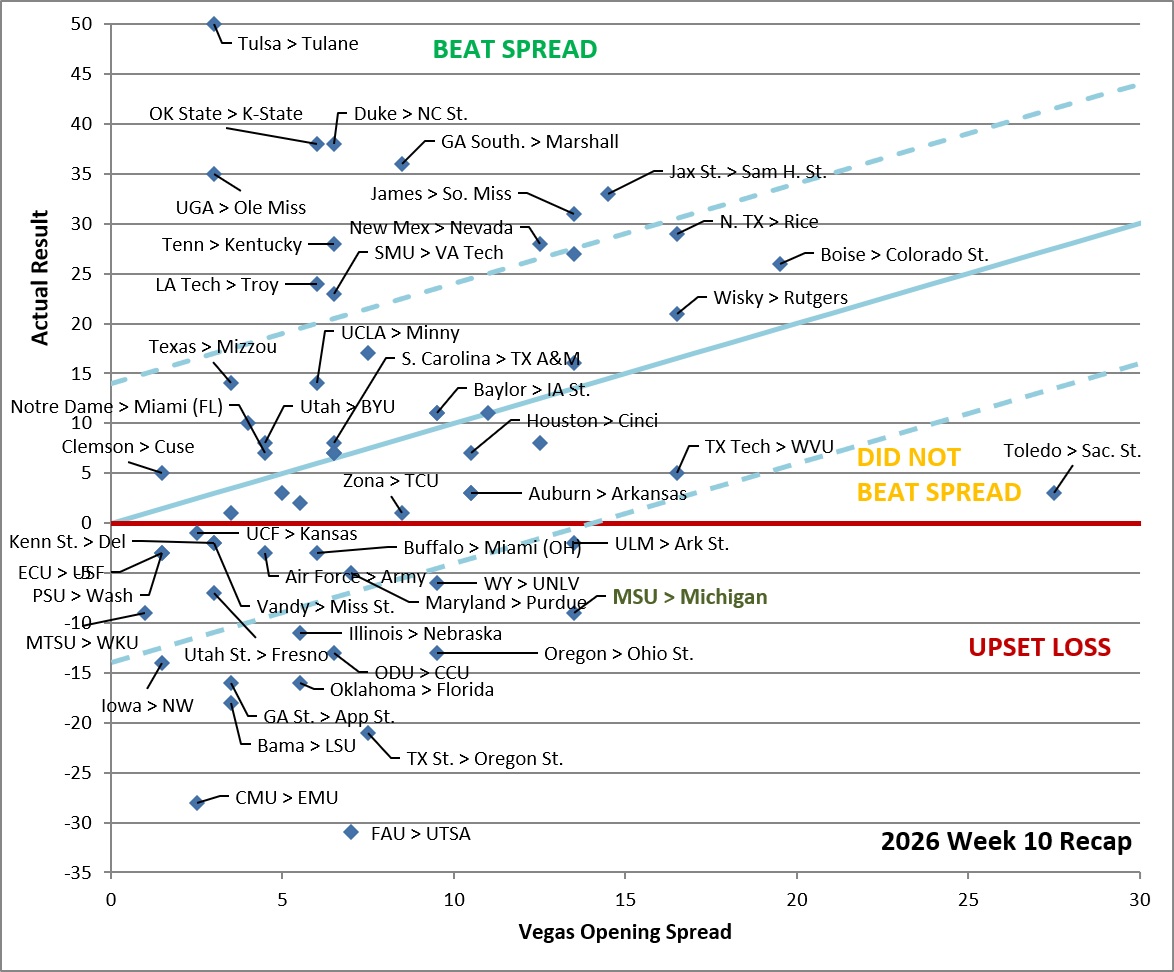
Figure 1: Week 10 results showing actual point differentials relative to the opening spread.
Twelve teams (that’s three times four) significantly overachieved in Week 10. The list includes Oklahoma State, Georgia, Duke, Wake Forest, Tennessee, James Madison, SMU, and New Mexico.
Only one team underachieved by winning the game but missing the spread by more than 14 points: Toledo.
There were 23 upsets in Week 10, a little more than one standard deviation above the predicted value of 18.7.
Table 1 summarizes those 23 upsets and compares them with last week’s picks.
Table 1: Week 10 upsets based on the opening spread, compared with last week’s upset projections.
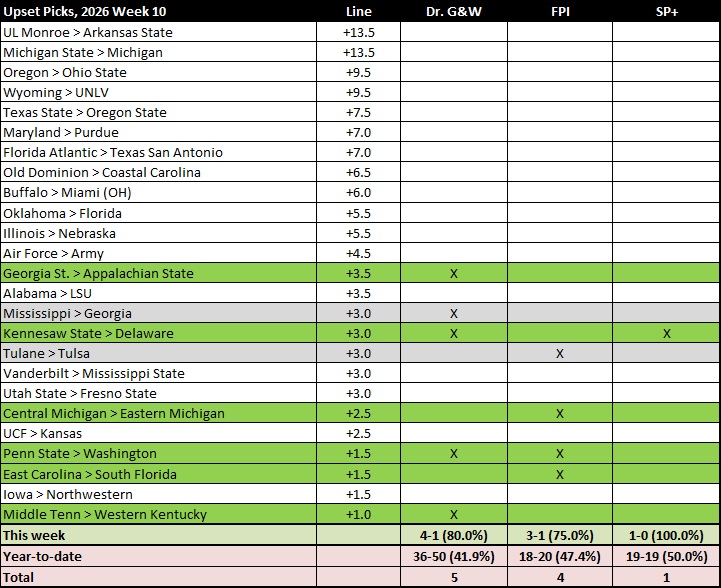
Michigan State’s magical win over the Wolverines (-13.5) was tied for the biggest upset of the weekend with UL Monroe’s victory over Arkansas State.
Other notable upsets included Oregon (+9.5) over Ohio State, Maryland (+7) over Purdue, Oklahoma (+5.5) over Florida, Illinois (+5.5) over Nebraska, Alabama (+3.5) over LSU, Penn State (+1.5) over Washington, and Iowa (+1.5) over Northwestern.
My algorithm had a magical week, going 4-1 (80%) on upset picks, which raises its year-to-date record to 36-50 (42%).
FPI went 3-1 (75%), bringing its season tally to 18-20 (47%). SP+ finished 1-0 for an overall record of 19-19 (50%).
Table 2 shows the computers’ results against the opening spread.
Table 2: Results of the recommended Week 10 picks against the opening spread.
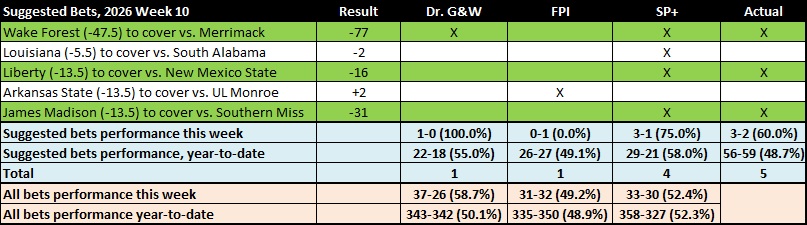
The computers mostly did well this week. My computer got its sole pick correct, while SP+ went 3-1 (75%). My analysis of FPI data produced just one pick, and it was wrong.
For the season, my algorithm moves to 22-18 (55%) on curated picks. My recommended FPI picks are now 26-27 (49%), and my SP+ selections continue their magical run at 29-21 (58%).
Across the full schedule, my machine conjured a 37-26 (59%) week, pushing its year-to-date total to 343-342 (50.1%). FPI finished 31-32 (49%) for the week and is now 335-350 (49%) overall. SP+ went 33-30 (52%), leaving its season record at 358-327 (52%).
Table 3 shows the Week 10 point-total results.
Table 3: Results of the recommended Week 10 point-total wagers.
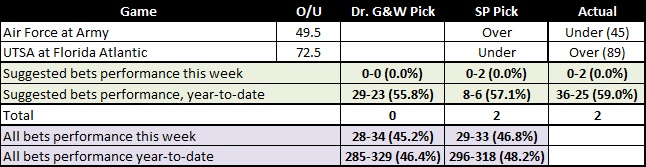
My analysis of SP+ data provided just two picks this week, and both were wrong. My computer is holding steady at 29-23 (56%) on curated point-total bets, and SP+ is now 8-6 (57%).
Both computers had a less-than-magical week on the full schedules. My computer went 28-34 (45%), while SP+ finished 29-33 (47%). Year to date, my computer is 285-329 (46%) across all games, and SP+ is a little better, but still not great, at 296-318 (48%).
Updated Big Ten Odds and Expected Wins
After Week 10, I reran the full-season Monte Carlo simulation using updated power rankings and their current uncertainty. Table 4 shows the latest Big Ten odds, and Table 5 shows the conference’s updated win-distribution matrix.
The Spartans have new life, but how much? Subscribe to see the updated Big Ten odds, Michigan State's chances of reaching a bowl game, and a national playoff picture that might just be magical.