
College football head coaches often invoke a familiar theory in times of crisis. It surfaced repeatedly during the press conference following Michigan State’s 28-10 loss at UCLA.
In coachspeak, it’s called “next man up.” I propose an alternative name: string theory.
The theory goes something like this: If an injury keeps a player from suiting up, the second-, third-, or fourth-string replacement is expected to step in and perform to the same standard as the starter.
Admitting that moving down the depth chart might cause a drop-off in performance apparently violates some natural law.
In my experience, though, this version of string theory remains highly theoretical, with little experimental evidence to support it. Not all those strings vibrate at the same frequency.
At full strength, Michigan State likely would have been competitive in the Big Ten’s middle tier. The Spartans could have won six or seven games, reached a bowl, and demonstrated clear momentum for the program.
Instead, injuries first thinned the defense, particularly at cornerback and linebacker. Then starting running back Cam Edwards was lost for the season.
Just when the injury outlook seemed to be improving, starting quarterback Alessio Milivojevic and second-string running back Jaziun Patterson were ruled out against UCLA. With backup quarterback Cam Fancher also injured, third-string freshman Kayd Coffman moved into the starting role.
Once the game began, the hits kept coming. Most notably, star defensive tackle Ben Roberts went down on the Spartans’ first defensive play from scrimmage. He later returned to the sideline on crutches, leaving his return timetable uncertain.
Third-string running back Marvis Parrish left in the first half, thrusting fourth-string back Kenneth Williams into the primary ball-carrying role.
Toward the end of the game, safety Devin Vaught also suffered an injury after a potentially touchdown-saving tackle.
Is it really surprising that the Spartans couldn’t stay within two touchdowns of the nation’s No. 9 team on the road?
Head coach Pat Fitzgerald said all the right things afterward.
"(I) thought we had a good plan coming in," he said. "We just didn't coach the guys well enough to execute for four quarters."
Later, though, Fitzgerald offered a glimpse of the practical limits of this version of string theory.
"There were a lot of times today on the headphones where it was like 'just call what we can execute,'" he said.
Does that sound like a situation in which the fourth string and the first string are interchangeable? Or has the coaching staff had to operate on a different wavelength?
At programs like Ohio State or Georgia, where third- and fourth-string players may be four-star prospects who simply lack experience, that expectation might be realistic.
For a program with a new head coach and less-than-elite name, image, and likeness resources, the equation looks different. Defensive end Kenny Soares Jr. summed it up most succinctly.
"It sucks, but that's the reality," he said.
Injuries aren’t a theory of everything that explains the Spartans’ 2-6 record, but they seem to rank first, second, and perhaps even third on the list. Unless Michigan State gets healthy soon, the rest of the season may follow a predictable trajectory.
No reinforcements are hiding in an unseen dimension, ready to turn things around. What you see is what you get, and it isn’t pretty.
That is not just a theory. It's reality.
Week 8 Betting Results
Let’s review last week’s Bad Betting Advice, beginning with Figure 1. For an explanation of how to read it, see the Week 1 edition of Against All Odds.
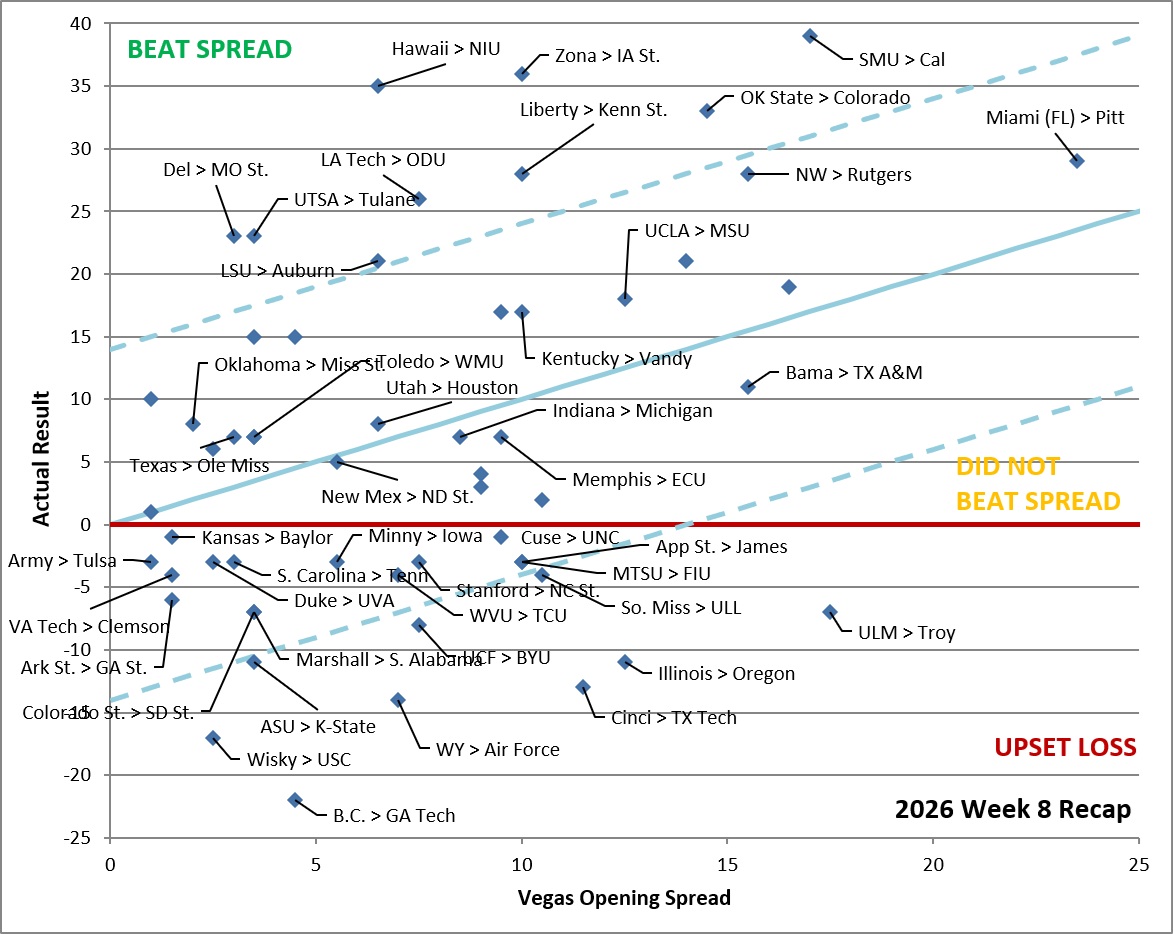
Figure 1: Week 8 results showing actual point differentials relative to the opening spread.
Nine teams significantly overachieved this week, including Arizona, SMU, UTSA, Oklahoma State, and LSU.
For the fourth straight week, every significant underachiever lost outright.
Week 8 produced another long string of upsets, 23 in all.
Table 1 summarizes those 23 upsets and compares them with last week’s picks.
Table 1: Week 8 upsets based on the opening spread, compared with last week’s upset projections.
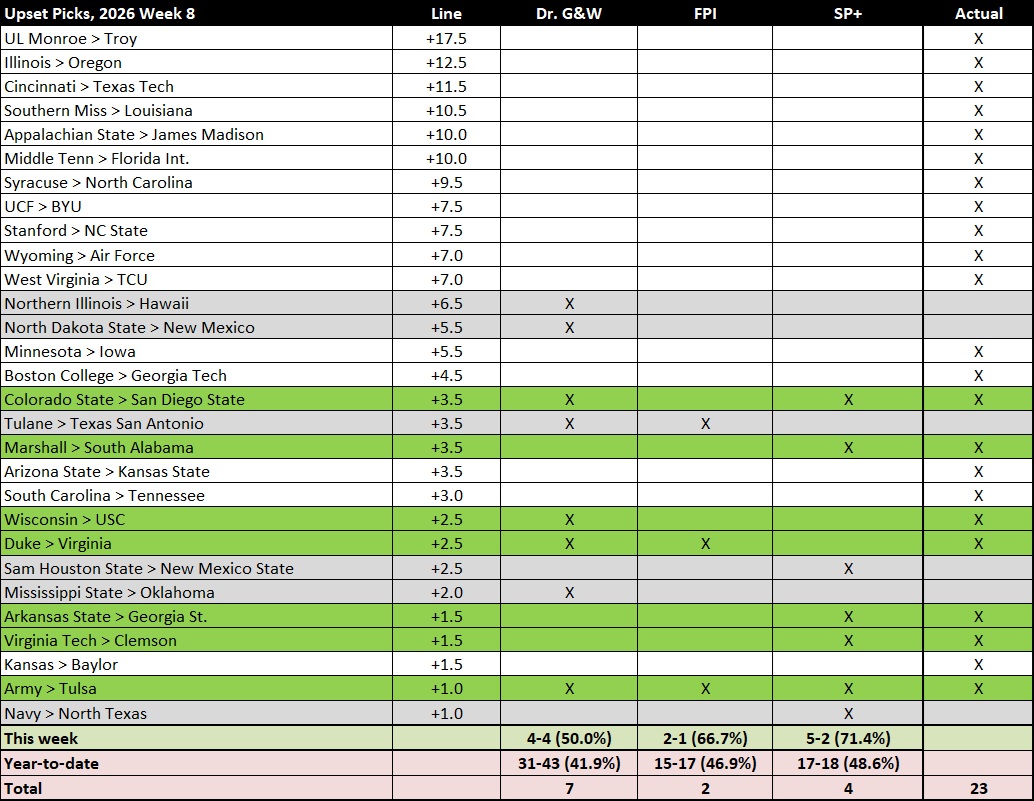
The week’s biggest and most significant upsets were Louisiana Monroe (+17.5) over Troy, Illinois (+12.5) over Oregon, Cincinnati (+11.5) over Texas Tech, Syracuse (+9.5) over North Carolina, UCF (+7.5) over BYU, Minnesota (+5.5) over Iowa, South Carolina (+3) over Tennessee, and Wisconsin (+2.5) over USC.
My algorithm went 4-4 (50%) on upset picks, bringing its year-to-date record to 31-43 (42%).
FPI went 2-1 (67%), bringing its season tally to 15-17 (47%). SP+ finished 5-2 (71%) for an overall record of 17-18 (49%).
Table 2 shows the computers’ results against the opening spread.
Table 2: Results of the highlighted Week 8 picks against the opening spread.

SP+ supplied the only highlighted pick, which finished as a push against the opening spread.
For the season, my algorithm remains at 21-18 (54%) on curated picks. My recommended FPI picks stand at 25-26 (49%), and my SP+ selections are 26-19 (58%).
Across the full schedule, my machine had another tough week at 25-31 (45%) and is 275-291 (49%) overall. FPI finished 21-35 (37.5%) for the week and is 278-288 (49%) overall. SP+ went 26-30 (46%), bringing its season record to 295-271 (52%).
There were no officially recommended point-total bets for Week 8.
My computer remains 29-23 (56%) for the season on curated point-total picks, while SP+ is 7-4 (64%).
On the full schedule, my computer went 25-31 (45%) on point-total picks, while SP+ finished 28-28 (50%). Year to date, my computer is 238-258 (48%) across all games, and SP+ is slightly better at 243-253 (49%).
Updated Big Ten Odds and Expected Wins
After Week 8, I reran the full-season Monte Carlo simulation using updated power rankings and their current uncertainty. Table 3 shows the latest Big Ten odds, and Table 4 shows the conference’s updated win-distribution matrix.
All rankings beside team names refer to my computer’s power rankings, not either national poll.
Michigan State’s bowl hopes are hanging by a string, but is that string stronger than it looks? Subscribe to Spartans Illustrated for Dr. Green and White’s updated projections for all four remaining games, the Big Ten title and bowl races, and the national playoff picture. The theory is free. The calculations continue below.